On this page
How to identify it
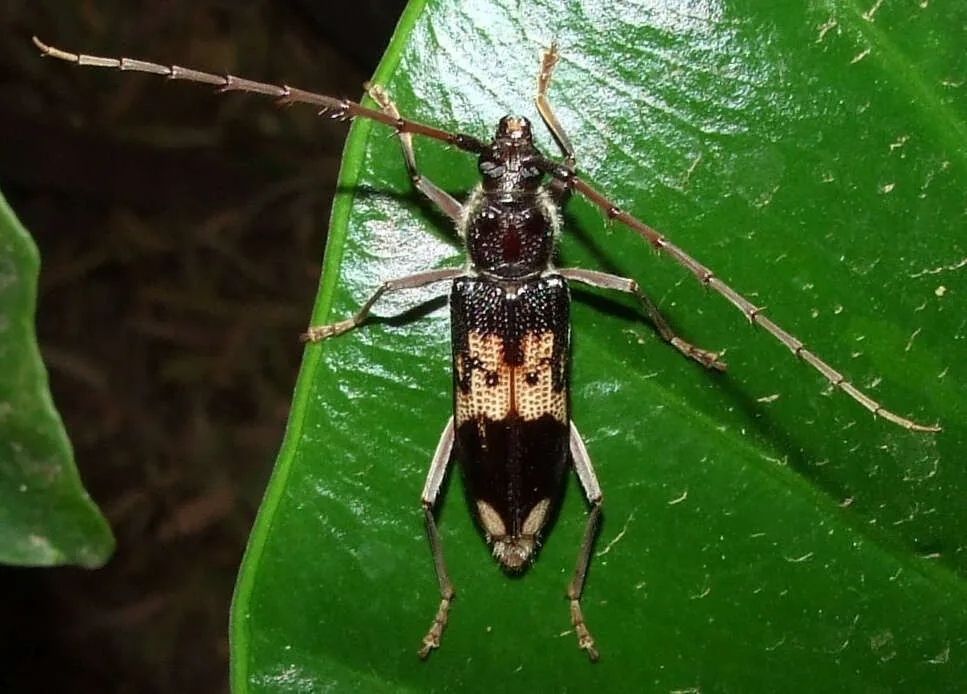
- Antennae are as long as or longer than the body; males' antennae carry prominent spines.[1]
- Look at the wing covers and antennae. P. semipunctata is mostly dark brown with a cream middle band crossed by a zigzag line, and has few or no golden hairs on its antennae. P. recurva is mostly cream to yellow, dark only on the rear third, with long, dense antennal hairs.[1]
- Holes in the bark and stains or oozing liquid on limbs and trunks are common signs.[1]
- EPPO gives adults as 22 to 28 mm long and shiny dark reddish brown. Exit holes are oval, roughly 8-10 by 4-5 mm. Grown larvae are cream colored and legless, over 1 inch (UC) or 30-40 mm (EPPO) long.[2][1]
- Newly hatched larvae leave a dark trail on the bark surface before boring in. In a quiet spot you can sometimes hear older larvae chewing from several feet away.[2][1]
Where it lives
Both are native to Australia. P. semipunctata reached Southern California in the 1980s and spread statewide; P. recurva was found in 1995 in Los Angeles, Riverside, Orange and San Bernardino counties and has since spread through much of California. EPPO says the main cause of worldwide spread has been the movement of eucalyptus wood.[1][2]
Biology and life cycle
Females lay groups of 3 to 30 eggs under loose bark, mostly at night, up to 300 eggs each. UC says females live a month or more; EPPO gives 40 days in summer and up to 180 in winter.[1][2]
Eggs hatch in one to two weeks. Larvae need about 70 days in fresh wood in summer and up to 180 days in drier logs, and a single gallery can run over a meter.[1][2]
Generation counts differ by source. UC IPM reports two and possibly three overlapping generations a year in California, while EPPO says one to three in Mediterranean climates. Adults emerge from April through October, and P. recurva as early as February.[1][2]
Adults feed on eucalyptus pollen. In lab tests, females on a eucalyptus pollen diet lived longer and laid more eggs than those on other diets.[5]
Damage and signs
- Larvae feed between the bark and wood. If feeding girdles the trunk, the canopy thins and wilts and the tree usually dies within weeks, though it may resprout from the base.[1]
- EPPO notes that in Australia damage is usually limited to dead and dying trees, since natural enemies keep the beetles in check. In most other regions it kills trees in woodlots, especially during dry spells, including trees that looked healthy.[2]
- For about 150 years after they were first planted, eucalyptus in California were free of insect pests and diseases. A 2002 UC Riverside review says that over the previous 15 years many plant-feeding insects had been introduced by accident, these two borers among them.[3]
Health risk
It attacks eucalyptus only; neither UC IPM nor EPPO mentions any risk to people.[1][2]
Control
Prevention
Reduce tree stress, especially drought; a well-kept susceptible tree can be safer than a neglected resistant one.[1]
Sources disagree on which species resist. UC IPM rates lemon gum, mountain gum, red ironbark, river red gum, sugar gum and swamp mahogany as more resistant, and blue gum, manna gum, karri and Sydney blue gum as more susceptible. EPPO, citing Moroccan plantations, classes river red gum (E. camaldulensis) and sugar gum (E. cladocalyx) as only moderately susceptible. UC also notes blue gum is invasive.[1][2]
Sanitation
Remove infested trees and branches right away, but do other pruning in December and January, when adults aren't flying. Debark, split, bury, burn or chip infested wood, or seal it under clear plastic in the sun. EPPO says dry logs older than nine months can be considered free of larvae and pupae.[1][2]
Biological control
An introduced egg parasite, Avetianella longoi, kills more than 90% of P. semipunctata eggs but is less effective against P. recurva. Avoid persistent broad-spectrum sprays on bark or foliage, which harm it.[1]
Pesticides
Sources differ. EPPO calls chemical control in forests impractical because adults are active most of the year. UC IPM says early studies found insecticides unsuitable, but newer soil-applied systemics might protect individual trees if applied before beetles move in.[2][1]
Why P. recurva now outnumbers P. semipunctata
P. semipunctata killed large numbers of eucalyptus after it arrived, then declined in the mid-1990s after P. recurva arrived and the egg parasite was released. In southern California, P. recurva has largely replaced it.[4][1]
Lab tests at UC Riverside found little sign that the two beetles compete. The researchers concluded that natural enemies most likely caused P. semipunctata's decline.[4]
Common questions
- Why is my eucalyptus oozing and full of holes?
- Holes, stains and oozing on the trunk of a stressed eucalyptus are typical signs of longhorned borers. Check for oval exit holes and frass-packed galleries under loose bark.[1][2]
- Will spraying save it?
- Rarely. EPPO calls chemical control impractical, and UC IPM says only that newer systemics might protect a tree if applied before an attack. Watering and wood handling matter more.[2][1]
- Can I keep eucalyptus firewood?
- Fresh logs draw the beetles, so debark, split or cover cut wood with clear plastic in the sun, and don't move it. EPPO says logs dry for more than nine months are considered free of larvae.[1][2]
Sources
- University of California Statewide IPM Program, “Pest Notes: Eucalyptus Longhorned Borers (Publication 7425).” ipm.ucanr.edu/PMG/PESTNOTES/pn7425.html (accessed 2026-11-13)
- European and Mediterranean Plant Protection Organization (EPPO Global Database), “Phoracantha semipunctata (PHOASE) datasheet.” gd.eppo.int/taxon/PHOASE/datasheet (accessed 2026-11-13)
- Bulletin of Entomological Research, 2002 (via PubMed), “Insect pests of eucalypts in California: implications of managing invasive species (abstract).” pubmed.ncbi.nlm.nih.gov/12020373/ (accessed 2026-11-13)
- Environmental Entomology, 2015 (via PubMed), “Potential for Interspecific Competition Between Congeneric Longhorned Beetle Species (Coleoptera: Cerambycidae) in an Adventive Environment (abstract).” pubmed.ncbi.nlm.nih.gov/26314041/ (accessed 2026-11-13)
- Journal of Economic Entomology, 2003 (via PubMed), “The effects of Eucalyptus pollen on longevity and fecundity of Eucalyptus longhorned borers (Coleoptera: Cerambycidae) (abstract).” pubmed.ncbi.nlm.nih.gov/14994803/ (accessed 2026-11-13)
- Global Biodiversity Information Facility (GBIF), “Phoracantha semipunctata (Fabricius, 1775) (GBIF Backbone Taxonomy).” api.gbif.org/v1/species/1114140 (accessed 2026-11-13)
- Global Biodiversity Information Facility (GBIF), “Phoracantha recurva Newman, 1840 (GBIF Backbone Taxonomy).” api.gbif.org/v1/species/1114246 (accessed 2026-11-13)