On this page
How to identify it
- Adults are wasp-like insects about 5/16 inch long, but with a broad join between thorax and abdomen.[1]
- Larvae look like caterpillars but have prolegs on every abdominal segment.[1]
- Older larvae leave entry holes with brownish frass on the fruit.[2]
- UMass Extension describes the adult as a small, orange-brown, wasp-like insect with transparent wings, and the larva as cream colored with a black head and seven pairs of prolegs.[3]
Look-alikes
| Look-alike | How to tell them apart |
|---|---|
| Caterpillars in apples | Sawfly larvae resemble caterpillars but have prolegs on each abdominal segment.[1] |
Where it lives
Penn State Extension says that since 1985 it has spread from northeastern Pennsylvania to the Maryland border and is now common in orchards throughout Pennsylvania. Agriculture and Agri-Food Canada researchers call it an economically important pest in eastern Canada.[2][5]
Biology and life cycle
There's one generation a year, and larvae overwinter in the soil.[1]
Adults emerge during late pink and early bloom (Penn State) or during pink (UMass). Penn State says eggs are laid on the calyx end of developing fruit; UMass says they are inserted into the flower receptacle, starting just after the king flower opens.[1][3]
Young larvae tunnel just under the skin; second and later instars bore into the seed chamber and can move on to other fruit.[2]
UMass Extension says infested fruit falls to the ground, where larvae leave it and enter the soil.[3]
In Nova Scotia, Agriculture and Agri-Food Canada researchers found it preferred some apple cultivars over others for egg laying, larval development and damage at harvest, though the ranking shifted through the season; its total impact on most cultivars was consistent over several years.[5]
Damage and signs
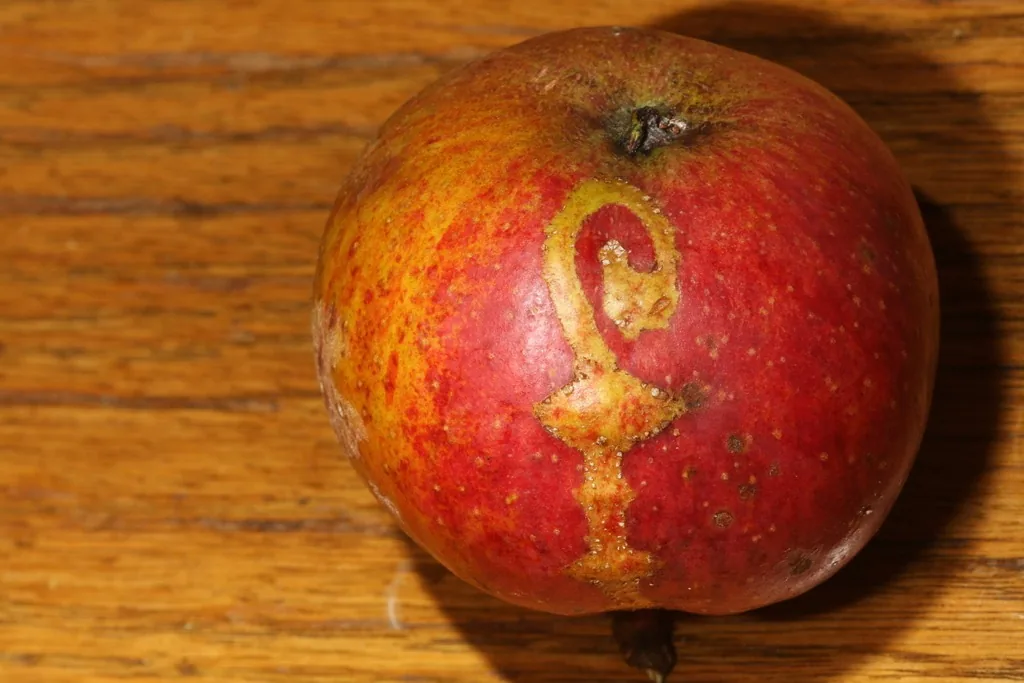
- Early feeding leaves a winding, ribbon-like scar; these apples usually stay on the tree, and the scars lower their value.[1][2]
- Older larvae bore deep into one or more fruits, usually making them drop in mid-season.[1]
- UMass Extension says later feeding leaves exit holes with reddish-brown frass and a strong odor, and larvae feed on several fruit in a cluster.[3]
Health risk
It feeds on apple fruit, and no cited source describes any risk to people or pets.[1][3]
Control
Prevention
Orchards hang white sticky rectangle traps on the south sides of trees at pink: Penn State says 5 to 6 feet above the ground along the orchard edge, UMass at head height within 18 inches of the drip line, near a large group of blossoms.[2][3]
Sanitation
UMass Extension advises removing wild or untended trees near the orchard and hand-thinning to break up fruit clusters so larvae can't move from one apple to the next.[3]
Biological control
No native natural enemy is reported to be effective in North America; Canada introduced the parasitic wasp Lathrolestes ensator with partial success.[2]
Pesticides
Where this sawfly has been a problem before, Penn State's best tactic is an insecticide as soon as pollination is complete. UMass says to apply recommended insecticides when trap catches reach action thresholds and to rotate IRAC groups, and the University of Maine says sprays applied for plum curculio also prevent sawfly damage.[1][2][3][4]
Where the sources disagree
Trap thresholds: Penn State's home-planting page gives 5.5 flies per trap by petal fall with no prebloom insecticide or 4.7 with one; its tree fruit page gives 5 flies per trap with no prebloom insecticide; UMass gives a cumulative 5 per trap without a prebloom insecticide or 9 with one.[1][2][3]
Where eggs go: Penn State says on the calyx end of developing fruit, UMass into the flower receptacle, and the University of Maine on the base of the apple flower during bloom.[1][3][4]
Adult emergence: Penn State says late pink and early bloom, UMass during pink.[1][3]
Larval prolegs: Penn State says prolegs on each abdominal segment, UMass seven pairs.[1][3]
Trap height: Penn State says 5 to 6 feet above the ground, UMass head height.[2][3]
Common questions
Sources
- Penn State Extension, “European Apple Sawfly in the Home Fruit Planting.” extension.psu.edu/european-apple-sawfly-in-the-home-fruit-planting (accessed 2026-11-13)
- Penn State Extension, “Tree Fruit Insect Pest: European Apple Sawfly.” extension.psu.edu/tree-fruit-insect-pest-european-apple-sawfly (accessed 2026-11-13)
- UMass Amherst Extension Fruit Program, “Apple IPM: European Apple Sawfly (J. Piñero, E. Garofalo, S. Schloemann).” ag.umass.edu/fruit/fact-sheets/apple-ipm-european-apple-sawfly (accessed 2026-11-13)
- University of Maine Cooperative Extension, “European Apple Sawfly (Home and Garden IPM).” extension.umaine.edu/home-and-garden-ipm/fact-sheets/common-name-listing/european-apple-sawfly/ (accessed 2026-11-13)
- Insects, 2021 (Agriculture and Agri-Food Canada) (via PubMed), “A New Look at Cultivar Preference in Hoplocampa testudinea on Apple in the Annapolis Valley of Nova Scotia, Canada (abstract).” pubmed.ncbi.nlm.nih.gov/34564209/ (accessed 2026-11-13)
- Global Biodiversity Information Facility (GBIF), “Hoplocampa testudinea (Klug, 1816) (GBIF Backbone Taxonomy).” api.gbif.org/v1/species/1249700 (accessed 2026-11-13)