On this page
How to identify it
- Mites are about the size of a printed period. NC State describes them as gray with pale legs, while the PNW handbook calls the adult greenish to brown.[1][2][3]
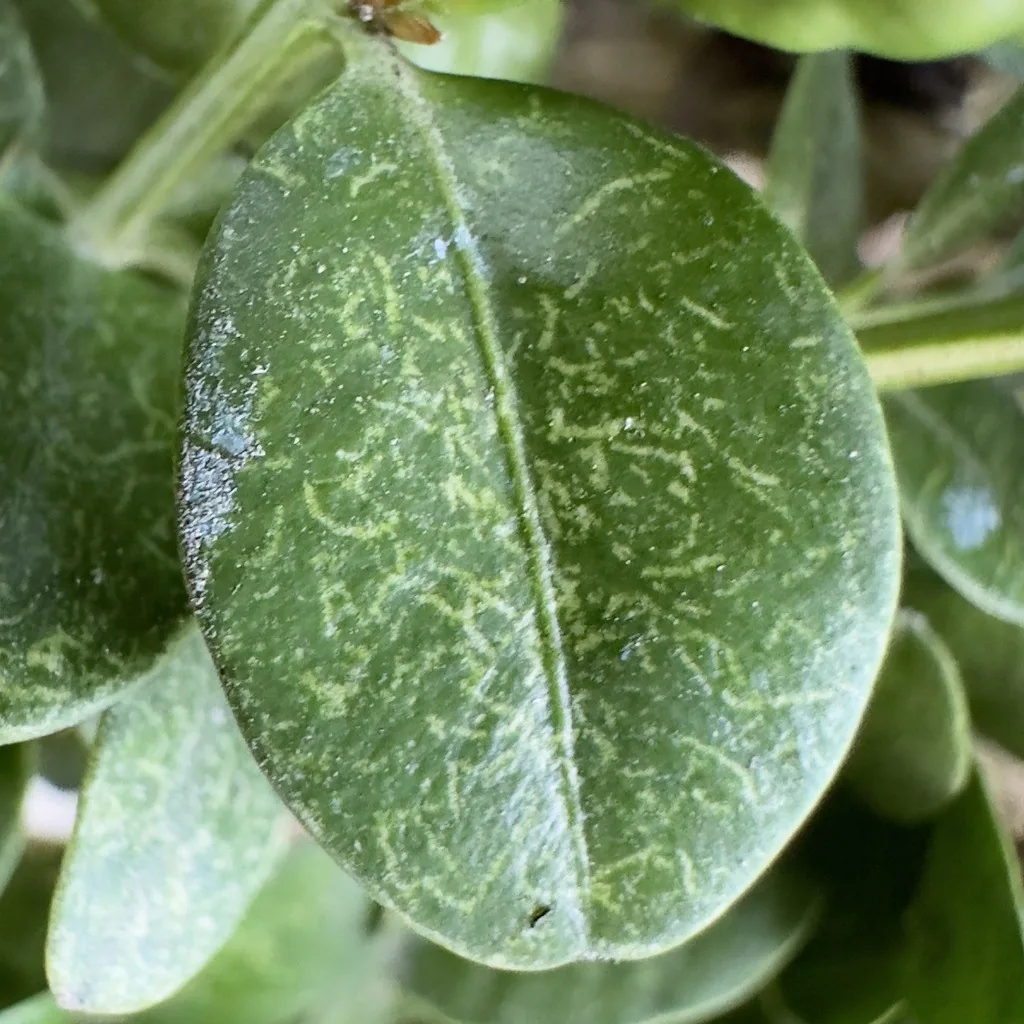
- Unlike most spider mites, NC State and UMass say they feed on the upper as well as the lower leaf surface; Rutgers describes feeding on the undersides. NC State notes the feeding tends to run in lines that look like tiny scratches under a hand lens.[1][2][4]
- Overwintering eggs are yellowish and flattened; UMass says they sit on the undersides of the leaves.[1][2]
- Rutgers notes that boxwood mites make little or no webbing, and that pale cast skins and eggshells may show on leaf undersides.[4]
Look-alikes
| Look-alike | How to tell them apart |
|---|---|
| Twospotted spider mite | Twospotted and other spider mites usually leave tiny discrete pale dots rather than scratch-like lines.[1] |
| Boxwood psyllid | Boxwood psyllid feeding cups the new leaves, which curl around the nymphs; the nymphs are covered in waxy threads.[2] |
| Boxwood leafminer | Boxwood leafminer larvae live inside the leaf, making yellowish mines visible from the underside; leaves may blister, yellow or brown, and drop.[2] |
Where it lives
It is a common boxwood pest in the eastern U.S., covered by NC State, UMass and Rutgers, and the PNW handbook says damage is common throughout Oregon's Willamette Valley.[1][2][4][3]
Biology and life cycle
Eggs laid in September and October overwinter on the leaves and hatch in mid-spring; UMass gives roughly the beginning of May as a treatment window in Massachusetts.[1][2]
NC State gives a full life cycle of 18 to 21 days and at least eight generations a year; each female lays about 25 to 30 eggs. Rutgers says the mites are active mainly in cool spring weather, and NC State says most injury happens in spring.[1][4]
Damage and signs
- Feeding causes fine whitish, yellow or bronze stippling and streaks, and plants can look off-color, dull or bronzed; new growth is most susceptible.[1][2][4][3]
- UMass calls the damage often minor, and NC State says it doesn't usually cause general yellowing or dieback; heavy infestations can cause early leaf drop. Damage is often noticed later in the year than it occurred.[2][1][3]
- Boxwood is the only host. UMass says European, common and English boxwood suffer most and Japanese boxwood is often much less susceptible.[1][2]
Health risk
It feeds only on boxwood, and none of the NC State, UMass, Rutgers or PNW handbook pages mention a risk to people or pets.[1][2][4][3]
Control
Traps and physical control
Knock mites off with a hard stream of water early in spring.[4]
Biological control
Predatory mites and lacewings feed on them; Rutgers advises avoiding unneeded broad-spectrum sprays, and the PNW handbook says natural enemies usually bring enough control by midsummer.[4][3]
Pesticides
NC State recommends two treatments of insecticidal soap, horticultural oil or another labeled miticide 10 to 14 days apart in spring when mites are present; if mites are found later, an oil spray then and again the next spring.[1][4]
Common questions
- What causes tiny pale scratches on boxwood leaves?
- Boxwood mites, which feed in lines on both leaf surfaces.[1]
- Will boxwood mites kill my shrubs?
- Usually not. UMass calls the damage often minor, though heavy infestations can cause some leaves to drop early.[2][3]
- When should I treat boxwood mites?
- In spring when mites are present, with two soap or oil sprays 10 to 14 days apart.[1]
Sources
- NC State Extension, “Boxwood Mite (PDIC Factsheet).” content.ces.ncsu.edu/boxwood-mite (accessed 2026-11-13)
- UMass Amherst Extension, Landscape, Nursery and Urban Forestry Program, “Boxwood: Common Health Issues in the Landscape.” www.umass.edu/agriculture-food-environment/landscape/fact-sheets/boxwood-common-health-issues-in-landscape (accessed 2026-11-13)
- Pacific Northwest Pest Management Handbooks (OSU, WSU, University of Idaho), “Boxwood (Buxus)-Boxwood spider mite (Pacific Northwest Insect Management Handbook).” pnwhandbooks.org/node/7137/print (accessed 2026-11-13)
- Rutgers Cooperative Extension, “Boxwood Growing Guide (Nursery IPM).” sites.rutgers.edu/nursery-ipm/boxwood-growing-guide/ (accessed 2026-11-13)
- Global Biodiversity Information Facility (GBIF), “Eurytetranychus buxi (Garman, 1935) (GBIF Backbone Taxonomy).” api.gbif.org/v1/species/2128890 (accessed 2026-11-13)
- iNaturalist, “Eurytetranychus buxi taxon page (order and family).” www.inaturalist.org/taxa/903829 (accessed 2026-10-06)