On this page
How to identify it
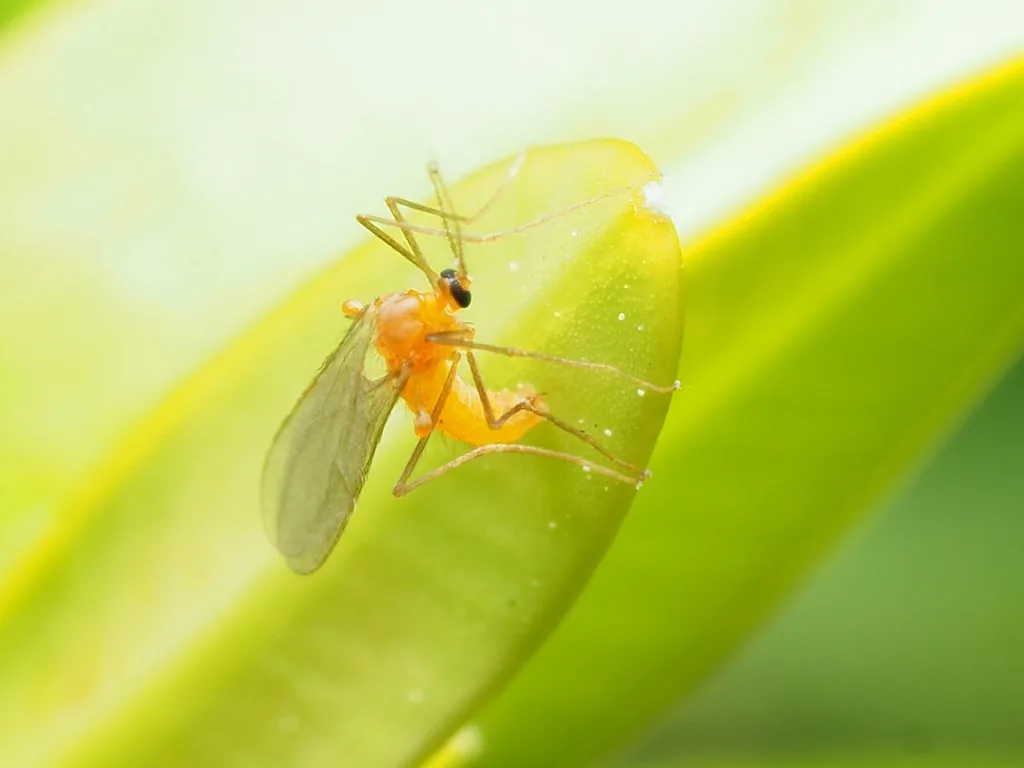
- Adults are delicate mosquitolike flies about 1/10 inch (2 to 3 mm) long with long legs and antennae and a yellow-orange to reddish orange body. UF/IFAS gives about 2.5 mm and notes adults have 14 antenna segments.[1][5][4][3][6]
- Larvae are legless maggots up to 1/8 inch (3 mm), whitish, yellow or orange (UC also lists green), hidden in the leaf; a broken-open blister holds 2 to 6 of them. UF/IFAS describes them as yellowish-white to green, about 3 mm long; pupae are whitish to dark yellow and about the same size.[1][5][4][6]
- In spring the blisters develop a clear window, and after the adults leave, empty whitish pupal skins stick out of small holes under the leaves.[1][5][2]
Where it lives
Feeds only on boxwoods (Buxus). Native to Europe, it is now found from coast to coast in the United States wherever boxwood grows. UF/IFAS says it is widespread in continental Europe but rarely damaging in its native range.[1][4][5][6]
Biology and life cycle
Larvae overwinter in the leaf, resume feeding in spring and pupate inside the mine.[1][5][7][8]
Adults emerge over about 2 weeks in spring, timed with weigela bloom. Adults live only a few days, and females die within hours of laying their last eggs. UF/IFAS says more adults emerge in the early morning, timed by light levels.[1][2][5][4][7][6]
Eggs hatch in 2 to 3 weeks; larvae mine alone at first, then their mines merge and they feed in groups through summer. UF/IFAS gives 14 to 21 days for hatching.[1][5][7][6]
Damage and signs
- Mines start as pale green or yellow spots on the upper leaf and become brownish swollen blisters underneath, giving the leaf a puffy look.[1][4][2]
- Infested leaves are yellower and smaller; heavy infestations brown and drop leaves and cause branch dieback, and stressed plants are more open to disease and winter injury. UF/IFAS says blisters cut the flow of nutrients in the leaf, leading to early leaf drop, and cites an older report that a severely infested plant usually dies after a year.[1][2][4][6]
- Pacific Northwest specialists call the damage mainly cosmetic, but repeated severe attacks can harm shrubs.[8]
- Chickadees, warblers, nuthatches and titmice can hear pupae in the leaves and peck them out, but UF/IFAS says titmice pecking can do more harm to the foliage than the insect does.[6]
Health risk
It feeds only on boxwood; none of the sources describes any risk to people or pets.[1][5]
Control
Prevention
Keep boxwoods growing well, with enough water in the dry season. UF/IFAS adds proper fertilizing and pruning, since healthy plants are less likely to be attacked.[1][6]
Plant resistant boxwoods. UC and UMass list Buxus microphylla 'Green Pillow' and 'Grace Hendrick Phillips' and B. sempervirens 'Argenteo-variegata', 'Handworthiensis', 'Justin Brouwers', 'Pendula', 'Pyramidalis', 'Suffruticosa' and 'Vardar Valley'; UMass adds B. microphylla var. japonica and 'Franklin's Gem'. UF/IFAS's list also includes B. microphylla var. sinica 'Franklin's Gem', B. harlandi 'Richard' and B. sinica var. insularis 'Nana'.[1][4][8][6]
Sanitation
Pick off lightly mined leaves or shear infested tips, destroy the clippings away from the plants, and rake up fallen boxwood leaves in fall and winter. The PNW handbook says to shear before the flies emerge; UMass suggests cutting first-year growth back by about a third after egg-laying in June. UF/IFAS says pruning out infested leaves or twigs while larvae are still inside, and disposing of them away from the site, can cut localized infestations; crushing leaves by hand isn't practical.[1][8][4][6]
Pesticides
Sprays have to hit the short-lived adults, so time them to weigela bloom and confirm flies are present first. For valued plants UC lists dinotefuran or imidacloprid soil drenches in late winter or spinosad sprays in spring; all three harm bees, so apply after the boxwood has finished blooming. UF/IFAS says the adults are the stage most exposed to insecticides, and systemic products such as imidacloprid applied to the soil have reduced larvae in boxwood leaves; boxwood's waxy leaves hold foliar sprays better when a surfactant is added.[4][5][1][6]
Where it came from and where it's found
It came from Europe, probably on potted boxwood in the 1600s, but wasn't reported as a pest until the early 1900s (Penn State says 1910).[4][5][2]
It is now found across the United States wherever boxwood grows; in North Carolina it is a bigger problem in the Mountains and Piedmont than on the Coastal Plain.[5][4][2]
UF/IFAS says the first boxwoods in North America were common boxwood planted on Shelter Island, New York, in 1653, and the leafminer probably arrived on potted shrubs around then. It was first reported as a pest in the early 1900s in Kingston, Rhode Island; it now occurs from the Pacific to the Atlantic coast.[6]
Older literature often calls it Monarthropalpus buxi; UF/IFAS says the accepted name is Monarthropalpus flavus.[6]
Where sources disagree
Which leaf surface gets the eggs: UC and Penn State say females insert eggs through the underside, and Oregon State says the underside; UMass, NC State and the PNW handbook say the upper surface.[1][5][7][4][2][8]
Egg numbers: UC says up to about 20 eggs per leaf; Penn State and UMass say a female lays about 29 in all.[1][5][4]
When adults fly: UC says generally April, Oregon State late April through May, the PNW handbook early May, Penn State May, and UMass mid-May to early June.[1][7][8][5][4]
English boxwood: UMass says English boxwood ('Suffruticosa') is rarely attacked and NC State that slow-growing English types are less susceptible, while Penn State says most varieties are attacked.[4][2][5]
Egg-laying surface (more): UF/IFAS also says eggs go into the underside of newly expanded leaves.[6]
Egg numbers (more): UF/IFAS agrees with UC on about 20 eggs per leaf.[6]
English boxwood (more): UF/IFAS says cultivars of English boxwood are less susceptible than other commonly used kinds, yet also says common boxwood (the same species, Buxus sempervirens) is heavily attacked.[6]
Common questions
- What are the little orange flies around my boxwood?
- Probably adult boxwood leafminers, which swarm for about two weeks in spring, around when weigela blooms.[1][2][5]
- Can I avoid the problem?
- Planting resistant boxwoods is the main long-term option UC and UMass give; UMass notes there are no known effective natural enemies to rely on.[1][4]
- When is the best time to spray?
- When the adults are flying in spring, at weigela bloom, since larvae inside the leaves are protected from contact sprays.[4][5][7]
- Do natural enemies control boxwood leafminer?
- Not usefully. UF/IFAS says birds that peck out pupae damage the leaves more than the insect, and a parasitic wasp found in a few mines isn't sold or recommended for control.[6]
Sources
- University of California Statewide IPM Program, “Boxwood Leafminer (Pests in Gardens and Landscapes).” ipm.ucanr.edu/PMG/GARDEN/PLANTS/INVERT/boxwoodlfmin.html (accessed 2026-11-14)
- NC State Extension, “Pests of Boxwood.” content.ces.ncsu.edu/pests-of-boxwood (accessed 2026-11-14)
- Clemson Cooperative Extension Home & Garden Information Center, “Boxwood Diseases and Insect Pests in South Carolina (HGIC 2052).” hgic.clemson.edu/factsheet/boxwood-diseases-insect-pests/ (accessed 2026-11-14)
- UMass Amherst Extension, “Boxwood Leafminer (Landscape fact sheet).” www.umass.edu/agriculture-food-environment/landscape/fact-sheets/boxwood-leafminer (accessed 2026-11-14)
- Penn State Extension, “Boxwood Leafminer.” extension.psu.edu/boxwood-leafminer (accessed 2026-11-14)
- University of Florida/IFAS Extension (Featured Creatures), “Boxwood Leafminer, Monarthropalpus flavus (Schrank), EENY-752/IN1291.” ask.ifas.ufl.edu/publication/IN1291 (accessed 2026-11-14)
- Oregon State University College of Agricultural Sciences, “Boxwood Leafminer (Nursery pests).” agsci.oregonstate.edu/nurspest/insects/boxwood-leafminer (accessed 2026-11-14)
- Pacific Northwest Pest Management Handbooks, “Boxwood (Buxus)-Boxwood leafminer.” pnwhandbooks.org/insect/hort/landscape/hosts-pests-landscape-plants/boxwood-buxus-boxwood-leafminer (accessed 2026-11-14)
- iNaturalist, “Monarthropalpus flavus taxon page (order and family).” www.inaturalist.org/taxa/467578 (accessed 2026-11-14)