On this page
How to identify it
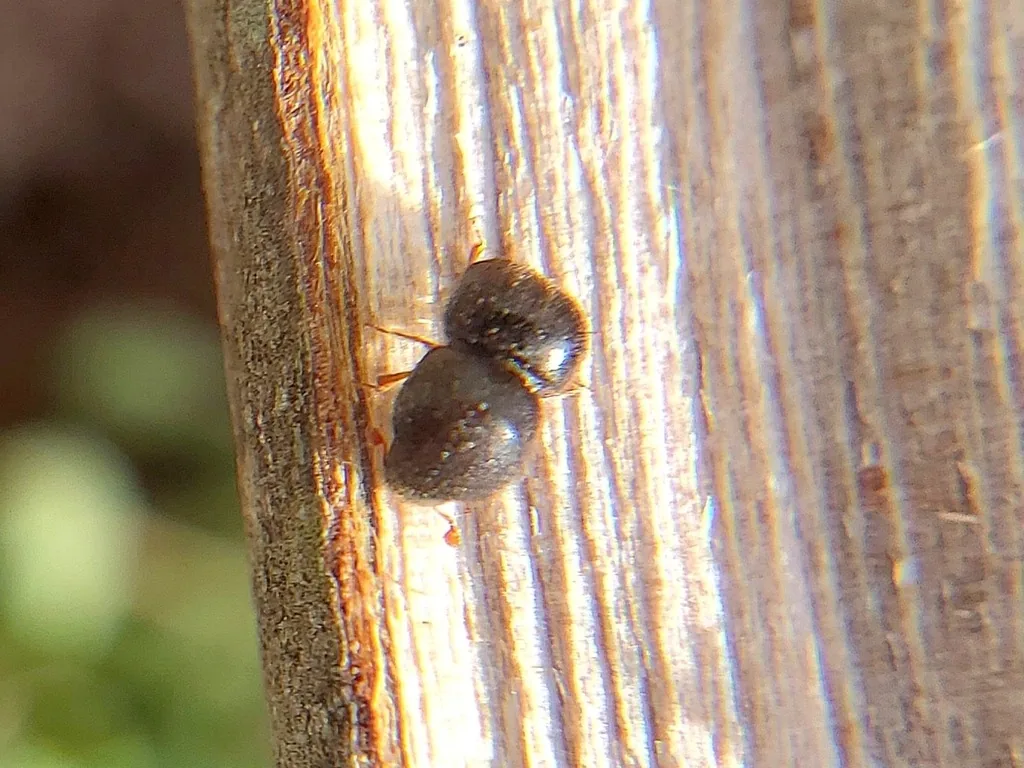
- Adults are robust, dark brown beetles about 3 to 4 mm long (2.6 to 3.9 mm per Penn State), the largest ambrosia beetles in North America.[1][2][5]
- The body is cylindrical, and the rear looks cut off at an angle, so the abdomen is shorter than the head and thorax.[1]
- Entry holes are about 2 mm across. Tennessee's test: a 5/64-inch drill bit fits the hole but a 3/32-inch bit doesn't. Look also for sawdust, sap stains and dark fungal staining around the hole.[1][3]
Look-alikes
| Look-alike | How to tell them apart |
|---|---|
| Other ambrosia beetles | Camphor shoot borer holes are relatively large, about 2 mm, and a split stem shows a T- or cross-shaped gallery whose arms run with the grain, up to about 1.5 inches long. NC State says it's much bigger than the usual ambrosia beetles.[1][3][5] |
Where it lives
Native to Asia, it likely arrived in wood packing material. Sources differ on its first U.S. record: Penn State, Tennessee State and Mississippi State give Mississippi in 1999, while Texas A&M says 2004. It now ranges from Texas to North Carolina and north to Ohio, West Virginia and southern Pennsylvania, and it was found in Slovenia in 2024.[1][3][4][2][7]
Biology and life cycle
Females carry a fungus into the wood, and the beetles feed on the fungus rather than the tree itself.[1]
It attacks many hardwood trees, shrubs and vines, with sweetgum a preferred host. Penn State says it takes only stressed, weakened or dying plants; nursery researchers note even fewer than five attacks can make a thin-barked tree unsellable.[1][3][6]
Ethanol from stressed plants helps draw the beetles in; drought, flooding, poor drainage, herbicide injury and transplant shock all raise the risk.[1]
Sources differ on stem size. Penn State says it colonizes stems 2.5 to 3.8 cm (about 1 to 1.5 inches) thick, at least 0.5 m above the ground; Tennessee State says it prefers branches 0.8 inch or less, at about chest height.[1][3]
Only females fly to new hosts; males mate with their sisters inside the gallery and never leave it.[1]
In Pennsylvania adults have been collected from May into early October. Farther south the season starts earlier: Mississippi flights begin in March and peak in April, with a smaller peak in August, and Tennessee's highest risk is mid-March to June.[1][3][2]
Development from egg to adult can take as little as five to six weeks, and females may spend winter in their galleries.[3]
Damage and signs
- Attacks cause wilting leaves and branch dieback, and a colonized trunk can die above the attack, sometimes killing the whole tree.[1]
- Gasoline with up to 10 percent ethanol fools them into attacking plastic gas cans, mower tanks and fuel lines, sometimes by the hundreds. Mississippi State also reports sprayer hoses bored after holding ethanol-based antifreeze.[1][4][2]
- Enough beetles can bore through a container to ruin it, and Penn State warns that bored boat fuel lines can leak and leave a boater stranded.[1]
Health risk
It attacks plants and plastic fuel containers; none of the extension sources mentions any risk to people.[1][3][4]
Control
Prevention
The best prevention is unstressed plants: species suited to the site, no herbicide drift near hardwoods, and transplanting outside peak flight.[1]
Kaolin clay on trunks has been suggested, since the white coating keeps beetles from recognizing trees as hosts.[1]
Keep them out
Store mowers and gas cans in a shed or under a tarp in spring, and wipe spilled fuel off cans.[2]
Sanitation
Prune out infested branches or remove and destroy infested plants, though these strong fliers can reinfest from nearby.[1][3]
Pesticides
Sources differ on sprays. Penn State and Tennessee State say no insecticide has been tested against it and sprays are unlikely to reach beetles already inside. NC State says a protective pyrethroid trunk spray, such as bifenthrin, reduces attacks.[1][3][5]
Common questions
- Why are there tiny holes in my plastic gas can?
- Camphor shoot borers mistake the ethanol in gasoline for a stressed tree and bore into plastic cans, tanks and fuel lines.[1]
- Does the camphor shoot borer attack healthy trees?
- Penn State says it colonizes only stressed, weakened or dying plants, which give off ethanol.[1][6]
- How can I tell camphor shoot borer holes from other ambrosia beetles?
- Try a drill bit: a 5/64-inch bit fits a camphor shoot borer hole but a 3/32-inch bit doesn't. Smaller ambrosia beetles leave smaller holes.[3]
Sources
- Penn State Extension, “Camphor Shoot Borer (Cnestus mutilatus).” extension.psu.edu/camphor-shoot-borer-cnestus-mutilatus (accessed 2026-11-13)
- Texas A&M AgriLife Extension (Insects in the City), “Boozy beetle: the Camphor Shoot Borer.” citybugs.tamu.edu/2017/04/27/boozy-beetle-the-camphor-shoot-borer/ (accessed 2026-11-13)
- Tennessee State University and University of Tennessee Extension, “Camphor Shot Borer: A New Nursery and Landscape Pest in Tennessee (SP 742, 2012).” trace.tennessee.edu/bitstreams/5cd08aaf-1b56-4f82-bf8d-529303c7558e/download (accessed 2026-11-13)
- Mississippi State University Extension Service, “Gas Can Beetle (Bug's Eye View, Vol. 7, No. 7, 2021).” extension.msstate.edu/newsletters/bugs-eye-view/2021/gas-can-beetle-vol-7-no-7 (accessed 2026-11-13)
- NC State Extension, Entomology, “Camphor Shot Borers Active Throughout the State (May 12, 2020).” entomology.ces.ncsu.edu/news/camphor-shot-borers-active-throughout-the-state/ (accessed 2026-11-13)
- Journal of Economic Entomology, 2026 (via PubMed), “Natural history, landscape ecology, and management of ambrosia beetles (Coleoptera: Curculionidae) as pests of nursery crops (abstract).” pubmed.ncbi.nlm.nih.gov/41967471/ (accessed 2026-11-13)
- Zootaxa, 2025 (via PubMed), “First record of the non-native Cnestus mutilatus (Blandford) and further findings of other Xyleborini (Curculionidae, Scolytinae) recently recorded in Slovenia (abstract).” pubmed.ncbi.nlm.nih.gov/41119037/ (accessed 2026-11-13)
- Global Biodiversity Information Facility (GBIF), “Cnestus mutilatus Dole & Cognato, 2010 (GBIF Backbone Taxonomy).” api.gbif.org/v1/species/6132425 (accessed 2026-11-13)