On this page
How to identify it
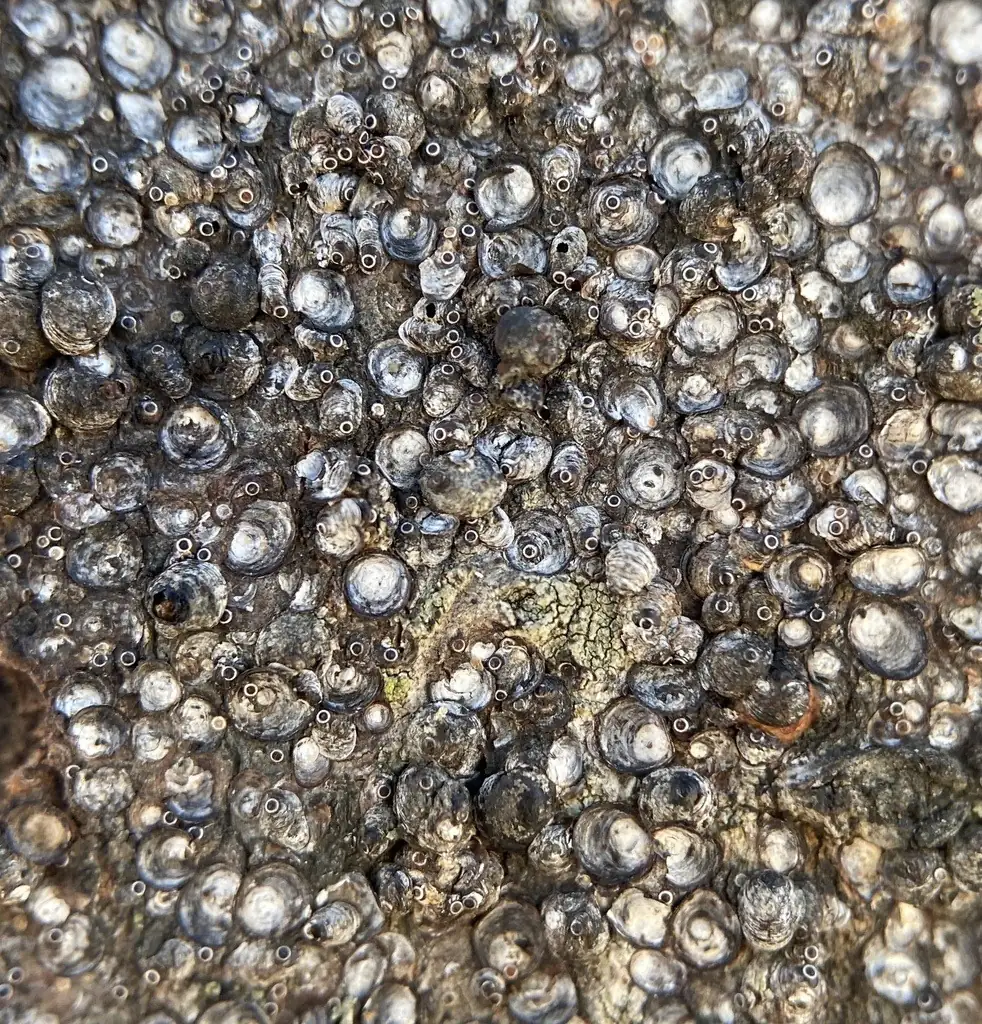
- Female covers are round and convex, gray to brown with a pale ring and darker center, and blend in with the bark. NC State and Delaware give a size of up to 2 mm; Georgia gives about 1.5 mm. Arkansas compares adults to the tip of a ballpoint pen.[1][3][2][4]
- Under the cover the female is pink, cream or light brown, legless and wingless; male covers are smaller and oval, and crawlers are orange and under 1 mm. Like other armored scales, it makes no honeydew.[1][3][2]
- Heavily infested bark looks darkened and bumpy, unlike the smooth bark of young maples.[1]
Look-alikes
| Look-alike | How to tell them apart |
|---|---|
| Other armored scales | Dead scale covers stay on the bark for years, so check that covers are alive before treating. Unlike soft scales, gloomy scale produces no honeydew, and its cover lifts off the body with a knife.[1][2] |
Where it lives
Native to eastern U.S. forests, it occurs across the Southeast, north to Maryland, south to Florida and west to Texas, and is more abundant on city trees than in natural areas.[1][5]
Biology and life cycle
There is one generation a year. Mated females overwinter; Georgia says females live about 12 months and lay about 70 eggs over eight weeks, which hatch under the cover.[1][2]
Crawler timing varies by source and place. NC State says crawlers emerge for 6 to 8 weeks starting in early May in North Carolina; Delaware says eggs hatch in late June and crawlers are active for 4 to 6 weeks.[1][3]
Crawlers settle within about 30 cm of their mother, insert their mouthparts and start building a cover; males emerge in August to mate. Crawlers can spread farther on wind, insects and birds.[1][2]
Damage and signs
- Red maple is the main host; Georgia also lists silver and Freeman maple. Others include sugar maple, elm, tulip poplar, hackberry, boxelder, sweetgum, mulberry and native hollies; Arkansas adds catalpa.[1][2][4]
- Scales feed on bark tissue, robbing the tree of nutrients and energy and possibly injecting toxins in their saliva.[1]
- Heavy or prolonged infestations kill branches or whole trees. Georgia says dieback typically shows up 6 to 10 years after an infestation starts, and that infested trees eventually die.[1][2]
Health risk
It feeds on tree bark. NC State, Georgia and Delaware treat it only as a tree pest and don't mention any risk to people or pets.[1][2][3]
Control
Prevention
Plant red maples away from large paved areas (NC State suggests avoiding sites with more than 60% impervious surface) and water to reduce drought stress.[1][6]
Avoid excess nitrogen fertilizer, which can increase scale numbers.[1]
UF/IFAS's red maple planting guide sets thresholds for impervious cover within a 25m radius of the planting site: 0–36% is where red maple planting is appropriate; at 36–61% trees are most likely to end up in fair condition and planting is not recommended unless other factors such as irrigation help; over 61%, red maples should not be planted.[11]
To measure a site without software, UF/IFAS's Pace to Plant technique walks 100 steps in an X through the planting site; the number of steps that land on impervious surface equals the percentage of impervious cover.[11]
For trees already on hot, paved sites, UF/IFAS says irrigating during the warmest months to reduce drought stress can help manage these pests.[10]
Traps and physical control
Before treating, confirm scales are alive: flip a cover to look for a pink female or scrape them for pink or yellow juice; dry, flaky covers are dead. Double-sided tape around twigs in May and June shows when crawlers are moving.[1][3]
Biological control
Parasitic wasps in Encarsia, Signiphora and Ablerus attack it, with help from lacewings, lady beetles and predatory midges, but NC State and Georgia both say natural enemies rarely give much control on city trees.[1][2]
Pesticides
Sources differ on sprays. Oils can be applied during crawler activity or dormancy. NC State says pyrethroids may not work and kill natural enemies, while Georgia notes that pyrethroid residues last longer than oil or soap. NC State says pressure washing dormant trees is untested but may help; Georgia says the effectiveness of power washing is inconsistent. Chemical control can take years, so NC State suggests weighing it against replacing the tree.[1][2]
Why city trees are hit hardest
Arkansas describes NC State research on 2,780 living street trees in Raleigh: trees in cooler areas with plenty of soil moisture had less gloomy scale than trees in hotter, water-stressed locations, and females averaged about 20 live nymphs at the cooler sites against 60 at the hotter ones. In a UF/IFAS-led study of urban red maples in Raleigh, half the trees were irrigated in the summers of 2014 and 2015; the hotter and drier the trees were, the more eggs the gloomy scales produced.[4][10]
A 2019 study found densities stayed low until at least seven seasons after planting and rose with surrounding pavement, and suggested scouting branches rather than trunks and starting management early.[6]
Warming estimates differ: Arkansas reports about 200 times more scales on hot urban trees, and a 2020 study estimates density can rise 300-fold with 2.5°C of warming, with drought stress also helping the scale. A separate 2020 study suggests its range may shift north as the climate warms.[4][7][5]
UF/IFAS entomologist Adam Dale says this native pest acts much like an invasive insect in urban landscapes, and its favorite host, red maple, is the most common urban landscape tree in the eastern U.S.[10]
Where the sources disagree
Crawler timing: NC State says crawlers emerge for 6 to 8 weeks starting in early May in North Carolina; Delaware says eggs hatch in late June and crawlers are active for 4 to 6 weeks; Georgia says emergence lasts 6 weeks, and up to 8.[1][3][2]
What it feeds on: NC State and Georgia say it feeds on parenchyma cells in the bark; Arkansas says it reaches the sugar-rich phloem cells.[1][2][4]
Size: NC State and Delaware say female covers are up to 2 mm wide; Georgia says the adult female is about 1.5 mm.[1][3][2]
Mating: NC State says it overwinters as mated adult females; Georgia says females reproduce both with and without mating, and that reproduction without mating is believed to be more common.[1][2]
Outcome: Georgia says all affected trees eventually die; NC State says scales may persist at low densities on trees in cooler, more vegetationally complex landscapes and never need intervention.[2][1]
Pyrethroids: NC State says broad-spectrum contact insecticides such as pyrethroids may not be effective and can add to the problem by killing natural enemies; Georgia says pyrethroids may offer better control of crawlers than oils or soap because their residues persist longer.[1][2]
Paving threshold: NC State suggests avoiding sites with more than 60% impervious surface, while UF/IFAS's red maple guide treats 36% as the limit for appropriate planting and says red maples should not be planted above 61%.[1][11]
Common questions
- Why is my red maple dying back with bumpy gray bark?
- Gloomy scale may cover the bark in overlapping round covers, causing dieback; it is worst on trees near pavement.[1][2]
- How do I know if the scales are alive?
- Flip covers to look for pink females or scrape them for pink or yellow juice; dead covers are dry and flaky.[1]
- When should gloomy scale be treated?
- Treatments target the crawlers. In North Carolina they appear from early May; in Delaware eggs hatch in late June. Tape traps on twigs show when they're active.[1][3]
Sources
- NC State Extension, “Gloomy Scale, Melanaspis tenebricosa (Entomology Insect Notes).” content.ces.ncsu.edu/gloomy-scale-1 (accessed 2026-11-13)
- University of Georgia Cooperative Extension, “Gloomy Scale: Biology and Management in Landscapes (Circular 1286).” fieldreport.caes.uga.edu/?p=4899 (accessed 2026-11-13)
- University of Delaware Cooperative Extension, “Gloomy Scale Insect (fact sheet).” www.udel.edu/udel/en/academics/colleges/canr/cooperative-extension/fact-sheets/gloomy-scale-insect/ (accessed 2026-11-13)
- University of Arkansas System Division of Agriculture, Cooperative Extension Service, “Gloomy Scale (Plant of the Week, September 21, 2018).” uaex.uada.edu/yard-garden/resource-library/plant-week/gloomy-scale-09-21-2018.aspx (accessed 2026-11-13)
- Environ Entomol 2020;49(1):104-114, via PubMed, “Thermal Tolerance of Gloomy Scale (Hemiptera: Diaspididae) in the Eastern United States (2020).” pubmed.ncbi.nlm.nih.gov/31904081/ (accessed 2026-11-13)
- Environ Entomol 2019;48(5):1113-1120, via PubMed, “Chronology of Gloomy Scale (Hemiptera: Diaspididae) Infestations on Urban Trees (2019).” pubmed.ncbi.nlm.nih.gov/31504349/ (accessed 2026-11-13)
- Insects 2020;11(3), via PubMed, “Can Cities Activate Sleeper Species and Predict Future Forest Pests? A Case Study of Scale Insects (2020).” pubmed.ncbi.nlm.nih.gov/32106554/ (accessed 2026-11-13)
- Global Biodiversity Information Facility (GBIF), “Melanaspis tenebricosa (Comstock, 1881) (GBIF Backbone Taxonomy).” api.gbif.org/v1/species/2083296 (accessed 2026-11-13)
- iNaturalist, “Melanaspis tenebricosa taxon page (order and family).” www.inaturalist.org/taxa/48083 (accessed 2026-10-06)
- University of Florida IFAS, “'Gloom' and doom when these insects are on hot, dry red maple trees (March 9, 2017).” blogs.ifas.ufl.edu/news/2017/03/09/gloom-and-doom-when-these-insects-are-on-hot-dry-red-maple-trees/ (accessed 2026-11-14)
- University of Florida IFAS Extension, EDIS, “Impervious Surface Thresholds and the Pace to Plant Technique for Planting Urban Red Maple Trees, ENY-341/IN1185 (A. G. Dale et al.).” ask.ifas.ufl.edu/publication/IN1185 (accessed 2026-11-14)