On this page
How to identify it
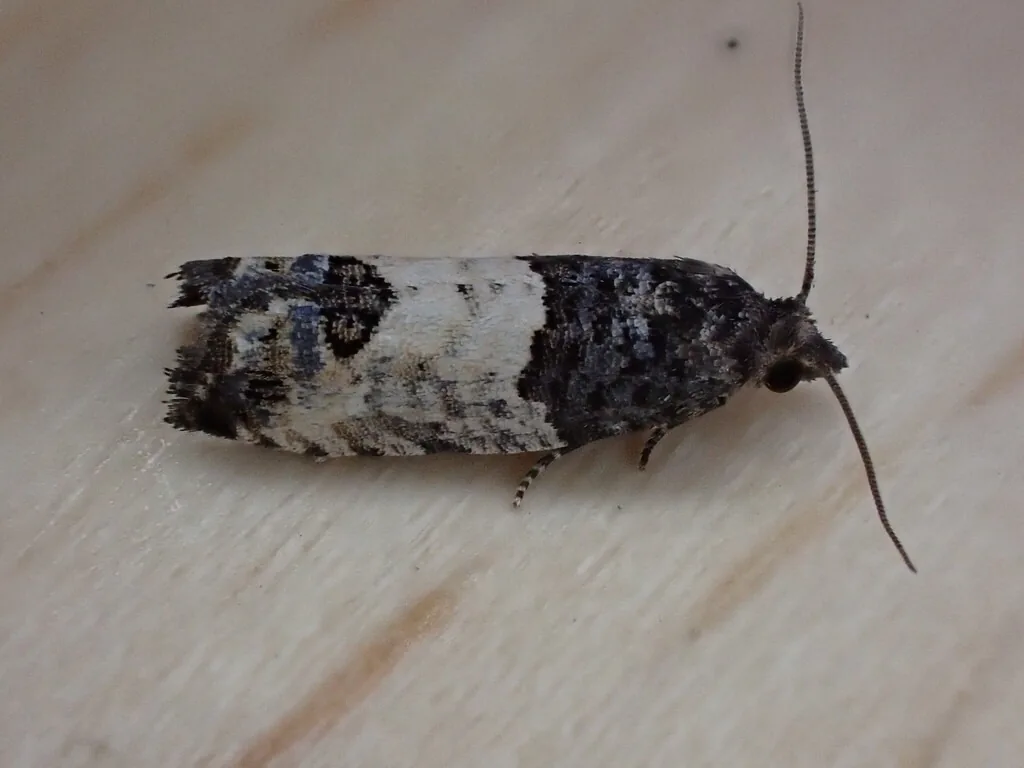
- Adults are grayish moths about 0.4 inch long with a wide light band across each forewing. TortAI notes light and dark forms, with the band white, cream or gray; UC IPM says they look like a smaller codling moth. A 1924 USDA bulletin says the name refers to eyelike markings on the forewings: near the rear corner and before the tip are short black dashes followed by lead-blue streaks, and the middle of the forewing is cream white between darker ash-gray areas.[1][2][3][4]
- Larvae are brown with a black or reddish-brown head. Sources differ on color and size: the PNW handbook calls them chocolate brown and up to 1 inch long, UC IPM calls them dull brown with a shiny black head, and TortAI gives 9 to 14 mm for late-stage larvae, gray to dull reddish-brown.[1][3][2]
- Eggs are laid flat on leaves, a rounded oval 0.72 to 0.99 mm long, pale watery white and almost transparent when fresh. The 1924 USDA bulletin gives 11 to 13 mm for full-grown larvae, dull brown with a shiny head ranging from medium brown to nearly black.[4]
- The winter shelter (hibernaculum) is 3 to 5 mm long and 1 to 2 mm wide, most often in the angle at the base of a fruit spur or short twig, and is covered with bits of frass and bark so that it matches the bark and is hard to see.[4]
Look-alikes
| Look-alike | How to tell them apart |
|---|---|
| Codling moth | UC IPM says eyespotted bud moth adults look like codling moth but are smaller, with a white band across the middle of the wings.[3] |
| Obliquebanded leafroller | The 1924 USDA bulletin says it can also overwinter as a partly grown larva in a similar but smaller shelter, often under a dead bud scale, but after the leaves expand it feeds as a leafroller and is unlikely to be confused with the bud moth.[4] |
Where it lives
Native to Europe and found in apple-growing regions across the northern hemisphere. TortAI says it was introduced to North America before 1840 and now occurs across southern Canada and the northern United States, south to North Carolina, Ohio and California. The 1924 USDA bulletin says it was presumably brought to the United States on early imports of apple and other nursery stock, that the first US account dates from 1841, and that it has spread mainly on nursery stock because its winter shelters are so hard to spot.[2][4]
Biology and life cycle
Partly grown larvae spend winter in a silk shelter (hibernaculum), often in the crotch of a spur or small limb, and become active around budbreak. In Connecticut the 1924 USDA bulletin found that nearly all larvae entered winter at the end of the third stage, starting in late August; a British Columbia study found larvae coming out between mid-March and late April, with half out when McIntosh buds reached the tight-cluster stage.[1][2][4][5]
They feed in nests of webbed leaves and pupate there. The PNW handbook and TortAI describe one generation a year, with moths flying from early to midsummer (June to August in TortAI). UC IPM reports two generations in California, with moths in May and again in September and October.[1][2][3]
Eggs are laid singly on leaves. The young larvae feed there until early August, then build their winter shelters.[1][2]
In Connecticut the pupal stage lasted 12 to 21 days, averaging 15 to 16 days. Moths fly mainly at night; females laid eggs singly on both sides of leaves, most hatching in 8 to 10 days, and the most eggs from one moth was 156.[4]
Recorded food plants include apple, pear, cherry, plum, peach, quince, hawthorn, blackberry, raspberry and oak, and it is also a pest of blueberry.[4][5]
Damage and signs
- In spring, larvae feed on buds, leaves and blossoms inside webbed nests. The 1924 USDA bulletin says spring feeding in unopened blossoms reduces fruit set, larvae sometimes kill shoots by using the tip leaf as a nest or boring into the shoot, and nearly full-grown larvae may eat into young fruit, which drops or becomes deformed with corky areas. It put losses as high as 30 per cent in severe infestations, though such losses were unusual.[1][2][4]
- UC IPM says summer larvae chew small patches out of leaves, leaving a web of veins (windowpaning), and can tie leaves to fruit and chew shallow marks on the fruit surface.[3]
- Late-summer larvae feed under a silk web on the leaf, usually on the underside next to a vein, and where a leaf touches an apple they gnaw small, shallow pits in the skin.[4]
Health risk
Its larvae feed on apple and cherry buds and leaves. The PNW handbook, UC IPM and TortAI treat it only as an orchard pest and don't mention any risk to people or pets.[1][3][2]
Control
Prevention
Look for larvae in nests of webbed-together leaves in spring. On home apples treatment is rarely needed; UC IPM notes that sprays used for other pests in conventional orchards usually keep it in check.[1][3]
Traps and physical control
Orchards monitor moth flights with pheromone traps, which UC IPM says should be in place by May 1 and kept up all season.[3]
Biological control
UC IPM lists Bacillus thuringiensis subspecies kurstaki, which works best in warm, dry weather while larvae are small.[3]
Natural enemies are recorded: birds eat the larvae, a mud-nesting wasp stocks its nest with them, predatory beetles, bugs and mites feed on them, and more than a score of parasites have been reared from them.[4]
Pesticides
The PNW handbook lists carbaryl for home use if control is needed and notes it's highly toxic to bees; UC IPM likewise warns that spinosad is toxic to bees.[1][3]
Why it shows up in organic orchards
UC IPM says the moth is mainly a problem in organic apple orchards that use pheromone mating disruption against codling moth, since those orchards skip the broad sprays that control it elsewhere. It is a problem in coastal areas, not the interior valleys, and its life cycle and damage are similar to the apple pandemis moth, which may share the same orchard.[3]
A 2012-13 field trial in isolated Swedish apple orchards found that a pheromone dispenser aimed at several leafroller species at once cut trap catches of all the species tested, including this one, and reduced leafroller damage to fruit. The authors note that orchards may still need field scouting.[6]
Where the sources disagree
Generations: the PNW handbook and TortAI describe one generation a year, with TortAI putting adults in June to August; UC IPM has observed two in California, with moths in May and again in September and October.[1][2][3]
Where larvae spend the winter: the PNW handbook says in a cocoon on the bark in the crotches of small limbs; TortAI says in a hibernaculum, often in a spur crotch; UC IPM says it is believed that summer-generation larvae overwinter in hibernacula.[1][2][3]
The larvae: the PNW handbook calls them chocolate brown and up to 1 inch long; TortAI gives 9 to 14 mm for late-stage larvae.[1][2]
Does it need control: the PNW handbook says it doesn't usually need control on apples; UC IPM says it has become an important pest in organic apple orchards in coastal California, where treatments may be warranted.[1][3]
Overwintering stage: the 1924 USDA bulletin found nearly all larvae entering winter at the end of the third stage in Connecticut; the British Columbia study found them usually overwintering as fifth and sixth instars, with fewer than 6% as fourth instars.[4][5]
First record in North America: TortAI says it was introduced before 1840; the 1924 USDA bulletin says the first US account was published in 1841.[2][4]
Common questions
- What brown caterpillars web together my apple leaves in spring?
- They may be eyespotted bud moth larvae, which are brown with dark heads and feed in webbed nests of leaves and buds in spring.[1][3]
- Do I need to spray for eyespotted bud moth?
- Rarely. The PNW handbook says it doesn't usually require control on apples; UC IPM treats it mainly as a pest of organic orchards.[1][3]
- Why is it called the eyespotted bud moth?
- A 1924 USDA bulletin says the name refers to eyelike markings on the forewings, short black dashes followed by lead-blue streaks; the moths themselves are seldom noticed, while the larvae's work in the fruit buds is.[4]
- When do bud moth larvae come out in spring?
- In a British Columbia orchard the first larvae appeared between mid-March and early April and none after late April, with half out by the tight-cluster stage of McIntosh apple buds. The 1924 USDA bulletin says they usually leave their winter shelters as the buds are unfolding.[5][4]
Sources
- Pacific Northwest Pest Management Handbooks (OSU, WSU, University of Idaho), “Apple: Eyespotted bud moth (Insect Management Handbook).” pnwhandbooks.org/insect/tree-fruit/apple/apple-eyespotted-bud-moth (accessed 2026-11-14)
- USDA APHIS PPQ Identification Technology Program, “Spilonota ocellana (TortAI: Tortricids of Agricultural Importance, Gilligan & Epstein).” idtools.org/id/leps/tortai/Spilonota_ocellana.htm (accessed 2026-11-14)
- University of California Statewide IPM Program, “Eyespotted Bud Moth, UC IPM Pest Management Guidelines: Apple.” ipm.ucanr.edu/agriculture/apple/eyespotted-bud-moth/ (accessed 2026-11-14)
- U.S. Department of Agriculture (scan at Internet Archive), “The Bud Moth (B. A. Porter, USDA Department Bulletin 1273, 1924; scanned copy).” archive.org/details/budmoth1273port (accessed 2026-11-14). Historic 1924 bulletin read from the Internet Archive's full text; used only for descriptions, biology and history, not for its control advice.
- Journal of the Entomological Society of British Columbia (BioStor scan at Internet Archive), “Emergence of overwintered larvae of eye-spotted bud moth, Spilonota ocellana, in relation to temperature and apple tree phenology at Summerland, British Columbia (McBrien and Judd 2004, J. Entomol. Soc. B.C. 101: 15-28).” archive.org/details/biostor-204907 (accessed 2026-11-14)
- Peer-reviewed literature (PubMed), “Mating disruption of Spilonota ocellana and other apple orchard tortricids using a multispecies reservoir dispenser (Porcel M et al., Pest management science, 2015).” pubmed.ncbi.nlm.nih.gov/24916099/ (accessed 2026-11-14)
- Global Biodiversity Information Facility (GBIF), “Spilonota ocellana (Denis & Schiffermüller, 1775) (GBIF Backbone Taxonomy).” api.gbif.org/v1/species/5103066 (accessed 2026-11-14)
- iNaturalist, “Spilonota ocellana taxon page (order and family).” www.inaturalist.org/taxa/231405 (accessed 2026-11-14)