On this page
How to identify it
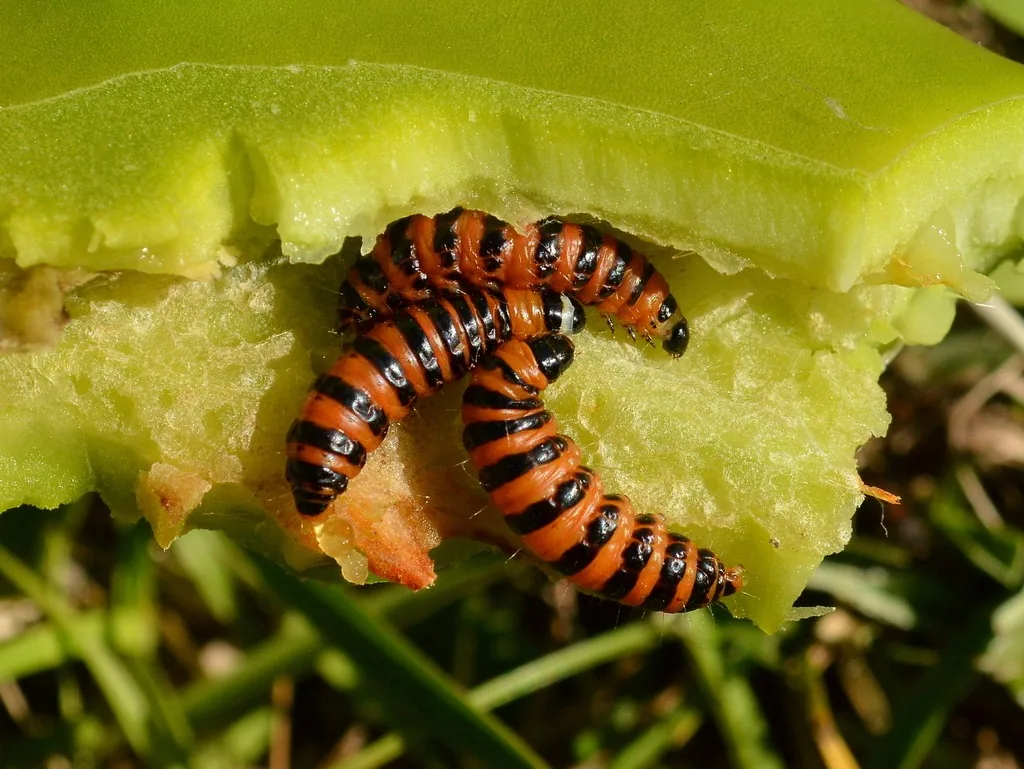
- Caterpillars grow to about 1 inch (2.5 cm) and are bright orange or red with dark crossbands. Florida's agriculture department says red-and-black banded caterpillars feeding inside a cactus pad are diagnostic; native cactus-feeding caterpillars aren't red and black.[1][4]
- Adults are plain grayish-brown moths with a wingspan up to 1 1/4 inches (3 cm), whiter margins and dark lines on the forewings, and they rest with their wings wrapped around the body.[1][4]
- Eggs are stacked like coins into an egg-stick that looks like a cactus spine.[1][4]
Look-alikes
Where it lives
Native to Argentina. Since its detection in the Florida Keys in 1989 it has spread as far north as North Carolina and as far west as mid-Texas, where it was first found in Brazoria County in 2017 and later in Matagorda, Colorado and Chambers counties. GBIF's 1990-2026 U.S. records (197) are mostly from Florida and Alabama, plus Hawaii, where it was used against weedy cacti.[4][1][3][7]
Biology and life cycle
Females lay their eggs 50 to 80 at a time in an egg-stick, usually on a cactus spine. The larvae bore into a pad, feed together, and move to a new pad when the food runs out.[1][4]
Grown larvae usually leave the plant and spin white cocoons in leaf litter or bark crevices nearby. The whole life cycle takes about 90 days.[1]
In the southeastern U.S. adults fly three times a year: late March to May, July to August, and late September to mid-November.[4]
BAMONA lists prickly pear cacti (Opuntia) as its caterpillar hosts. In a field test of 14 North American opuntioid cacti, egg-laying and larval survival didn't line up: females preferred two varieties of Engelmann prickly pear, while larvae survived best on two other species.[4][6]
Adult moths have been known to disperse naturally up to 16 miles. Genetic work suggests it reached the U.S. mainland both through shipping trade from the Caribbean and by hurricanes, and that hurricanes may be its main means of further spread once human movement is controlled.[3][5]
Damage and signs
- Larval feeding inside the pads can kill the plant, and heavy feeding can destroy entire stands of prickly pear.[4][3]
- The same moth has been used on purpose to control weedy prickly pears in Australia, Hawaii and several Caribbean islands, which is why its arrival in Florida was seen as a threat to cactus-rich desert ecosystems and commercial cactus production.[1]
Health risk
It feeds on prickly pear cacti; neither state agency mentions any risk to people.[4][1][3]
Control
Prevention
Commercial sales of infested cacti can carry eggs and larvae long distances, so check prickly pears before buying or moving them. In Texas, report suspected cactus moth to the Texas Department of Agriculture.[3]
Biological control
Sterile moth releases plus removal of infested plants slowed its westward spread through the Florida Panhandle and Mississippi barrier islands but were stopped in 2012. Florida has reared a wasp, Apanteles opuntiarum, that attacks only cactus moth larvae in Argentina, and applied to USDA APHIS in July 2023 for a release permit.[1]
When to call a professional
No satisfactory chemical control has been found, because the larvae feed inside the pads and the cactus habitat is sensitive and widespread.[1]
Common questions
- What is eating the inside of my prickly pear pads?
- In the Southeast, look for the cactus moth: bright orange caterpillars with dark crossbands feeding inside the pads are diagnostic.[1][3]
- Can I spray for cactus moth?
- Florida's agriculture department says no satisfactory chemical control has been found, because the larvae feed inside the pads.[1]
- Who should I tell if I find cactus moth?
- In Texas, the Department of Agriculture asks nurseries and the public to scout prickly pears and report finds to its Plant Quality program.[3]
Sources
- Florida Department of Agriculture and Consumer Services, “Argentine Cactus Moth Biological Control.” www.fdacs.gov/Agriculture-Industry/Pests-and-Diseases/Plant-Pests-and-Diseases/Biological-Control/Argentine-Cactus-Moth-Biological-Control (accessed 2026-11-11)
- iNaturalist, “Cactoblastis cactorum taxon page (order and family).” www.inaturalist.org/taxa/199409 (accessed 2026-11-11)
- Texas Department of Agriculture, “Cactus Moth (Pest and Disease Alerts).” www.texasagriculture.gov/Regulatory-Programs/Plant-Quality/Pest-and-Disease-Alerts/Cactus-Moth (accessed 2026-11-11)
- Butterflies and Moths of North America (BAMONA), “Cactus Moth, Cactoblastis cactorum (Berg, 1885).” www.butterfliesandmoths.org/species/Cactoblastis-cactorum (accessed 2026-11-11)
- Scientific Reports, via PubMed, “Andraca-Gomez G, Lombaert E, Ordano M, Perez-Ishiwara R, Boege K, Dominguez CA, Fornoni J (2020), Local dispersal pathways during the invasion of the cactus moth, Cactoblastis cactorum, within North America and the Caribbean, Scientific Reports 10:11012.” pubmed.ncbi.nlm.nih.gov/32620784/ (accessed 2026-11-11). Cited from the PubMed abstract.
- Environmental Entomology, via PubMed, “Jezorek HA, Stiling PD, Carpenter JE (2010), Targets of an invasive species: oviposition preference and larval performance of Cactoblastis cactorum on 14 North American opuntioid cacti, Environmental Entomology 39(6):1884-1892 (University of South Florida, USDA-ARS).” pubmed.ncbi.nlm.nih.gov/22182554/ (accessed 2026-11-11). Cited from the PubMed abstract.
- Global Biodiversity Information Facility (GBIF), “Cactoblastis cactorum (cactus moth): occurrence records in the U.S., 1990-2026 (GBIF occurrence search).” api.gbif.org/v1/occurrence/search?taxonKey=1870532&country=US&hasGeospatialIssue=false&occurrenceStatus=PRESENT&year=1990%2C2026&facet=stateProvince&facetLimit=400&limit=0 (accessed 2026-11-11). State counts are records reported (iNaturalist research-grade, museum specimens, surveys), not established populations or abundance.