On this page
How to identify it
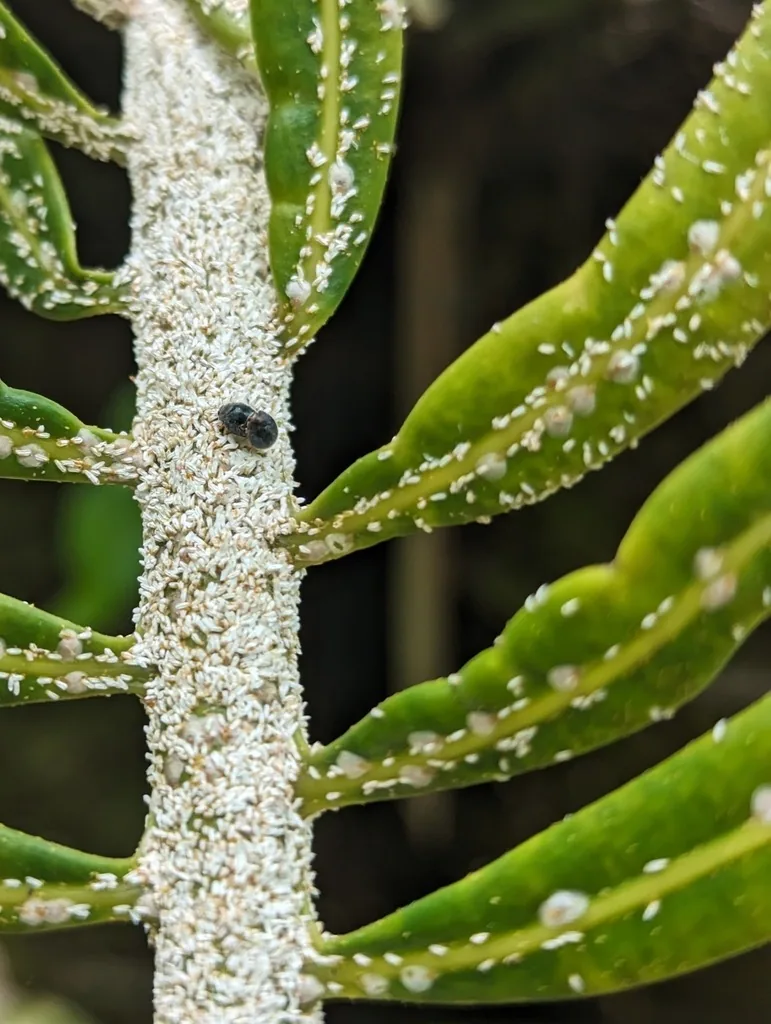
- Female scale covers are white, flat and pear-shaped or irregular, about 1.2 to 1.6 mm long (Hawaii's extension says about a sixteenth of an inch). Lift one and the insect's body and eggs underneath are orange.[5][3]
- Male covers are smaller and narrower: elongate, white or light yellow, 0.5 to 0.6 mm long, with three parallel ridges. Adult males are tiny orange-brown winged insects that look like midges.[5][4][3]
- Heavy infestations build up in layers of live and dead scales, thousands per square inch, so the fronds look flocked with artificial snow. Infestations usually start under the fronds and then spread to the upper side and stems.[4][5]
- The crawlers that hatch are very small; use a 10x hand lens to check leaf undersides.[5][3]
Look-alikes
| Look-alike | How to tell them apart |
|---|---|
| False oleander scale | The scale most often mistaken for it, according to the Texas Invasive Species Institute. It is also non-native, from China, but less of a threat.[5] |
Where it lives
It is native to Thailand. In the U.S. it was first found on sago palms in Miami: Hawaii and Texas extension give 1996, the Texas Invasive Species Institute 1997. Mostly on moved nursery plants, it reached Hawaii (Oahu, 1998), southern California (2003) and South Texas, and the institute lists it as established in Florida, Hawaii, Georgia, Texas, Alabama, California, Louisiana and South Carolina, plus Puerto Rico, the Cayman Islands and the U.S. Virgin Islands. GBIF holds U.S. records from six states, most from Florida.[3][4][5][9]
Biology and life cycle
A female lays about 100 eggs under her cover. They hatch in 7 to 14 days, and the crawlers leave the cover and settle to feed. Hawaii's extension says nymphs mature in about 30 days and the cycle from egg to adult takes about 35, with adults living about 75 days on average; the Texas Invasive Species Institute gives about 28 days to adulthood.[3][5]
Generations overlap and numbers climb fast: Texas extension says a medium-sized sago can be completely coated within a couple of months.[5][4]
Unlike most scales it also infests the roots, as deep as 24 inches (60 cm), along with the trunk, leaf stalks, cones and seeds. Those parts are hard to reach with sprays and can reinfest the plant.[5][4][3]
It can't spread far on its own. It moves on infested plants, on pruning tools and clippings, and on people and animals, and the light crawlers can be carried by wind.[5][4][3]
In laboratory tests it did best at 25 to 28°C and poorly at lower temperatures.[6]
Damage and signs
- Feeding starts under the fronds and first shows as small yellow spots on the upper surface. Fronds then yellow, lose their ability to photosynthesize and turn brown and dry; on badly infested plants new flushes may be stunted.[5][3]
- Sago palm (Cycas revoluta) is the most commonly affected and is more susceptible than queen sago. It has also been found on Mexican sago and cardboard palm, and the institute lists hosts in six cycad genera. Texas extension says Florida's native coontie resists it.[3][4][5]
- Unchecked, it kills plants. The Texas Invasive Species Institute says that can happen within weeks or months and estimates at least 80 percent of south Florida's sago palms have died; Texas extension says it takes several months of heavy infestation to weaken a sago to the point of death.[5][4]
- It has also damaged wild native cycads on Guam and Taiwan. On Guam, an introduced predatory lady beetle preferred scale on adult plants, and seedlings left without that control suffered 100% mortality.[5][7]
Health risk
It feeds only on cycads; the extension and research sources describe it only as a plant pest.[3][5]
Control
Prevention
Check cycads for scale and crawlers before you buy or plant them, then inspect weekly or every other week, especially leaf undersides. Small populations are much easier to control.[5]
Sanitation
Clean pruning tools before using them on another plant. Texas extension says to soak them for 10 minutes in a 10% bleach solution, since just spraying them doesn't always kill the insects. Double-bag cut fronds, and don't compost them.[4][5]
Traps and physical control
Trim fronds that are heavily infested and yellow or brown, but don't over-prune: the plant needs green leaves, and because crawlers also live on the roots, removing fronds alone doesn't clear the scale.[3][4]
Dead scales stay stuck to the fronds. After five or six rounds of oil, Texas extension says to spray the plant down hard with a hose to loosen them, then treat again.[4]
Biological control
A tiny black lady beetle, Rhyzobius lophanthae, chews through the scale covers to eat eggs, crawlers and adults; Hawaii's extension calls it highly effective and the primary control there. A predatory beetle, Cybocephalus binotatus, and a parasitic wasp, Coccobius fulvus, have been introduced into Florida.[3][5]
Pesticides
Horticultural oil is the preferred spray, and coverage matters more than product: wet both sides of the fronds and the stem. Hawaii's extension cites four applications 10 to 14 days apart in Florida, Texas extension says every two weeks, and the Texas Invasive Species Institute says 2 to 3 applications of oil or insecticidal soap 5 to 10 days apart.[3][4][5]
Sources differ on stronger insecticides. Hawaii's extension advises against broad-spectrum products such as malathion, diazinon and pyrethroids because they kill the predatory lady beetle; Texas extension suggests malathion mixed with oil and says systemic imidacloprid and acephate have not been consistently effective; the Texas Invasive Species Institute says systemics usually work better as soil drenches.[3][4][5]
More from the research literature
A 2018 PeerJ study calls it one of the most serious pests of cycads, which are popular in landscapes even though nearly all species are threatened in the wild, and its climate model rates much of Asia and North America, where the scale is already recorded, as highly suitable.[1]
On Guam, the dense hairs on sago palm cataphylls hid scale from predatory beetles. When researchers removed the hairs, the beetles began eating the exposed scale within a day.[8]
Common questions
- What is the white crust on my sago palm?
- Often cycad aulacaspis scale, which can coat cycads in white, starting under the fronds.[3][4]
- Why does the scale stay after I treat it?
- Dead scales stay stuck to the fronds. Texas extension suggests hosing the plant hard after several oil treatments to remove them, then treating again.[4]
- Will it spread to my real palms?
- No. It feeds only on cycads; true palms such as fan palms and date palms are not at risk.[4][5]
Sources
- Peer-reviewed literature (PubMed Central), “Predicting the potential distributions of the invasive cycad scale Aulacaspis yasumatsui (Hemiptera: Diaspididae) under different climate change scenarios and the implications for management (Wei J et al., PeerJ, 2018).” pmc.ncbi.nlm.nih.gov/articles/PMC5970564/ (accessed 2026-11-11)
- iNaturalist, “Aulacaspis yasumatsui taxon page (order and family).” www.inaturalist.org/taxa/199419 (accessed 2026-11-11)
- University of Hawaii at Manoa, College of Tropical Agriculture and Human Resources (CTAHR) Cooperative Extension, with the Hawaii Department of Agriculture, “Cycad Scale on Sago Palm (Pest Alert IP-23, Hara et al., October 2005).” www.ctahr.hawaii.edu/oc/freepubs/pdf/ip-23.pdf (accessed 2026-11-11)
- Texas Cooperative Extension (now Texas A&M AgriLife Extension), Nueces County, “Asian Cycad Scale: A New Threat to Sago Palms (M. Womack, County Horticulturist, revised September 7, 2004).” txmg.org/aransas/files/2025/01/cycad-scale.pdf (accessed 2026-11-11). PDF hosted by the Aransas County Master Gardeners.
- Texas Invasive Species Institute, Sam Houston State University, “Cycad Aulacaspis Scale, Aulacaspis yasumatsui (species account).” tsusinvasives.org/home/database/aulacaspis-yasumatsui (accessed 2026-11-11)
- Journal of Economic Entomology, via PubMed, “Ravuiwasa KT, Tan CW, Bezirganoglu I, Hwang SY (2012), Temperature-dependent demography of Aulacaspis yasumatsui (Hemiptera: Diaspididae), Journal of Economic Entomology 105(5):1581-1590.” pubmed.ncbi.nlm.nih.gov/23156153/ (accessed 2026-11-11). Cited from the PubMed abstract.
- Insects, via PubMed, “Marler TE, Marler PN (2018), Rhyzobius lophanthae behavior is influenced by cycad plant age, providing odor samples in a Y-tube olfactometer, Insects 9(4):194.” pubmed.ncbi.nlm.nih.gov/30567297/ (accessed 2026-11-11). Cited from the PubMed abstract.
- Plant Signaling & Behavior, via PubMed, “Marler TE (2012), Boomeranging in structural defense: phytophagous insect uses cycad trichomes to defend against entomophagy, Plant Signaling & Behavior 7(11):1484-1487.” pubmed.ncbi.nlm.nih.gov/22990448/ (accessed 2026-11-11). Cited from the PubMed abstract.
- Global Biodiversity Information Facility (GBIF), “Aulacaspis yasumatsui: US occurrence records by state, 1990-2026 (GBIF occurrence search).” api.gbif.org/v1/occurrence/search?taxonKey=2087616&country=US&hasGeospatialIssue=false&occurrenceStatus=PRESENT&year=1990%2C2026&facet=stateProvince&facetLimit=400&limit=0 (accessed 2026-11-11). State counts are records reported (iNaturalist research-grade, museum specimens, surveys), not abundance.