On this page
How to identify it
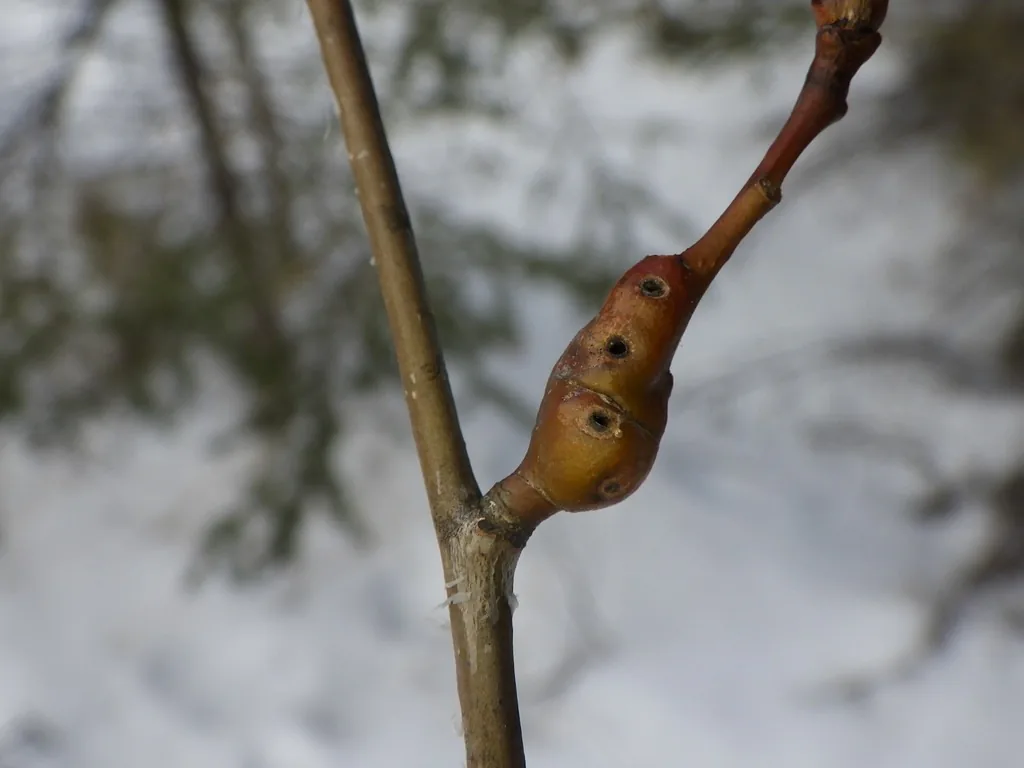
- Galls are smooth swellings on the current season's twigs and shoots and can form anywhere along them. Hidden by leaves, they are rarely noticed until leaves fall in autumn.[1][2]
- Adults are stout, shiny, dark flies about 1/6 inch long that rest and sun on leaves by day. The larva is a yellow-green maggot inside the gall.[1][2]
- Torn bark around a gall's exit hole is a sign that chickadees or other birds have been pulling out pupae.[1]
Where it lives
A native insect that has become much more common since the early 1980s. Problems first centered on the south Denver metro area and have since spread through Colorado and much of the Rocky Mountain region. Utah State's diagnostic lab recorded it in a Cache County, Utah, nursery on quaking aspen in 2011.[1][4]
Biology and life cycle
Full-grown maggots overwinter in the gall. CSU says they pupate in the gall in late winter or early spring and most pupae then drop to the ground; Utah State says they pupate in the gall or in the soil.[1][2]
Adults emerge as new growth forms, in April and May per Utah State. After mating, females insert eggs into developing twigs, and the larvae's feeding makes the twig swell. There is one generation a year.[1][2]
Sources differ on hosts. CSU says serious galling has been limited to aspen, with small numbers of galls on other poplars; Utah State lists poplar, cottonwood and aspen as hosts.[1][2]
Extension sources use the name Hexomyza schineri. The GBIF taxonomy backbone now treats that as a synonym of Euhexomyza schineri.[1][5]
Damage and signs
- Galled tissue keeps growing and is absorbed into the branch, ending up as swollen bands on branches and trunks. These are permanent disfigurements but don't seem to threaten tree health.[1][2][3]
- Galling is most common on younger aspen that put out lots of succulent new growth.[1]
- Cytospora canker occasionally starts at a gall, through the fly's exit hole or wounds made by birds, but CSU says the insect adds little to overall Cytospora canker.[1]
Health risk
It lives inside aspen and poplar twigs. None of the cited sources describes any risk to people or pets.[1][2]
Control
Prevention
Don't overwater or fertilize aspen. Slowing succulent growth slows gall formation.[1]
Sanitation
Pruning out galls often means removing a lot of branch and leaves wounds that can let disease in. Pruning late may remove mainly the galls holding the fly's parasitic wasps.[1]
Biological control
A small parasitic wasp, Eurytoma contractura, commonly kills 20 to 30 percent of the flies and more than 80 percent in some years; the wasps emerge about two weeks after the flies. Chickadees and other birds eat pupae in spring.[1]
Pesticides
Utah State says trees tolerate the galls, so treatment isn't needed. Sprays have worked poorly. CSU reports that a soil-applied systemic insecticide (imidacloprid) at bud break gave good control in nurseries, while Utah State says a systemic soil drench may give only some suppression, and the Colorado State Forest Service summary says there are no effective chemical controls to prevent the gall.[2][1][3]
Common questions
- What are the round knots on my aspen twigs?
- They're likely galls made by poplar twiggall fly larvae. The galls form on the current year's twigs and keep swelling for years.[1]
- Will twiggalls kill my aspen?
- No. CSU Extension says old galls disfigure trees but don't seem to threaten their health, and Utah State says trees tolerate them.[1][2]
- Should I prune out the galls?
- Usually not. CSU says pruning often removes a lot of branch, creates wounds that can let disease in, and late pruning may remove mainly the galls holding the fly's parasitic wasps.[1]
Sources
- Colorado State University Extension, “Poplar Twiggall Fly (Fact Sheet 5.579).” extension.colostate.edu/resource/poplar-twiggall-fly/ (accessed 2026-11-13)
- Utah State University Extension, “Poplar Twiggall Fly.” extension.usu.edu/planthealth/ipm/ornamental-pest-guide/arthopods/flies/poplar-twiggall-fly.php (accessed 2026-11-13)
- Colorado State Forest Service, “Common Insects & Diseases of Aspen.” csfs.colostate.edu/forest-management/common-forest-insects-diseases/common-insects-diseases-of-aspen/ (accessed 2026-11-13)
- Utah State University Extension, “Arthropod Samples in February 2011 (Utah Plant Pest Diagnostic Lab).” extension.usu.edu/planthealth/uppdl/recent-pests/2011/arth-feb-2011 (accessed 2026-11-13)
- Global Biodiversity Information Facility (GBIF), “Euhexomyza schineri (Giraud, 1861) (GBIF Backbone Taxonomy).” api.gbif.org/v1/species/10876010 (accessed 2026-11-13)