On this page
How to identify it
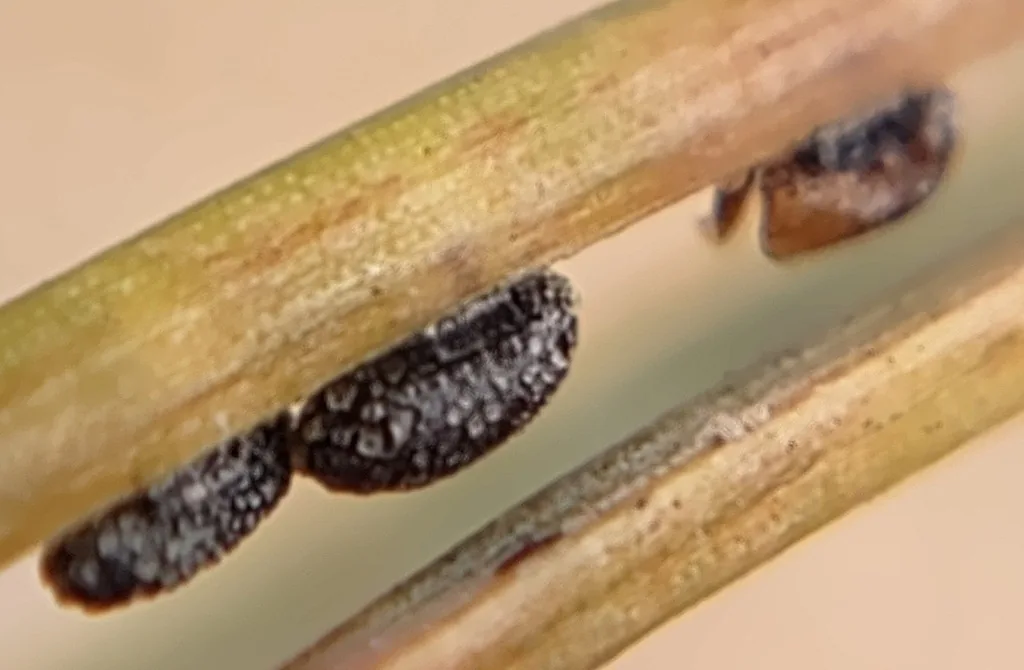
- On the needles it spends the winter as small, black, bean-shaped nymphs, easiest to see in fall. Sizes differ: about 0.5 mm in Arizona Extension's account, 1.5 mm in Utah State's.[5][2][1][4]
- In late winter and spring, look for white, cottony wax, which NMSU likens to dryer lint, at the base of the trunk, in branch crotches, under large branches and in bark cracks. Eggs are laid inside it.[3][6][4][5]
- The mobile adult females are yellowish. Males are tiny winged insects with waxy tails that look like gnats.[2][3]
Where it lives
It is native and attacks pinyon, singleleaf pinyon and foxtail pine across the Southwest. NMSU reports it in forest piñons across New Mexico, but most damaging infestations there are in towns, where trees are stressed by limited water and rooting space and by soil compaction.[1][4][3][6]
Biology and life cycle
Overwintering nymphs finish developing in spring. Females leave their black cases, walk down to twigs, branches and trunks and gather in the cottony wax to mate and lay eggs. NMSU puts this between February and April, earlier in southern New Mexico; Colorado State says mating begins in early April. NMSU says the males spend the winter in the duff under the tree.[5][3][6]
Crawlers climb back to the branch tips and settle on the previous year's needles. Second-stage nymphs form in late summer and stay through winter. There is one generation a year.[5][3]
Damage and signs
- It feeds on year-old needles, which yellow, die and drop, leaving a tufted or lion-tailed look. Utah State says new needles can be much shorter than normal.[4][5][3][1]
- Sources differ on how deadly it is. Arizona and Utah State say repeated attacks frequently kill small trees, and NMSU's scale guide says large populations can kill pinyon unless treated, while a New Mexico State Forestry specialist quoted by NMSU says it rarely kills trees. All agree weakened trees are more likely to be hit by pinyon ips and other bark beetles.[1][4][2][3][5]
Health risk
It feeds on pinyon sap. Arizona, NMSU, Utah State and Colorado State Extension describe tree damage only and don't mention any risk to people or pets.[1][3][4][5]
Control
Prevention
Keep valued trees watered and avoid compacting the soil. Colorado State says pinyon doesn't grow well above 7,500 feet and suggests avoiding overwatering and clay soils.[6][5]
Beat branches over a white dishpan to see whether scales are active. NMSU says control is a yearly job, with no once-and-done fix.[6]
Traps and physical control
NMSU's main advice is a power shower: while the scales are active, hose the tree hard from top to bottom, let it drip about 20 minutes, then rake up and bag what falls, and repeat. The aim is to keep numbers down, not wipe the scale out.[6]
Pesticides
Sources disagree on sprays. Colorado State says no treatment has been shown to work reliably, though trunk sprays of dinotefuran or imidacloprid in early spring, when the scales mass on trunks, may help. NMSU lists horticultural oil, insecticidal soap (not dish detergent), dinotefuran and imidacloprid when showers aren't possible, and warns some can burn new growth.[5][6]
Common questions
- Why does my pinyon have only tufts of needles at the tips?
- That thinning is the first sign of pinyon needle scale.[1][4][5]
- What is the white cotton at the base of my pinyon?
- Probably pinyon needle scale females gathering to mate and lay eggs. Rake up and bag the wax and hose the tree down while the scale is active.[3][6][5]
- Will pinyon needle scale kill my tree?
- It can, especially small trees, though a New Mexico State Forestry specialist quoted by NMSU says it rarely does. The bigger risk is that weakened trees draw pinyon ips.[1][4][3]
Sources
- University of Arizona Cooperative Extension, “Pinyon Needle Scale (AZ1315, revised December 2011).” extension.arizona.edu/publication/pinyon-needle-scale (accessed 2026-11-13)
- New Mexico State University Cooperative Extension Service, “Scale Insects & Their Relatives (Guide O-#07, Sutherland, 2006).” plantclinic.nmsu.edu/documents/o-07-scaleinsects.pdf (accessed 2026-11-13)
- New Mexico State University Cooperative Extension Service, “Southwest Yard & Garden: Piñon needle scale, part 1 (March 2, 2019).” swyg.nmsu.edu/2019/030219.html (accessed 2026-11-13)
- Utah State University Extension, “Scale Insects (landscape insects slideshow, 2007).” extension.usu.edu/planthealth/files/slideshows/insects-landscape/07sh-insects-scales.pdf (accessed 2026-11-13)
- Colorado State University Extension, “Pinyon Pine Diseases and Insects.” extension.colostate.edu/resource/pinyon-pine-diseases-and-insects/ (accessed 2026-11-13)
- New Mexico State University Cooperative Extension Service, “Southwest Yard & Garden: Piñon needle scale, part 2 (March 9, 2019).” swyg.nmsu.edu/2019/030919.html (accessed 2026-11-13)
- Global Biodiversity Information Facility (GBIF), “Matsucoccus acalyptus Herbert, 1921 (GBIF Backbone Taxonomy).” api.gbif.org/v1/species/2080255 (accessed 2026-11-13)
- iNaturalist, “Matsucoccus acalyptus taxon page (order and family).” www.inaturalist.org/taxa/484384 (accessed 2026-10-06)