On this page
How to identify it
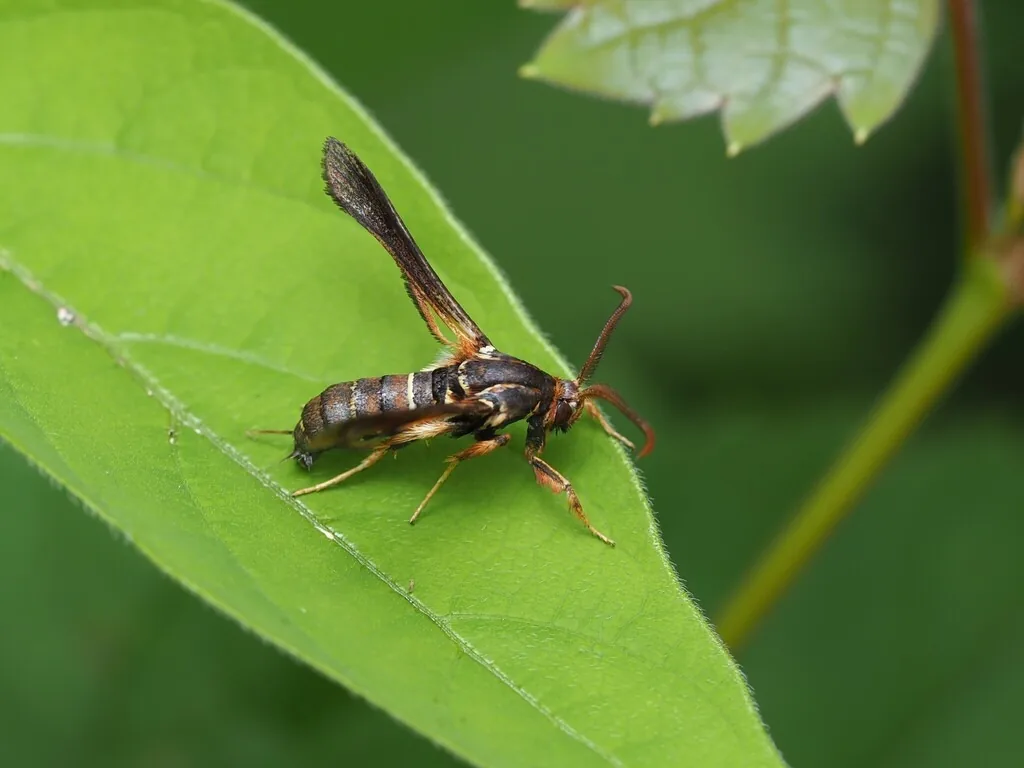
- Adults are day-flying clearwing moths that mimic paper wasps. The body is brown with narrow yellow bands on some abdominal segments, the legs and antennae are orange marked with dark brown, the forewings are dark and the hind wings clear.[1][3]
- Grown larvae are white to cream with a brown head. Kentucky gives up to 1 1/2 inches and Virginia Tech about 25 mm, roughly 1 inch.[1][3]
Look-alikes
| Look-alike | How to tell them apart |
|---|---|
| Paper wasps | The moth resembles some paper wasps, and males even fly like wasps.[1] |
| Squash vine borer | Shows up in grape root borer traps. It's heavier and fuzzier, with heavy red-orange bands on the abdomen, lots of red on the legs and greenish wings.[3] |
Where it lives
It feeds on wild and cultivated grapes and rootstocks in the eastern U.S. Kentucky calls it potentially the most destructive grape insect in the state, and NC State calls it potentially the most significant grape pest in the Southeast.[6][1][2]
Biology and life cycle
Adults emerge from late June or early July, with Virginia's peak in the last two weeks of July. Females lay eggs on soil, leaves and weeds; Kentucky puts the average at 350 eggs and Virginia Tech at 300.[3][4][1]
Larvae usually feed for about 22 months, so the cycle takes two years. NC State gives one to two years, and Virginia Tech notes some studies found three.[1][3][2][5]
Most young larvae die before reaching roots. Kentucky puts losses at about 95 percent and Virginia Tech says only 1.5 to 2.7 percent get through that first stage, but those that do have very low mortality.[1][3]
Damage and signs
Health risk
It feeds on grapevine roots, and no cited source describes any risk to people or pets.[1][3][4]
Control
Prevention
In midsummer, look within about 18 inches of each vine base for empty pupal skins sticking out of the soil. Kentucky suggests acting when more than 5 percent of vines have them.[1][3]
Traps and physical control
Mounding soil around vine bases after larvae pupate keeps adults from digging out; Georgia cites cuts in emergence of up to 90 percent. It's labor intensive, and Virginia Tech says it doesn't suit shallow soils or hilly sites.[4][3]
Biological control
Virginia Tech calls mating disruption with pheromone dispensers by far the most effective tool against grape root borer, and Georgia says it works much better after two years of vineyard-wide use. The product has not been routinely available: Virginia Tech says it was unavailable in 2024, and the North Carolina Department of Agriculture lists the grape root borer mating-disruption product only on its emergency exemption list, with an expiration date of September 30, 2025.[3][4][9]
Insect-killing nematodes work in the lab and greenhouse, but Virginia Tech reports variable field results. Georgia notes they need moist soil and must be reapplied each year.[3][4]
Pesticides
EPA says chlorpyrifos food uses were cancelled except on 11 crops (alfalfa, apple, asparagus, tart cherry, citrus, cotton, peach, soybean, strawberry, sugar beet and wheat), and that since July 1, 2025 no one in the U.S. may legally use it on the cancelled crops; grapes are not on the list. Virginia Tech says chlorpyrifos was formerly the single insecticide registered against grape root borer, and that contact insecticides are ineffective against larvae underground. Kentucky's fact sheet describes a coarse spray around the vine base as adults begin to emerge without naming a product, and says to check with your county agent or regulatory official before using any pesticide.[8][3][1]
Where infestations show up
Sources disagree on how infested vines are spread out. Virginia Tech's fact sheet says they are usually scattered at random, while a Virginia study found pupal skins clustered within blocks.[3][5]
Across 48 Virginia blocks, soil moisture and the clay-to-sand ratio were the factors most tied to infestation.[6]
Good weed control under vines appears to help, since more larvae die on bare soil and fewer weeds means fewer egg sites.[3][4]
Where the sources disagree
Eggs per female: Kentucky gives an average of 350, Virginia Tech 300.[1][3]
Grown larva: Kentucky and Georgia say 1 1/2 inches, Virginia Tech about 25 mm (roughly 1 inch).[1][4][3]
Life cycle: Kentucky says larvae feed for 22 months over a two-year cycle, NC State gives one to two years, and Virginia Tech notes some studies found three.[1][2][3]
Adult flight: Kentucky says moths are active from July through early August, Virginia Tech puts peak numbers in the last two weeks of July, a Virginia study found most moths emerged in the three weeks from the third week of July to the first week of August, and NC State says activity likely does not begin in North Carolina until early July.[1][3][5][2]
Early losses: Kentucky says about 95 percent of larvae die before reaching roots, while Virginia Tech says only 1.5 to 2.7 percent survive the first stage.[1][3]
Where infested vines are: Virginia Tech's fact sheet says usually at random across a vineyard, while the Virginia study found pupal skins clustered within blocks;[3][5]
Nematodes: Kentucky and Georgia describe insect-killing nematodes applied as a drench as able to kill grape root borer larvae, while Virginia Tech says field results are variable.[1][4][3]
Common questions
Sources
- University of Kentucky Entomology (ENTFACT), “Grape Root Borer (ENTFACT-220).” entomology.mgcafe.uky.edu/ef220 (accessed 2026-11-13)
- NC State Extension, “Do It Yourself - Grape Root Borer Monitoring (March 2014) - Entomology.” entomology.ces.ncsu.edu/news/grape-root-borer-monitoring/ (accessed 2026-11-13)
- Virginia Tech, Virginia Fruit (Department of Entomology), “Grape root borer.” www.virginiafruit.ento.vt.edu/GRB.html (accessed 2026-11-13)
- University of Georgia Extension, “Grape Root Borer (Georgia Integrated Pest Management).” ipm.uga.edu/2025/10/06/graperootborer/ (accessed 2026-11-13)
- Environmental Entomology, 2014 (via PubMed), “Spatial distribution of grape root borer (Lepidoptera: Sesiidae) infestations in Virginia vineyards and implications for sampling (Rijal JP et al.) (abstract).” pubmed.ncbi.nlm.nih.gov/24709345/ (accessed 2026-11-13)
- Environmental Entomology, 2014 (via PubMed), “Effects of biotic and abiotic factors on grape root borer (Lepidoptera: Sesiidae) infestations in commercial vineyards in Virginia (Rijal JP et al.) (abstract).” pubmed.ncbi.nlm.nih.gov/25198500/ (accessed 2026-11-13)
- Global Biodiversity Information Facility (GBIF), “Vitacea polistiformis (Harris, 1854) (GBIF Backbone Taxonomy).” api.gbif.org/v1/species/10495733 (accessed 2026-11-13)
- U.S. Environmental Protection Agency, “Chlorpyrifos (Ingredients Used in Pesticide Products; last updated August 24, 2026).” www.epa.gov/ingredients-used-pesticide-products/chlorpyrifos (accessed 2026-11-13)
- North Carolina Department of Agriculture and Consumer Services, “Structural Pest Control and Pesticides: Emergency Exemption List.” www.ncagr.gov/divisions/structural-pest-control-and-pesticides/product-registration/emergency-exemption-list (accessed 2026-11-13)