On this page
How to identify it
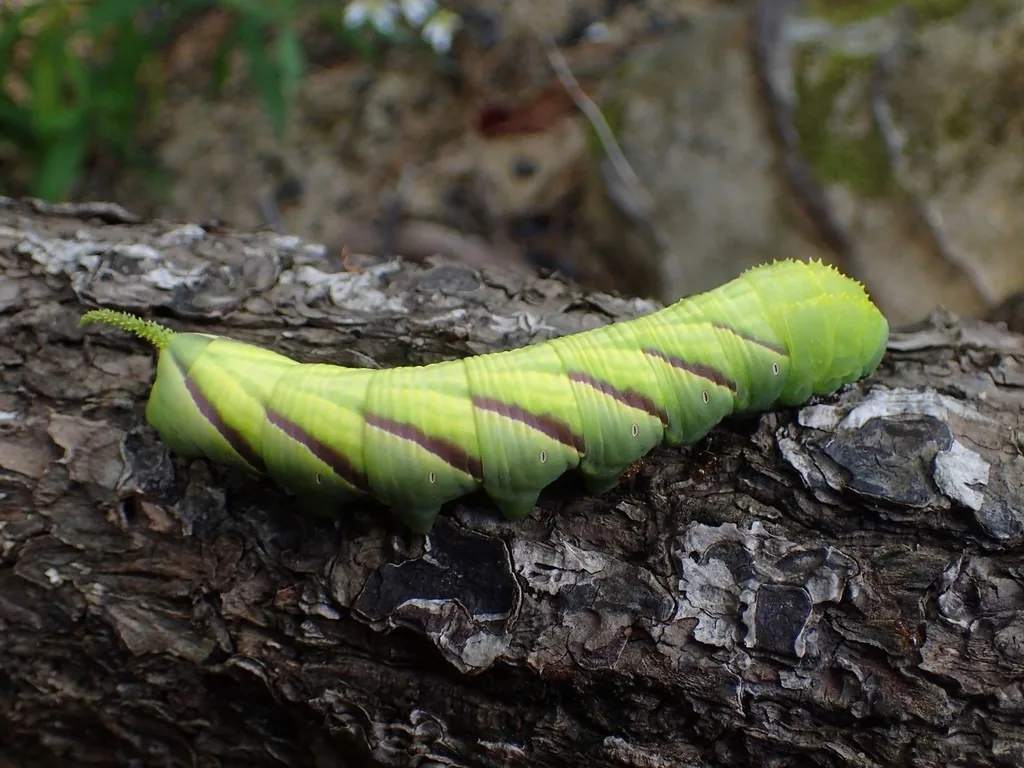
- Caterpillars are bright green with white to yellow diagonal stripes bordered above with darker green to purple-black, and grow up to about 3 inches long. UF/IFAS says the caterpillars closely resemble the more common tobacco hornworm and keep the same color pattern through every stage until the last.[1][3]
- The tail horn is covered in tiny bumps, which help tell it from other hornworms; the head and upper thorax are bumpy too. When disturbed, caterpillars often hold on and rear up their head and thorax in a 'sphinx' pose. UF/IFAS says the horn's granules help separate it from hornworms with a smooth horn, and that caterpillars often rest in a 'sphinx position,' rear end flat against the stem and head end curved up, named for the Great Sphinx.[1][3]
- Just before pupating, the top of the caterpillar turns light reddish brown. UF/IFAS says this color change is most likely camouflage as the caterpillar crawls down or drops to the ground to pupate.[1][3]
- The moths are heavy-bodied, with forewings mottled and zigzagged in black, white and brown and three pairs of yellow spots on the abdomen. NC State gives the wingspan as 3 1/2 to almost 6 inches; BAMONA gives 3 7/16 to 5 15/16 inches (8.7 to 15 cm). UF/IFAS says the mottled wings resemble tree bark, the brown abdomen has black lines and white marks with yellow-orange edging mostly visible in flight, the underside is white to cream, and the body is densely covered with short hairs.[1][2][3]
- The pupa has a maxillary loop that is typical of the genus. UF/IFAS says it forms in a chamber just under the soil surface with an arched top and flat bottom, 2 to 3 cm (3/4 to 1 1/8 inch) larger than the pupa.[3]
Look-alikes
| Look-alike | How to tell them apart |
|---|---|
| Tomato and tobacco hornworms | It belongs to the same genus as the tomato and tobacco hornworms. Its horn, head and upper thorax are covered in tiny bumps, and its listed hosts are mostly shrubs, vines and trees such as beautyberry, fringe tree and jasmine. UF/IFAS says the caterpillar closely resembles the tobacco hornworm (Manduca sexta) and that the granules on its horn are the useful difference.[1][2][3] |
Where it lives
BAMONA gives its range as Virginia to south Florida and west through Arkansas and Texas to southern New Mexico, Arizona and southern California, south through Central America to Uruguay, with strays to Maine, Massachusetts and New York. GBIF holds U.S. records from more than 30 states, most from Texas, Arizona, California, Florida and New Mexico, including smaller numbers from Pennsylvania, New Jersey and Utah outside that range. UF/IFAS calls it native to the southeastern United States, from southern Florida north to Virginia and west to Arkansas, Texas, New Mexico, Arizona and southern California, south to Argentina, with individuals found as far north as Maine.[2][4][3]
Biology and life cycle
Females lay one to five eggs on the undersides of host leaves, and a large female can lay up to 2,000 eggs. Caterpillars hatch about four days later and feed for about three weeks.[1]
Mature caterpillars tunnel into the soil and pupate in a cavity; moths emerge about three weeks later, and the last generation of the year overwinters as pupae.[1]
NC State reports at least two generations a year in North Carolina and several broods from May to October farther south. BAMONA lists several broods from May to October in Louisiana and two broods from July to November elsewhere in its range.[1][2]
The moths feed late at night on nectar from deep-throated flowers such as petunia and moonflower, and studies have recorded them visiting long-tubed hawk moth flowers in the American Southwest and carrying cactus pollen in Brazil. UF/IFAS lists it as a pollinator of shoals spider lily, woodland spider lily, common evening primrose and large-flowered evening primrose, and of some orchids, notably Habenaria johannensis.[1][2][5][6][3]
Damage and signs
- NC State lists American beautyberry, ash, basil, butterfly bush, crape myrtle, cross vine, desert willow, forked bluecurls, fringe tree, gardenia, heliotrope, jasmine, lantana, ligustrum, lilac, olive, sesame and sunflower as hosts; BAMONA adds bushy matgrass (Lippia alba), anacua (Ehretia anacua) and Bignonia species. UF/IFAS adds Bignonia, heliotrope and Trichostema to the host list.[1][2][3]
- Large caterpillars can strip foliage, but outbreaks are sporadic. UF/IFAS reports it defoliating trees on commercial olive farms in Florida, only the second report of it as a pest of a cultivated crop; the first was damage to sesame in Venezuela.[1][3]
Health risk
None. The horn is harmless.[1]
Control
Traps and physical control
Hand-pick caterpillars when many are feeding on one plant.[1]
Biological control
A tiny parasitic wasp, Cotesia congregata, develops inside the caterpillars and spins small white cocoons on their backs; it and other predators and parasites can greatly limit populations. UF/IFAS also notes Cotesia congregata as a natural enemy of the rustic sphinx in Florida.[1][3]
Pesticides
Because it is a sporadic pest, don't spray preventively; if needed, any insecticide labeled for landscape use should control it.[1]
Where the sources disagree
Southern limit: BAMONA gives its range south through Central America to Uruguay, while UF/IFAS says south to Argentina.[2][3]
Common questions
- What is the big green caterpillar with a horn on my beautyberry?
- Likely a rustic sphinx hornworm; American beautyberry is one of its listed hosts.[1]
- Does the hornworm's horn sting?
- No, it is harmless.[1]
- Should I kill caterpillars covered in little white cocoons?
- Leave them. The cocoons belong to a parasitic wasp whose larvae developed inside the caterpillar, and NC State says these parasites can greatly limit hornworm numbers.[1]
- Is the rustic sphinx moth a pollinator?
- Yes. UF/IFAS lists it as a pollinator of shoals and woodland spider lilies, common and large-flowered evening primrose and some orchids; the moths feed on nectar at dusk and in the evening.[3]
- Do rustic sphinx caterpillars damage olive trees?
- They can. UF/IFAS reports them defoliating trees on commercial olive farms in Florida, though NC State calls it a sporadic pest overall.[3][1]
Sources
- NC State Extension, “Rustic Sphinx (PDIC Factsheet).” content.ces.ncsu.edu/rustic-sphinx (accessed 2026-11-14)
- Butterflies and Moths of North America (BAMONA), “Rustic sphinx, Manduca rustica (Fabricius, 1775).” www.butterfliesandmoths.org/species/Manduca-rustica (accessed 2026-11-14)
- University of Florida/IFAS Extension (Featured Creatures), “Rustic Sphinx, Manduca rustica (Fabricius), EENY-652/IN1134.” ask.ifas.ufl.edu/publication/IN1134 (accessed 2026-11-14)
- Global Biodiversity Information Facility (GBIF), “Manduca rustica: occurrence records in the U.S., 1990-2026 (GBIF occurrence search).” api.gbif.org/v1/occurrence/search?taxonKey=1864021&country=US&hasGeospatialIssue=false&occurrenceStatus=PRESENT&year=1990%2C2026&facet=stateProvince&facetLimit=400&limit=0 (accessed 2026-11-14). State counts are records reported (iNaturalist research-grade, museum specimens, surveys), not abundance.
- Proceedings of the National Academy of Sciences USA, via PubMed, “Grant V, Grant KA (1983), Hawkmoth pollination of Mirabilis longiflora (Nyctaginaceae), Proceedings of the National Academy of Sciences USA 80(5):1298-1299.” pubmed.ncbi.nlm.nih.gov/16593287/ (accessed 2026-11-14). Cited from the PubMed abstract.
- Plant Biology, via PubMed, “Ferreira BHS et al. (2018), Pollination and reproductive system of synchronopatric species of Cactaceae (Cactoideae) subject to interspecific flow of pollen, Plant Biology 20(1):101-112.” pubmed.ncbi.nlm.nih.gov/28977737/ (accessed 2026-11-14). Cited from the PubMed abstract.
- iNaturalist, “Manduca rustica taxon page (order and family).” www.inaturalist.org/taxa/126568 (accessed 2026-11-14)