On this page
How to identify it
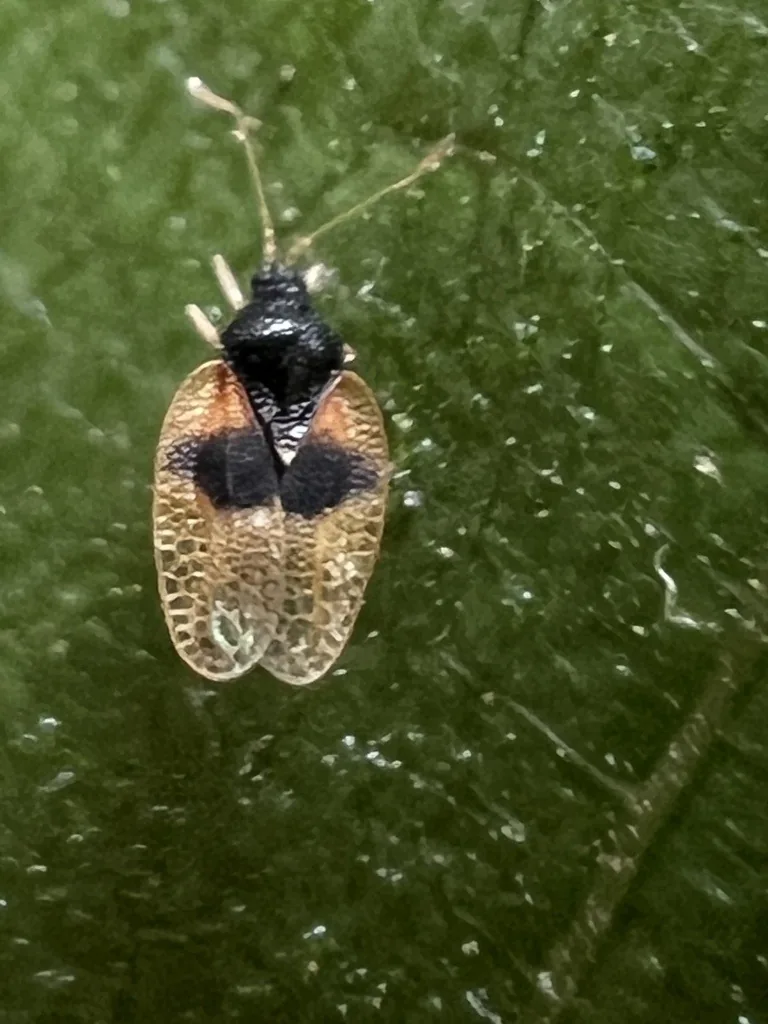
- Adults are about 1/12 inch (2 mm) long and oval, with a lacy, expanded thorax and wing covers; see where the sources disagree on their coloring.[1][3]
- Eggs hide under black, sticky globs of excrement on leaf undersides and look like grains of black pepper.[1]
- Nymphs are mostly black or dark brown with spiny projections and pale legs and antennae.[1]
- In adult males the fourth antennal segment is much darker than in females.[4]
Look-alikes
| Look-alike | How to tell them apart |
|---|---|
| Other lace bugs | Most lace bug species feed on only one or a few closely related plants; on avocado, camphor tree or red bay, a lace bug is likely this one.[1] |
| Thrips and mites | Avocado thrips cause irregular bronzing or brown scars on both sides of leaves, and thrips also scar fruit, which lace bugs don't feed on. Mites, salt damage and sunburn can also discolor leaves; salt burn starts at leaf tips and edges, while lace bug blotches sit between the veins.[1] |
Where it lives
UC IPM lists the Caribbean, French Guiana, Mexico and the southeastern United States; UC Riverside names Florida, Georgia and Texas, Bermuda, Cuba, the Dominican Republic, Jamaica, Puerto Rico and the U.S. Virgin Islands. It was first found on backyard avocado trees south of San Diego in September 2004; since 2017 damaging populations have turned up in commercial avocado groves in San Diego and Riverside Counties, and it is now established in Hawaii.[1][3][5][2]
Biology and life cycle
Hosts are plants in the laurel family: avocado and other Persea species such as red bay, and camphor tree.[1]
Development from egg to adult takes about 3 weeks in warm weather and several months in cool weather. A lab study estimated it needs about 476 degree-days to develop.[1][4]
Nymphs feed for about two to three weeks before becoming adults; see where the sources disagree on how many nymphal stages there are.[3][1][4]
There are several generations a year, and all stages can be present year round. At 32°C, females in the lab laid an average of about three eggs a day over a 69-day span.[1][4]
On backyard trees in San Diego County, UC Riverside found numbers tended to build in July and peak around September, then stay low from January through May.[3]
Damage and signs
- Colonies make faint pale green to yellow blotches, then large brown dead patches; black specks of excrement show under the leaf. Badly damaged leaves dry out, may curl and drop early.[1]
- Lace bugs don't feed on fruit, but heavy leaf loss sunburns limbs and fruit and reduces later yields. In Hawaii, infestations are linked to yield decline. Severe damage hasn't been reported on camphor trees.[1][2]
- UC Riverside says feeding damage is suspected of letting in leaf anthracnose fungi (Colletotrichum), and that the dead patches look like salt tip-burn except that they are islands inside the leaf surrounded by living tissue.[3]
Health risk
UC IPM, UC Riverside and the USDA-ARS and UC Riverside studies describe a leaf-feeding pest of avocado and don't mention any risk to people or pets.[1][3][2][4]
Control
Prevention
Low populations don't damage trees and feed predators, so tolerate them. Confirm lace bugs before acting, since other problems look similar. Keep trees healthy with good drainage, a thick organic mulch under the canopy and correct irrigation, and don't move avocado or camphor plants out of infested areas.[1]
Biological control
Lacewing larvae, lady beetles, jumping spiders, predatory thrips and predatory mites eat lace bugs. No parasites of avocado lace bug are known in California, and searches in its native range have not found egg parasitoids to bring in. See where the sources disagree on how much predators help.[1][3][2]
Pesticides
Don't spray low populations. If damage is expected, insecticidal soap, narrow-range oil or the fungus Beauveria bassiana give temporary control when sprayed thoroughly on leaf undersides. A systemic insecticide may work best, but only use a product whose label lists avocado or fruit trees. Don't spray drought-stressed trees or in heat over 90°F.[1]
In a USDA-ARS study in Hawaii, an azadirachtin (neem) soil drench on avocado seedlings gave an 85% to 98% chance of nymph death in the first week, compared with 14% on untreated trees, and mortality stayed higher for 3 to 6 weeks.[2]
How it reached California and Hawaii
Genetic work by UC Riverside found that the lace bugs in southern San Diego County are almost all the type first detected in 2004, while the populations found in commercial groves from 2017 on are a second type known from Florida and the Caribbean. California was invaded twice.[5]
Hawaii's lace bugs are the same second type, so Hawaii and the newer California populations may share a source, possibly Florida, or California may have been the stepping stone to Hawaii.[5]
Where the sources disagree
Nymphal stages: UC IPM says nymphs molt about five times; the 2025 UC Riverside lab study found four nymphal stages, not five as earlier reported.[1][4]
Adult coloring: UC IPM describes a dark head and thorax with both dark and light areas on the abdomen, antennae, legs and wing covers; UC Riverside's invasive species page describes black bodies with yellow legs and antennae.[1][3]
Spread in California: UC IPM (information as of 2006) and UC Riverside's invasive species page say it is limited to San Diego County, on backyard trees and not in commercial groves; the 2025 genetic study reports damaging populations in commercial groves in San Diego and Riverside Counties from 2017 on.[1][3][5]
Predators: UC Riverside says research found green lacewing larvae to be the most effective natural enemies; UC IPM says buying and releasing predators is unlikely to be very effective; the Hawaii study says the islands lack biological control agents, so management there relies on pesticides.[3][1][2]
Systemic insecticides: UC IPM says a systemic insecticide may give the most effective control with little harm to natural enemies, and a 2010 California field trial found imidacloprid applied through irrigation built up enough in older leaves to control lace bugs. The 2026 Hawaii study notes that many synthetic systemic soil drenches are toxic to nontarget animals and limited in how often they can be applied.[1][6][2]
Common questions
- Why do my avocado leaves have yellow blotches and black specks underneath?
- Avocado lace bug colonies cause blotches and leave black, shiny excrement specks under the leaves.[1]
- Do lace bugs damage the fruit?
- Not directly; they don't feed on fruit. Heavy leaf drop can sunburn fruit and lower later yields.[1][2]
Sources
- University of California Statewide IPM Program, “Pest Notes: Avocado Lace Bug (Publication 74134).” ipm.ucanr.edu/PMG/PESTNOTES/pn74134.html (accessed 2026-11-13)
- Journal of Economic Entomology, via PubMed, “Azadirachtin soil drenches show increased mortality of avocado lace bug nymphs in Hawai'i with evidence of multiweek residual activity (Bosch and Acebes-Doria, USDA-ARS, 2026).” pubmed.ncbi.nlm.nih.gov/41240355/ (accessed 2026-11-13)
- University of California, Riverside, Center for Invasive Species Research, “Avocado Lace Bug, Pseudacysta perseae (text by Mark Hoddle).” cisr.ucr.edu/invasive-species/avocado-lace-bug (accessed 2026-11-13)
- Annals of the Entomological Society of America, via PubMed, “The effects of fluctuating temperatures on degree-day development and life history parameters of Pseudacysta perseae (Dadlani, Milosavljevic and Hoddle 2025).” pubmed.ncbi.nlm.nih.gov/40093986/ (accessed 2026-11-13)
- Journal of Economic Entomology, via PubMed, “Range expansion by avocado lace bug, Pseudacysta perseae: a reassessment of population genetic structure reveals evidence for a second invasion into California (Dadlani, Gebiola, Rugman-Jones, Mauck and Hoddle 2025).” pubmed.ncbi.nlm.nih.gov/39928404/ (accessed 2026-11-13)
- Pest Management Science (Society of Chemical Industry), “Field evaluation of systemic imidacloprid for the management of avocado thrips and avocado lace bug in California avocado groves (Byrne et al. 2010, Pest Management Science 66:1129-1136), abstract.” pubmed.ncbi.nlm.nih.gov/20623704/ (accessed 2026-11-13)
- Global Biodiversity Information Facility (GBIF), “Pseudacysta perseae (Heidemann, 1908) (GBIF Backbone Taxonomy).” api.gbif.org/v1/species/2020729 (accessed 2026-11-13)
- iNaturalist, “Pseudacysta perseae taxon page (order and family).” www.inaturalist.org/taxa/623080 (accessed 2026-10-06)