On this page
How to identify it
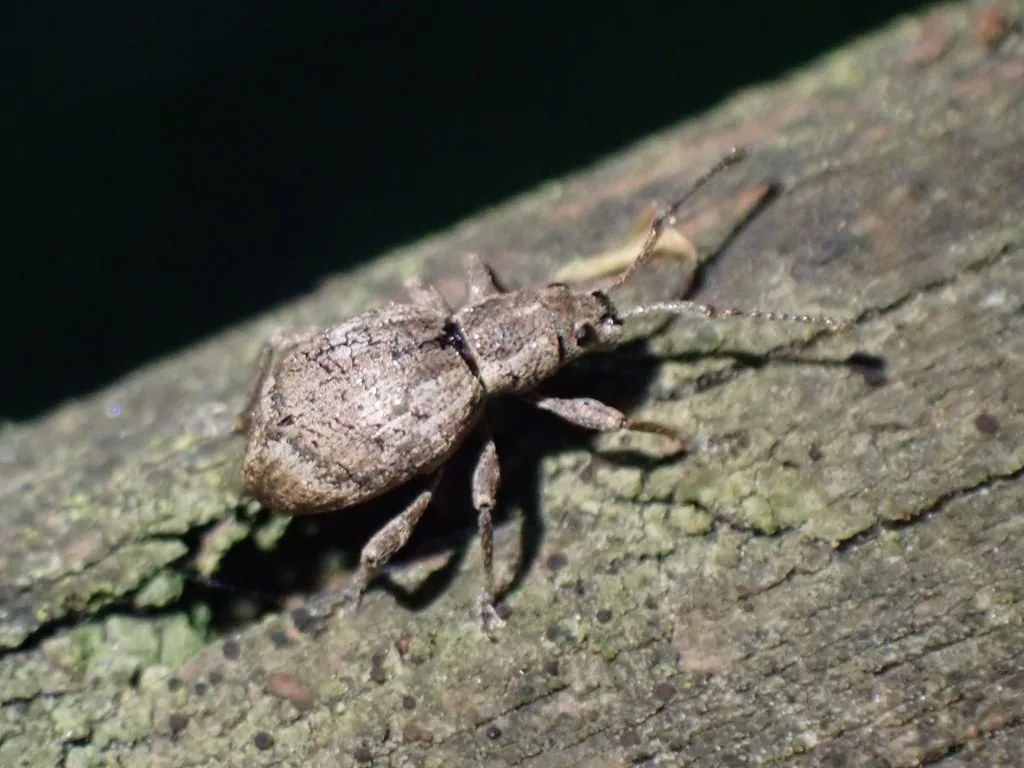
- Adults are gray to brown with a wavy brown line across the wing covers near the rear; see where the sources disagree on size and color.[1][2][3]
- Adult feeding leaves notches along leaf edges, which the PNW handbook says to watch for in early summer.[1][4]
- Larvae are legless white grubs with brown heads, and WSU says larvae of all root weevil species look very similar.[2]
Look-alikes
| Look-alike | How to tell them apart |
|---|---|
| Strawberry root weevil | Their larvae look alike and have similar life cycles; obscure root weevil adults are gray with a wavy brown line across the wing covers. The B.C. blueberry guide says both are about half the size of the black vine weevil.[1][4] |
Where it lives
Oregon State's 1984 review says adult root weevils, notably this one, are the most serious problem west of the Cascades in Oregon and Washington, north into British Columbia and south into California, on rhododendrons, viburnums, roses, salal and many other plants. The PNW handbook and the B.C. government cover it on blueberries.[3][1][4]
Biology and life cycle
The PNW handbook says larvae overwinter in the soil, may feed through mild winters, and pupate from April to June.[1]
Adults can't fly; they walk or ride on equipment, and the PNW handbook says all are females that can lay hundreds of eggs. WSU says this is why spread across a planting from nearby salal or huckleberry thickets, or from one infested plant, can take years.[1][2]
Many stay in the foliage by day and feed at night, though some hide in the soil or debris by day; there's one generation a year. Oregon State says it stays active in much cooler weather than the black vine weevil.[1][3]
Damage and signs
Health risk
It feeds on plants. The PNW handbook, WSU, Oregon State and the B.C. blueberry guide describe plant damage only and don't mention any risk to people or pets.[1][2][3][4]
Control
Prevention
Check foliage with a flashlight on warm, still nights, shake plants over a white sheet, or set out cardboard trunk wraps or boards on the soil and check under them for hiding weevils.[1][4]
Cultivating soil in April and May before planting can kill overwintering larvae, and small grains aren't hosts. The B.C. guide suggests a cereal cover crop for 12 to 16 months before planting blueberries in an infested field, and weevil-free planting stock.[1][4]
Some rhododendrons resist adult feeding; WSU says species rhododendrons are generally more resistant than hybrids.[2]
Traps and physical control
WSU suggests a band of sticky material around the trunk to keep night-feeding adults from climbing into the foliage; it works less well where taller plants overhang the shrub.[2]
Biological control
Beneficial nematodes (Heterorhabditis and Steinernema) drenched into the root zone have shown some effect on larvae; the PNW handbook says to apply in fall, and WSU says late summer to early fall when soil is 52 °F or warmer.[1][2]
Pesticides
The PNW handbook's blueberry listing has no products registered for home-garden control, and WSU says no insecticides are registered for general control of root weevil larvae.[1][2]
Where the sources disagree
Size and color: the PNW handbook says adults are mostly gray and 6 to 8 mm long; WSU says brown and 5 to 7 mm; Oregon State says grayish-tan and 5 to 6.5 mm.[1][2][3]
Adult season: the PNW handbook says adults emerge from April to June; WSU says they begin emerging in August and are most numerous from August to October.[1][2]
Where eggs go: the PNW handbook says in clusters in or on the soil from June to September. Oregon State says this species lays eggs in the folded tip of a leaf, unlike black vine and strawberry root weevils, which lay at the base of the plant.[1][3]
Which stage does the harm: the PNW handbook says adults do little leaf damage while larvae feed on roots, and the B.C. guide calls larvae the most damaging stage. WSU says root feeding is usually serious only in potted nursery stock or very sandy soil, and in landscapes it's the adults' leaf notching that's objectionable.[1][4][2]
Common questions
- What is notching my blueberry leaves at night?
- Likely obscure root weevils or other root weevils, which feed on foliage at night; check with a flashlight on a warm, still evening.[1][4]
- Do beneficial nematodes work on obscure root weevil?
- They've shown some effect on larvae when drenched into the root zone; the PNW handbook says in fall and WSU says late summer to early fall with soil at 52 °F or warmer.[1][2]
Sources
- Pacific Northwest Pest Management Handbooks (OSU, WSU, University of Idaho), “Blueberry: Obscure root weevil (Insect Management Handbook).” pnwhandbooks.org/insect/small-fruit/blueberry/blueberry-obscure-root-weevil (accessed 2026-11-13)
- Washington State University Extension (Extension Bulletins), “Root Weevil Control on Rhododendrons (EB0970E).” wpcdn.web.wsu.edu/wp-ecommerce/uploads/sites/2/product-4116-sku-EB0970E.pdf (accessed 2026-11-13)
- Oregon State University, Department of Horticulture, “Root Weevils in Review (Ornamentals Northwest Archives, Vol. 8, Issue 1; J. L. Green, 1984).” agsci.oregonstate.edu/sites/agscid7/files/horticulture/osu-nursery-greenhouse-and-christmas-trees/onn080121.pdf (accessed 2026-11-13)
- Government of British Columbia, Ministry of Agriculture and Food, “Blueberry production guide: Weevils (clay coloured, black vine, obscure and strawberry root weevils).” www2.gov.bc.ca/gov/content/industry/agriculture-seafood/animals-and-crops/crop-production/berries/berry-production-guides/blueberry (accessed 2026-11-13)
- Global Biodiversity Information Facility (GBIF), “Sciopithes obscurus Horn, 1876 (GBIF Backbone Taxonomy).” api.gbif.org/v1/species/10708834 (accessed 2026-11-13)
- iNaturalist, “Sciopithes obscurus taxon page (order and family).” www.inaturalist.org/taxa/366563 (accessed 2026-10-06)