On this page
How to identify it
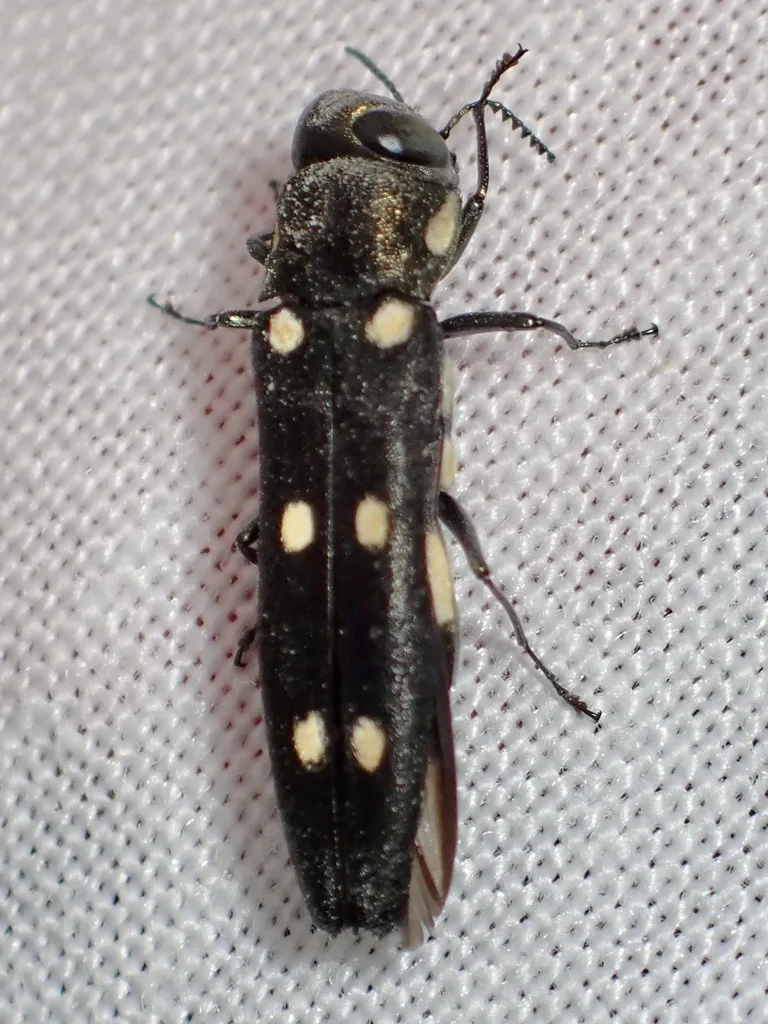
- Adults are bullet-shaped beetles about 10 mm long, black or iridescent green, with six gold spots on the wing covers and two on the thorax.[3]
- On the tree, look for thinning crowns, dark stains on the trunk, bark flaked off by woodpeckers, and D-shaped exit holes about 4 mm wide, mostly in the lower 10 feet of the trunk. UC IPM treats the D-shaped holes as the sign that confirms it; staining and thinning alone can have other causes.[3]
- Larvae are white and legless with two pincer-like spines at the tail, found only by cutting deep into bark.[3]
Where it lives
It is native to southeastern Arizona, where museum records date to the late 1800s. UC IPM says it most likely came to California in oak firewood from southeastern Arizona or northern Mexico; UC ANR points to Arizona and notes only a related species in southern Mexico and northern Guatemala. UC ANR knows of no oak deaths linked to it outside California.[3][1]
Biology and life cycle
It attacks only oaks, mostly the red oak group: coast live oak and California black oak, plus canyon live oak. Engelmann oak is attacked only rarely and doesn't seem to be seriously hurt.[3][4]
It prefers mature trees; oaks 18 inches or more in trunk diameter are the most likely to die.[3]
Larvae feed under the bark at the wood surface, girdling the cambium.[3]
Adults emerge from mid-May to September, with the peak from late June to early July, and must feed on oak leaves before laying eggs. UC IPM puts that feeding period at about two weeks and the Forest Service at about 10 days. There is one generation a year.[3][4]
A study of oak trunks found more exit holes on red oaks than on white oaks. On California red oaks it outnumbered native borers about two to one; in Arizona it didn't.[5]
Damage and signs
Health risk
UC IPM and CDFA discuss it only as a killer of oaks and don't describe a health risk to people or pets. UC IPM does warn that severely infested trees that are dying can drop limbs, a hazard to people and structures, and that dead oaks add fire fuel around buildings.[3][6]
Control
Prevention
Don't carry oak firewood out of an infested area. UC ANR says larvae keep developing in logs and firewood from recently killed trees, and the Forest Service's California message is to buy firewood where you burn it.[7][8][3]
When to call a professional
UC ANR advises insecticide only for lightly damaged, high-value trees or to protect uninfested ones. Trees with moderate to severe damage are unlikely to be saved and should be removed, with the wood treated so it doesn't spread the beetle.[7]
The products most likely to work aren't sold to homeowners in California and must be applied by a state-licensed, county-registered applicator, so hire a pest control professional who has treated it before.[7][3]
How far it has spread
UC ANR lists satellite infestations in Riverside County in 2012, Orange County in 2014, Los Angeles County in 2015, a second Orange County site in 2017, San Bernardino County in 2019 and 2020, and Ventura County in 2025. It credits most of these to people moving infested firewood.[2]
In San Bernardino County the beetle was found in dying California black oaks around Oak Glen in 2018, near Big Bear and Wrightwood in 2019, and at Forest Falls in 2020.[2]
Flight mill tests suggest it can't fly long distances across country without oaks, which fits the idea that people carried it from Arizona and between California sites. The Forest Service gives a maximum tethered flight of about 0.9 mile and expects slow natural spread but fast human-aided spread.[9][4]
UC ANR asks that sightings of goldspotted oak borer and other invasive forest pests in new areas be reported to Cal Fire forest entomology and pathology staff, the California Department of Food and Agriculture or the county agricultural commissioner.[10]
The Forest Service maps potential habitat, based on its oak hosts, north into Oregon and south into Mexico.[4]
CDFA's 2022 pest rating proposal said the beetle was not the subject of eradication efforts, that eradication did not appear practical, and proposed a B rating; it listed the beetle in Los Angeles, Orange, Riverside, San Bernardino and San Diego counties.[6]
The Orange County Agricultural Commissioner asks residents not to move firewood out of local areas, which it calls the primary way the beetle spreads widely, and to keep firewood local.[11]
Handling infested oak wood
Larvae finish developing in firewood-sized pieces, so cut oak can carry the beetle. Grinding to chips under 3 inches did best in trials, and both UC ANR and the Forest Service recommend it.[12][4][10]
Covering infested wood can keep emerging beetles in, but the sources differ on how well tarps work and for how long (see where the sources disagree).[4][12][10]
Stripping bark keeps beetles from coming out of the wood itself, but adults can still emerge from the removed bark and phloem. That material has to be screened, chipped, buried or burned.[12][4][10]
UC ANR says heat-treating firewood in a kiln is still being tested against this beetle, so there's no confirmed standard yet.[7]
For firewood, the Forest Service suggests seasoning wood from recently cut trees inside the infested zone for more than two years and keeping firewood within 50 miles of where it was cut. Its California region asks campers to leave firewood at home.[4][8]
Where the sources disagree
Maturation feeding: UC IPM says adults feed on oak leaves for about two weeks before reaching sexual maturity; the Forest Service says females need about 10 days.[3][4]
Adult size: UC IPM gives about 10 mm; CDFA's rating proposal about 9 mm.[3][6]
Where it came from: UC IPM says oak firewood from southeastern Arizona or northern Mexico; UC ANR points to southeastern Arizona and notes only a related species in southern Mexico and northern Guatemala; CDFA lists Arizona, California and Baja California Sur, Mexico.[3][1][6]
Covering wood: the Forest Service says stacks under thick, clear plastic with buried edges, kept intact from May to September, trap emerging adults; in the 2009 to 2011 trial, solarizing wood under thick or thin tarps did not significantly reduce emergence; UC IPM advises tarping or screening for at least two years, and UC ANR's handout full aluminum screening for 2 years.[4][12][3][10]
Trees killed: UC ANR gives an estimated 21,500 trees in San Diego County as of 2010; the Orange County Agricultural Commissioner says an estimated 80,000 oaks in San Diego County, and CDFA's 2022 proposal over 80,000 trees in California.[1][11][6]
Common questions
- What are the D-shaped holes in my oak bark?
- D-shaped exit holes, with bark staining and woodpecker damage, are classic goldspotted oak borer signs.[3]
- How does it spread?
- Adults fly, but not far. Long jumps to new counties have come from people moving infested oak firewood.[9][2][4]
- Can I move oak firewood out of an infested area?
- Agencies ask you not to. The Orange County Agricultural Commissioner asks people not to move firewood out of local areas, and the Forest Service's California region says to buy firewood where you burn it and to leave firewood at home when camping. CDFA's rating proposal says the beetle is suspected to have been brought to California in moved firewood.[11][8][6]
Sources
- UC Agriculture and Natural Resources, “About Goldspotted Oak Borer.” ucanr.edu/site/goldspotted-oak-borer/about-goldspotted-oak-borer (accessed 2026-11-13)
- UC Agriculture and Natural Resources, “Goldspotted Oak Borer Distribution Maps.” ucanr.edu/site/goldspotted-oak-borer/distribution-maps (accessed 2026-11-13)
- University of California Statewide IPM Program, “Pest Notes: Goldspotted Oak Borer (Publication 74163).” ipm.ucanr.edu/PMG/PESTNOTES/pn74163.html (accessed 2026-11-13)
- USDA Forest Service (Forest Insect & Disease Leaflets), “Goldspotted Oak Borer (FIDL 183).” www.fs.usda.gov/foresthealth/docs/fidls/FIDL-183-GoldspottedOakBorer.pdf (accessed 2026-11-13)
- Insects, 2014 (via PubMed), “Densities of Agrilus auroguttatus and Other Borers in California and Arizona Oaks (Haavik LJ et al.) (abstract).” pubmed.ncbi.nlm.nih.gov/26462589/ (accessed 2026-11-13)
- California Department of Food and Agriculture, “California Pest Rating Proposal: Agrilus auroguttatus Schaeffer, goldspotted oak borer (comment period 08/16/2022-09/30/2022; proposed rating B).” blogs.cdfa.ca.gov/Section3162/wp-content/uploads/2022/08/Agrilus-auroguttatus.pdf (accessed 2026-11-13)
- UC Agriculture and Natural Resources, “Goldspotted Oak Borer Management Options.” ucanr.edu/site/goldspotted-oak-borer/management-options (accessed 2026-11-13)
- USDA Forest Service, Pacific Southwest Region, “Firewood Movement (Pacific Southwest Region Forest Health).” www.fs.usda.gov/r05/natural-resources/forest-health/firewood-movement (accessed 2026-11-13)
- Journal of Economic Entomology, 2014 (via PubMed), “Assessing the flight capabilities of the goldspotted oak borer (Coleoptera: Buprestidae) with computerized flight mills (Lopez VM et al.) (abstract).” pubmed.ncbi.nlm.nih.gov/25026673/ (accessed 2026-11-13)
- UC Agriculture and Natural Resources, “Invasive Forest Pests and Pathways of Spread (zones of infestation handout, 2026).” ucanr.edu/sites/default/files/2026-06/Insect%20and%20Disease%20Pathways%20of%20Spread%20and%20Zones%20of%20Infestation%20-%20Final.pdf (accessed 2026-11-13)
- OC Agricultural Commissioner, County of Orange, California, “Current Threats (Goldspotted Oak Borer).” ocerac.ocpublicworks.com/service-areas/oc-environmental-resources/oc-agricultural-commissionersealer-weights-measures-35 (accessed 2026-11-13)
- Journal of Economic Entomology, 2013 (via PubMed), “Sanitation options for managing oak wood infested with the invasive goldspotted oak borer (Coleoptera: Buprestidae) in southern California (Jones MI et al.) (abstract).” pubmed.ncbi.nlm.nih.gov/23448037/ (accessed 2026-11-13)
- Global Biodiversity Information Facility (GBIF), “Agrilus auroguttatus Schaeffer, 1905 (GBIF Backbone Taxonomy).” api.gbif.org/v1/species/5878491 (accessed 2026-11-13)