On this page
How to identify it
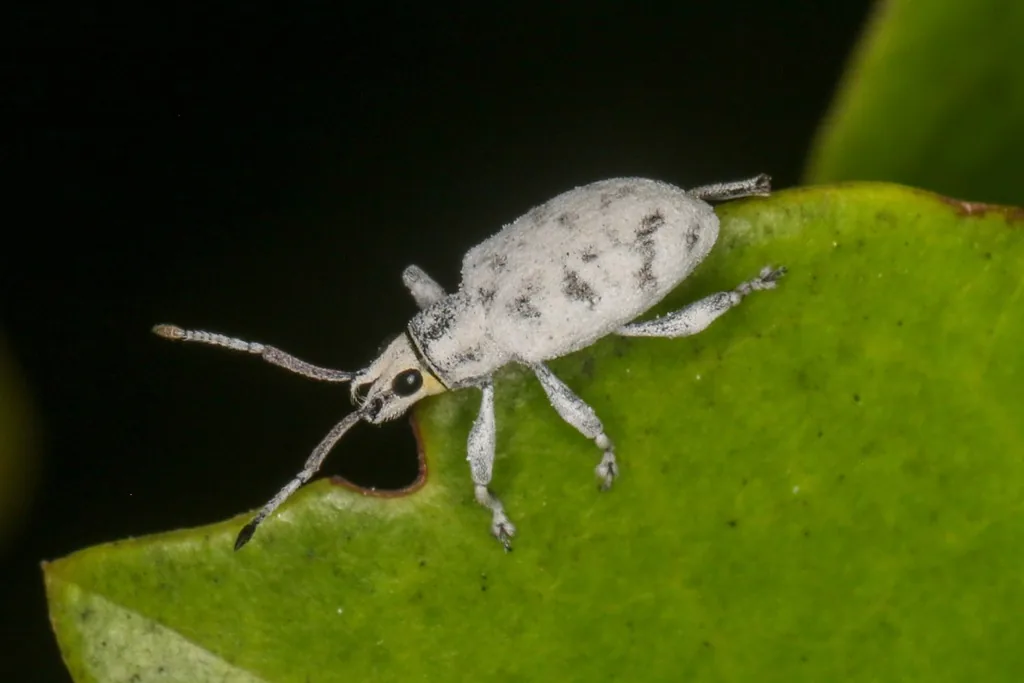
- Adults are about 6.0 to 8.5 mm long; females are 1.0 to 2.0 mm larger than males.[1]
- The body is mottled with dull white and black scales, often with yellowish scales on the snout and head. The wing covers carry large dark brown blotches, usually arranged in three irregular slanting bands, and the scale pattern varies among Florida populations.[2]
- Seen from above, the shoulders of the wing covers are strongly angled and stick out wider than the section behind the head. The thighs are toothed: two teeth on the front and middle legs and three on the hind legs. UF/IFAS lists the yellowish head and dark-mottled wing covers as further field marks.[2][6]
Look-alikes
| Look-alike | How to tell them apart |
|---|---|
| Little leaf notcher (Artipus floridanus) | UF/IFAS calls it the most similar weevil, but its thighs lack teeth, its shoulders aren't angled and its wing covers are grayish to white with smaller black marks.[6] |
Where it lives
Native to Sri Lanka. California's pest rating gives its native range as southern India, Sri Lanka and Pakistan, while a 2026 review treats this subspecies as the Sri Lankan form and its close relative as the southern Indian one. Outside its home range it has been reported from Southeast Asia, Africa, Australia and, in the U.S., Florida. It is not reported in California, although it was intercepted there six times between 2000 and March 2017, usually on nursery stock and plant parts from Florida. UF/IFAS says it was first detected in 2000, had been found in 12 Florida counties by May 2006, and Florida's Division of Plant Industry recorded it in 15 more counties after that; how it reached south Florida hasn't been determined.[2][1][6]
Biology and life cycle
Females of this genus can lay up to 360 eggs over a 24-day period. Eggs are under 0.5 mm, laid in clusters of 3 to 5 on organic matter at the soil surface, and turn from white or cream to brown before hatching 3 to 5 days later.[1]
Larvae feed on roots, while adults feed on leaves. UF/IFAS says larvae are beige-white with a reddish-brown head, grow from about 1.09 mm in the first instar to 4.0 mm in the fourth, feed on roots in the soil for about one to two months, and pupate in the soil for about a week.[1][2][6]
It is highly polyphagous. California's rating says it feeds on more than 80 plant species, including citrus, cotton, sweet potato, fig, loquat, plum, mango and mahogany, and a 2026 review counts host records in 17 plant families. UF/IFAS gives over 150 host species, among them citrus, green buttonwood, Hong Kong orchid tree, cocoplum, pygmy date palm, peach, crepe myrtle, pepper, lychee, strawberry tree and eggplant. Larval hosts are unclear, but larvae have been reared on pepper, eggplant, cotton, carrot and sweet potato roots.[1][2][3][6]
In south Florida it does most of the leaf damage on Surinam cherry (Eugenia uniflora), an invasive shrub from Brazil, and attacks a larger share of its leaves than those of native Eugenia species.[4]
Damage and signs
- Adults leave characteristic notches as they feed on leaves and can strip foliage; larvae injure roots. Damage is worst on young plants, and the pest can lower both crop yield and value. UF/IFAS says adults feed inward from the leaf edges and prefer new growth; heavy feeding can cause decline or stunting, young seedlings may not survive, and on healthy plants that recover the damage may be only cosmetic.[2][1][6]
- Its feeding is heavy enough to matter: on Surinam cherry in Florida it reduced stem height, survival and population growth. California's rating also reports Florida peach growers having a hard time managing the damage.[4][1]
Health risk
It feeds on plants; none of these sources describe any risk to people.[1][2]
Control
Traps and physical control
Shake a branch hard over an open, upside-down umbrella, then dump the weevils into a container of soapy water.[6]
Pesticides
UF/IFAS says many pesticides give only limited control: adults fly, hide or play dead and drop to the ground, and eggs, larvae and pupae in or on the soil are harder still to reach. Because recommendations change yearly, it advises checking with your local UF/IFAS Extension office.[6]
When to call a professional
There is little proven control: a 2020 study described it as a highly polyphagous pest with only a few control methods available and tested RNA-based treatments as a possible future option. For current advice on plants in your area, contact your county extension office.[3]
More from the California Department of Food and Agriculture
The California Department of Food and Agriculture rates the Sri Lankan weevil an A pest. It notes that the weevil spread from Sri Lanka into India and Pakistan, where it attacks more than 20 crops, and that the Republic of Korea lists it as a harmful organism.[1]
Where the sources disagree
Host range: California's rating gives more than 80 plant species and a 2026 review counts host records in 17 plant families; UF/IFAS gives over 150 plant species, including native, ornamental, vegetable and fruit plants.[1][2][6]
Common questions
- What's notching my citrus and hedge leaves in Florida?
- Sri Lankan weevils are one possible cause: adults notch leaves as they feed, and they feed on citrus and many other plants. In the U.S. they are known from Florida.[2][1]
- Is the Sri Lankan weevil found outside Florida in the U.S.?
- Florida is the only U.S. state CDFA lists. It is not reported in California, but inspectors there have intercepted it on nursery stock and plant parts shipped from Florida.[1]
- How can I get rid of them without spraying?
- Shake branches over an open, upside-down umbrella and drop the weevils into soapy water. UF/IFAS describes this as a way to remove adults from plants.[6]
Sources
- California Department of Food and Agriculture (Pest Ratings), “California Pest Rating: Sri Lankan Weevil | Myllocerus undecimpustulatus undatus.” blogs.cdfa.ca.gov/Section3162/?p=3824 (accessed 2026-11-11)
- ZooKeys, via PubMed Central, “Bridging biodiversity gaps: Updated taxonomy and diversity of Sri Lankan Myllocerus (Wijesinghe and Hong 2026).” pmc.ncbi.nlm.nih.gov/articles/PMC13354979/ (accessed 2026-11-11)
- Pest Management Science, via PubMed, “Delivery of gene-specific dsRNA by microinjection and feeding induces RNAi response in Sri Lanka weevil (Pinheiro et al. 2020).” pubmed.ncbi.nlm.nih.gov/31461216/ (accessed 2026-11-11)
- Ecology, via PubMed, “Herbivory by an introduced Asian weevil negatively affects population growth of an invasive Brazilian shrub in Florida (Stricker and Stiling 2012).” pubmed.ncbi.nlm.nih.gov/22928418/ (accessed 2026-11-11)
- iNaturalist, “Myllocerus undecimpustulatus taxon page (order and family).” www.inaturalist.org/taxa/55183 (accessed 2026-10-06)
- University of Florida IFAS Extension, EDIS (Featured Creatures), “Sri Lankan Weevil, Myllocerus undecimpustulatus undatus Marshall, EENY579/IN1016 (Featured Creatures).” ask.ifas.ufl.edu/publication/IN1016 (accessed 2026-11-14)