On this page
How to identify it
- Caterpillars reach about 1.5 inches (just under 4 cm) and have tufts of brown, black, yellow and sometimes white hairs.[1][2]
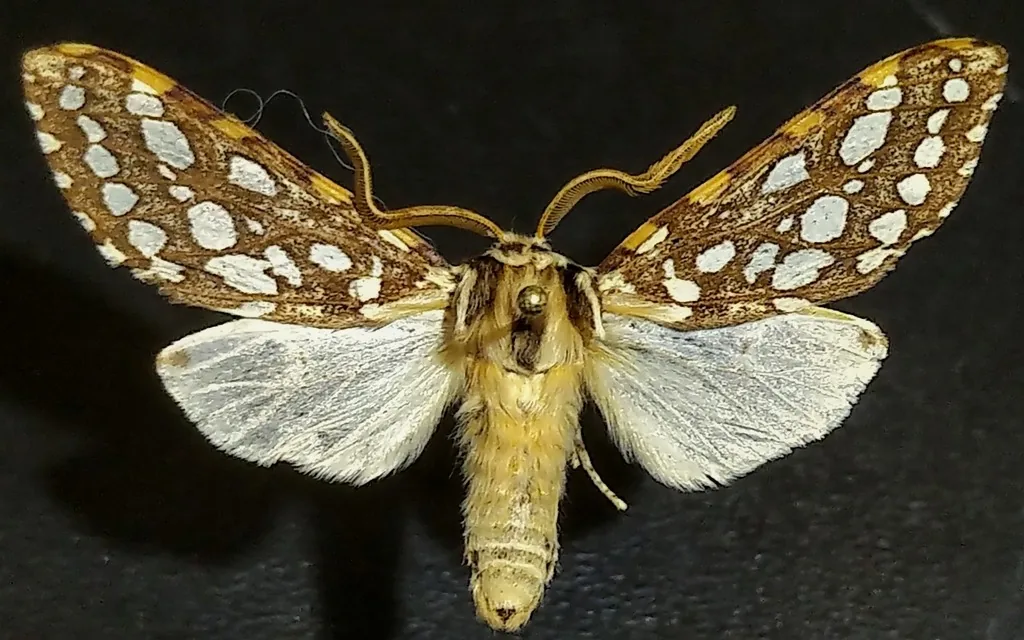
- Adults are tan to brown moths with a wingspan of up to about 2 inches and silvery spots on the forewings.[1][2][3]
- Eggs are round and green, laid in clusters on twigs and needles at branch tips.[1][2]
Where it lives
ODF says its range runs from Canada to northern Mexico and includes most states west of New Mexico.[2]
Biology and life cycle
Eggs are laid in July and August and hatch about three weeks later. The young larvae spin small webs at branch tips and overwinter in them, feeding on warm winter days.[2][1]
In spring they feed actively and then disperse to feed alone around May and June; in June, mature caterpillars often wander onto patios, decks and other plants looking for a place to spin cocoons.[2][1]
From June to August they spin brown cocoons of silk and shed hairs, attached to trees or litter. There's one generation a year, and the adults don't feed.[2][1]
Douglas-fir is the main host; true firs, spruce, pine and arborvitae are also attacked.[2][1]
Damage and signs
- Feeding usually strips only a few branches of needles. Buds and new growth are left alone, and the tree flushes normally the next spring.[2][1]
- Sources differ on how far it goes. The PNW handbook mentions reports of forest defoliation, while ODF says infestations usually hit a few scattered trees, don't spread or persist, collapse within one to two years, and aren't known to slow growth or kill trees.[1][2]
Health risk
The caterpillars are covered with tiny hairs that can cause a temporary allergic skin reaction with rashes or welts. Wear gloves if you handle them, and don't rub your eyes, because hairs can become painfully embedded in eye tissue.[2][1]
Control
Traps and physical control
The PNW handbook suggests pruning out and destroying tents with caterpillars, wearing gloves. ODF warns not to over-prune, since removing branches can do the tree more harm than the caterpillars.[1][2]
Biological control
Ophion parasitoid wasps and tachinid flies, including the large Tachinomyia similis, keep populations in check and can make them crash.[1][2]
ODF says spraying is rarely if ever warranted. For a high-value tree, it notes Bacillus thuringiensis kurstaki (Btk) has worked against young caterpillars with limited effects on other species. Follow the label.[2][3]
Should you worry about the tents?
Usually not. ODF says the damage is unsightly but cosmetic and short-lived, so control often isn't needed.[2]
Colorado State's Agricultural Biology department says tiger moth outbreaks on western conifers are infrequent, defoliation is minor and trees usually recover.[3]
Common questions
- What are the webs on my Douglas-fir branch tips in winter?
- Likely silver-spotted tiger moth caterpillars, which spend the winter in webs at the branch tips and feed on warm days.[1][2]
- Why are fuzzy reddish-brown caterpillars crawling on my deck in June?
- In June, grown caterpillars leave the tree to look for a spot to spin cocoons. Don't handle them bare-handed; their hairs can cause a rash.[1][2]
Sources
- Pacific Northwest Pest Management Handbooks (OSU, WSU, University of Idaho), “Douglas-fir (Pseudotsuga): Silver-spotted tiger moth (Insect Management Handbook).” pnwhandbooks.org/insect/hort/landscape/hosts-pests-landscape-plants/douglas-fir-pseudotsuga-silver-spotted-tiger-moth (accessed 2026-11-13)
- Oregon Department of Forestry (Forest Health Fact Sheets), “Silver-spotted Tiger Moth (Forest Health Fact Sheet, December 2017).” www.oregon.gov/odf/Documents/forestbenefits/SilverSpottedTigerMoth.pdf (accessed 2026-11-13)
- Colorado State University, Agricultural Biology, “Tent caterpillars.” agsci.colostate.edu/agbio/ipm-pests/tent-caterpillars/ (accessed 2026-11-13)
- Global Biodiversity Information Facility (GBIF), “Lophocampa argentata (Packard, 1864) (GBIF Backbone Taxonomy).” api.gbif.org/v1/species/1817727 (accessed 2026-11-13)
- iNaturalist, “Lophocampa argentata taxon page (order and family).” www.inaturalist.org/taxa/84792 (accessed 2026-10-06)