On this page
How to identify it
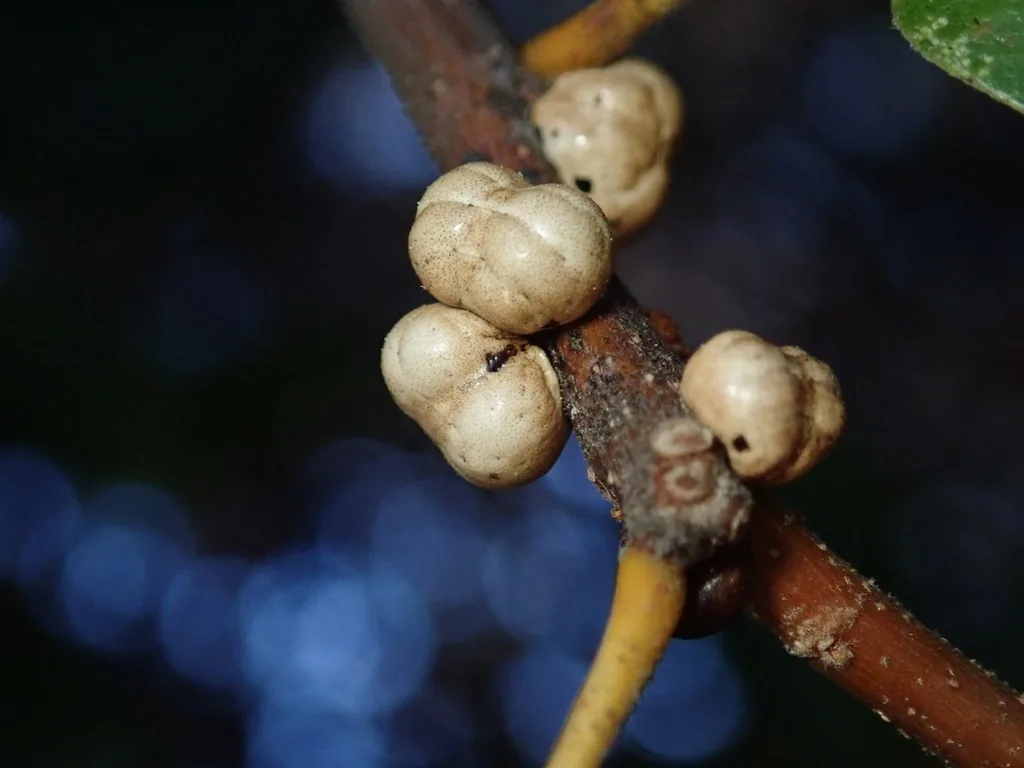
- Mature females are smooth and globular. Iowa State gives 1/8 to 1/4 inch across and UMass 3 to 6 mm; color runs from creamy white or light beige to brown or nearly black, depending on species. Colorado State likens them to small marbles.[1][2][3]
- Unlike real buds or galls, they pop off the twig easily.[1]
- They sit at twig crotches, near leaf axils and at the base of leaf stalks on new growth. UMass says they are easiest to spot from June through August, when the females are swollen.[2]
Look-alikes
| Look-alike | How to tell them apart |
|---|---|
| Oak galls and buds | Galls and buds are part of the twig. Kermes scales look much like them but come off the twig easily.[1] |
Where it lives
UMass counts about nine species in four genera in the Northeast and at least 32 species in five genera in North America. In Iowa the species on bur oak does the most damage, and Colorado State calls kermes a serious pest of pin and red oak.[2][1][3]
Biology and life cycle
Many kermes species have barely been studied, so life cycles are pieced together from a few. In Nanokermes pubescens, females lay eggs over about a month from late June, eggs hatch in early July, and crawlers spend the winter in bark cracks on the trunk before moving to new twigs in spring.[2]
Other species run later. In Allokermes kingii, eggs are laid in July and August and hatch in September, with one generation a year, and Colorado State describes eggs hatching in September and October.[2][3]
Once a female settles on a twig she stops moving and feeds on sap with piercing-sucking mouthparts. By early June the females swell and can be mistaken for small tan buds. Males mature on the trunk.[1][2]
Damage and signs
- Large numbers on new branches and leaves deform and stunt growth, and several scales on a single shoot can kill it.[1][2]
- The scales excrete honeydew, which coats surfaces below and can grow black sooty mold. UMass reports dead twigs and branches, slower tree growth and, with heavy infestations, some tree deaths.[2]
Health risk
It feeds on oak sap. None of the cited extension sources describes any risk to people or pets.[1][2][3]
Control
Traps and physical control
Prune off and destroy heavily infested branches.[2]
Biological control
Predators and parasites help keep numbers down. UMass lists Homalotylus wasps reared from male scales, a caterpillar (Euclemensia bassettella) that eats adult females, and twice-stabbed lady beetles that feed on young scales.[1][2]
Pesticides
Iowa State suggests treating only if scales stay a problem over several years, with a product labeled for kermes or soft scales: dormant oil before leaf-out, a contact insecticide while crawlers are active in spring, or a systemic insecticide.[1]
Sources differ on when to hit the crawlers. Iowa State targets them in spring, while Colorado State suggests fall sprays as crawlers move to winter sites. Colorado State adds that a systemic applied to the soil can take up to a year to control the scale.[1][3]
Checking an oak for kermes
Shiny, glossy leaves or objects under the tree, or black sooty mold on them, point to a sap-feeding insect overhead. Look on the twigs above for round scales.[2]
In winter, crawlers and males of Nanokermes pubescens can be found on the trunk.[2]
Common questions
- What are the round brown bumps on my oak twigs?
- Possibly kermes scales; unlike buds or galls they come off the twig easily.[1]
- Do kermes scales hurt oaks?
- Mostly by deforming and stunting new growth and killing some twigs, with bur oak hit hardest in Iowa. UMass notes slower growth and, rarely, tree death from heavy infestations.[1][2]
- When should kermes scale be treated?
- Iowa State suggests treating only if the problem lasts several years. Dormant oil goes on before leaf-out; crawler sprays are timed to spring by Iowa State and to fall by Colorado State.[1][3]
Sources
- Iowa State University Extension and Outreach (Yard and Garden), “Kermes Scale.” yardandgarden.extension.iastate.edu/encyclopedia/kermes-scale (accessed 2026-11-13)
- UMass Extension Landscape, Nursery and Urban Forestry Program (Landscape Insect & Mite Guide), “Allokermes spp. (Kermes Oak Scale).” www.umass.edu/agriculture-food-environment/landscape/publications-resources/insect-mite-guide/allokermes-spp (accessed 2026-11-13)
- Colorado State University Extension, “1400-11: Kermes Scale on Oak Trees (PlantTalk Colorado).” planttalk.colostate.edu/topics/insects-diseases/1400-11-kermes-scale-oak-trees/ (accessed 2026-11-13)
- Global Biodiversity Information Facility (GBIF), “Kermesidae (GBIF Backbone Taxonomy).” api.gbif.org/v1/species/8650 (accessed 2026-11-13)