On this page
How to identify it
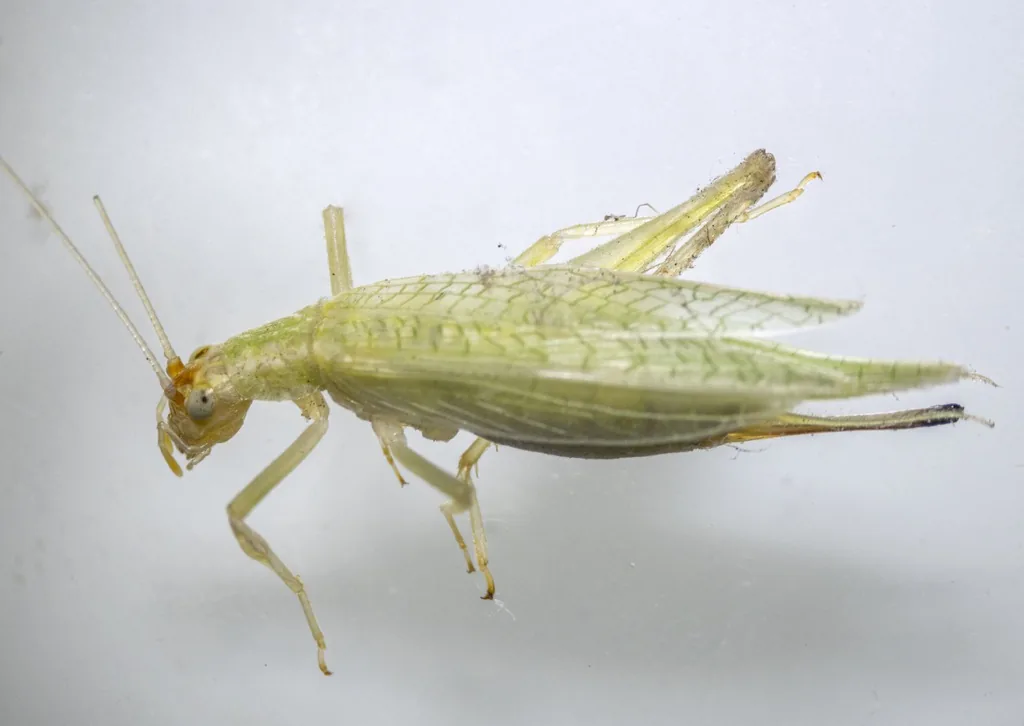
- Adults are frail, slender and light green to whitish. The PNW handbook gives a length of 12 to 20 mm; Utah State gives 15 to 18 mm and describes them as pale yellow or green.[1][3]
- The song is a very regular, melodious chirp. Utah State notes that only males chirp, rubbing their forewings together. Males have broad, paddle-like wings folded flat over the back, and females have narrower wings held close to the body.[1][3]
- Look for egg punctures in canes, often in straight parallel lines up and down the cane.[1]
Look-alikes
| Look-alike | How to tell them apart |
|---|---|
| Field crickets | Field crickets have stout bodies and are dark brown or black. Snowy tree crickets are pale yellow or green and more slender and elongated.[3] |
Where it lives
Extension sources from three regions cover it: Utah State reports snowy tree crickets throughout Utah, Michigan State writes about tree crickets, including this one, in Michigan yards and gardens, and the PNW handbook treats it as a caneberry insect in the Pacific Northwest.[3][2][1]
Biology and life cycle
Adults mate and females lay eggs in canes in early fall; eggs hatch in spring and young crickets grow through summer, maturing by early fall.[1]
There is one generation a year. In Utah adults are active from July to October and shelter in shrubbery, along the edges of clearings and in neglected fence rows.[1][3]
To lay an egg, the female digs a tiny hole with her ovipositor, puts the egg in and seals the hole. Utah State says she uses the bark or stems of fruit and ornamental trees, with apple, peach and cherry favored.[2][3]
Sources describe its diet differently. The PNW handbook calls it a generalist that feeds on the foliage of many plants, while Michigan State says tree crickets mainly eat other insects, such as aphids and scale, and MSU researchers have filmed them eating codling moth eggs.[1][2]
Damage and signs
- Canes can break where eggs were inserted, and disease can get in through the punctures. Even so, the PNW handbook says it isn't a common caneberry pest and isn't usually blamed for heavy damage.[1]
- In Michigan the egg wounds show up most often on fruit-tree twigs and grapevines and sometimes on berry bushes, and now and then they kill a twig.[2]
Health risk
None of the three Extension sources cited here describes any risk to people or pets; they treat it only as a garden and crop insect.[1][2][3]
Control
Prevention
Plantings near weeds, neglected fence rows or natural areas are most likely to be infested, since these give crickets food and shelter. Good weed management helps.[1]
Pesticides
Advice on spraying differs. The PNW handbook lists carbaryl and zeta-cypermethrin for home caneberry plantings, but Michigan State says the damage is seldom enough to justify pesticides, and Utah State says insecticides are not warranted for outdoor cricket control.[1][2][3]
A cricket that tells the temperature
Its chirps come faster as the air warms, which is why it is sometimes called the thermometer cricket. Michigan State's rule is to count chirps for 13 seconds and add 40 to get the temperature in degrees Fahrenheit.[2]
Utah State gives a slightly different version, known as Dolbear's Law: count the chirps in 12.5 seconds and add 38.[3]
Common questions
- What makes rows of tiny holes in my raspberry canes?
- Snowy tree crickets drill small egg holes, often in straight lines up and down the cane.[1]
- What cricket makes a steady, musical chirp at night?
- The snowy tree cricket is known for its very regular, melodious chirping.[1]
- Should I spray for snowy tree crickets?
- Usually not. Michigan State says the egg-laying damage seldom warrants pesticides and Utah State says outdoor insecticides aren't warranted, though the PNW handbook does list home-use products for caneberries.[2][3][1]
Sources
- Pacific Northwest Pest Management Handbooks (OSU, WSU, University of Idaho), “Blackberry and Raspberry: Snowy tree cricket (Insect Management Handbook).” pnwhandbooks.org/insect/small-fruit/blackberry-raspberry/blackberry-raspberry-snowy-tree-cricket (accessed 2026-11-13)
- Michigan State University Extension, “Michigan insects in the garden, Week 9: Tree crickets.” www.canr.msu.edu/news/michigan-insects-in-the-garden-week-9-tree-crickets (accessed 2026-11-13)
- Utah State University Extension and Utah Plant Pest Diagnostic Laboratory, “Crickets (ENT-129-08, Hodgson and Trina, 2008).” extension.usu.edu/planthealth/uppdl/files/factsheet/crickets_08.pdf (accessed 2026-11-13)
- Global Biodiversity Information Facility (GBIF), “Oecanthus fultoni Walker, 1962 (GBIF Backbone Taxonomy).” api.gbif.org/v1/species/1720949 (accessed 2026-11-13)