On this page
How to identify it
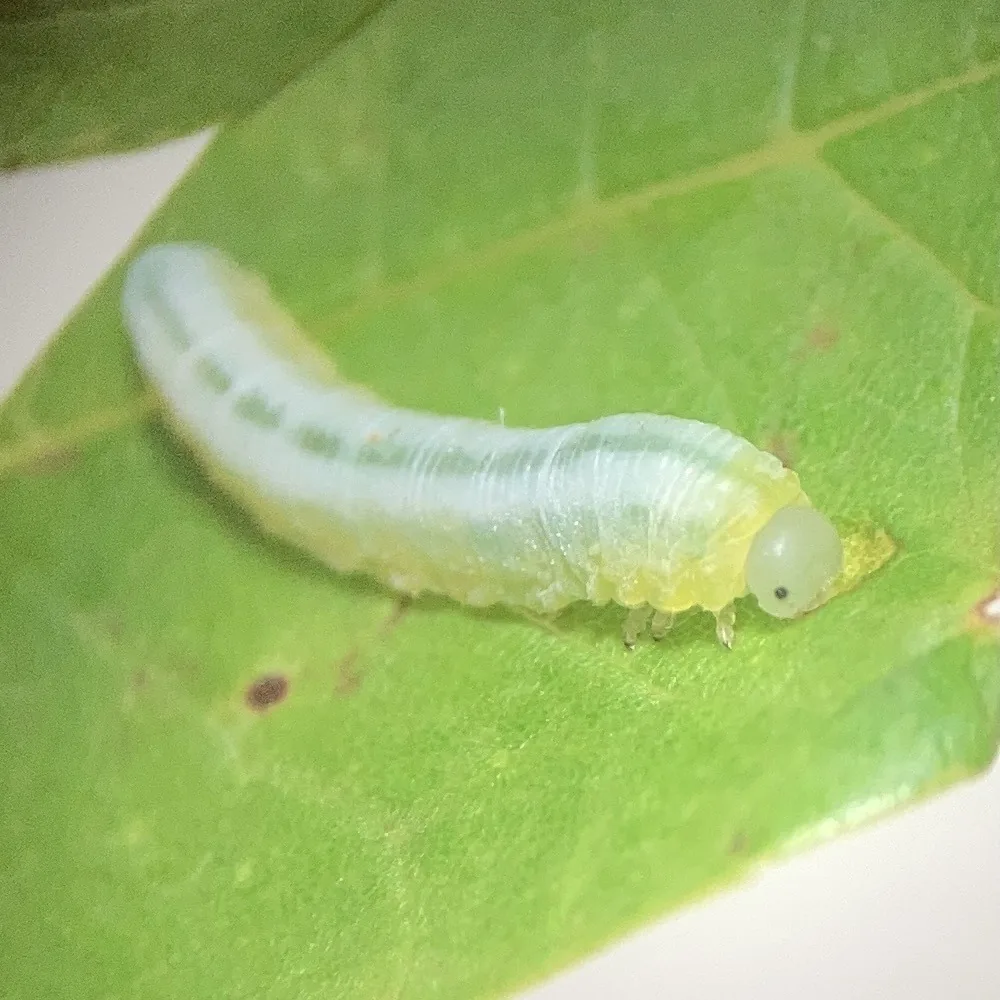
- Larvae are pale green or yellow-green with white and green stripes along the back. Sizes differ a little: NC State gives 1/2 to 7/8 inch when full grown, K-State 15 to 20 mm. NC State notes the head is only somewhat brown.[1][2][3]
- Young larvae leave small pinhole wounds inside the leaf; adults are small black wasps that don't sting.[1]
- They look like caterpillars, but K-State says sawfly larvae have prolegs on every abdominal segment and no hooks or hairs on those feet.[3]
- Full-grown larvae leave a papery shed skin stuck to the leaf, and heavy frass under the tree can be a sign of an infestation.[1][3]
Where it lives
Native to the eastern U.S., where it rarely causes concern, it appeared in Colorado's Arkansas Valley by the early 1980s and has since spread along the Front Range and onto the Western Slope. K-State calls it a sporadic pest of green ash.[1][3]
Biology and life cycle
Full-grown larvae overwinter in cocoons in the soil around previously infested ash trees and pupate in early spring. Adults emerge by late April, and swarms appear on warm days to mate; females insert eggs into the edges of expanding leaves, which can slightly distort them.[1][2]
Larvae finish feeding within two to three weeks of hatching; there's one generation a year.[1]
NC State says it feeds on green and white ash; K-State names green ash. When larvae are abundant, masses of them gather around the base of infested trees.[2][3]
Damage and signs
- During outbreaks larvae can strip a tree, and repeated heavy defoliation stresses it; wandering larvae can be a nuisance.[1][2]
- NC State says spring-defoliated trees in North Carolina usually regrow leaves, so long-term harm is small, but they may be briefly more open to emerald ash borer and other Agrilus borers.[2]
Health risk
It feeds on ash leaves, and the adults are nonstinging wasps; none of the CSU, NC State or K-State fact sheets mention a risk to people.[1][2][3]
Control
Prevention
Watch for pinholes early; healthy trees benefit from control only if at least 25 percent of foliage is threatened.[1]
Traps and physical control
On smaller trees a strong jet of water knocks many larvae off, and few climb back; K-State adds that scattered larvae are often eaten by birds.[1][2][3]
Biological control
Weather is the biggest natural check: CSU says late spring frosts and strong winds kill many larvae, and parasitic wasps attacking the pupae have helped along the Front Range.[1]
Pesticides
Insecticidal soap sprayed directly on the larvae works, and K-State lists several contact insecticides that need thorough canopy coverage. Bacillus thuringiensis (kurstaki) doesn't control sawflies, and CSU and NC State say neem doesn't appear effective either.[1][2][3]
More from NC State Extension
Full-grown larvae are 1/2 to 7/8 inch long, soft and pale green or yellow-green with white and green stripes down the back and a brownish head.[2]
Common questions
Sources
- Colorado State University Extension, “Brownheaded Ash Sawfly (Fact Sheet 5.586).” extension.colostate.edu/resource/brownheaded-ash-sawfly/ (accessed 2026-11-13)
- NC State Extension, “Brownheaded Ash Sawfly.” content.ces.ncsu.edu/brownheaded-ash-sawfly (accessed 2026-11-13)
- Kansas State University Research and Extension, “Brownheaded Ash Sawfly (MF3297).” bookstore.ksre.ksu.edu/download/brownheaded-ash-sawfly_MF3297 (accessed 2026-11-13)
- Global Biodiversity Information Facility (GBIF), “Tomostethus multicinctus (Rohwer) (GBIF Backbone Taxonomy).” api.gbif.org/v1/species/1249678 (accessed 2026-11-13)
- iNaturalist, “Tomostethus multicinctus taxon page (order and family).” www.inaturalist.org/taxa/851506 (accessed 2026-10-06)