On this page
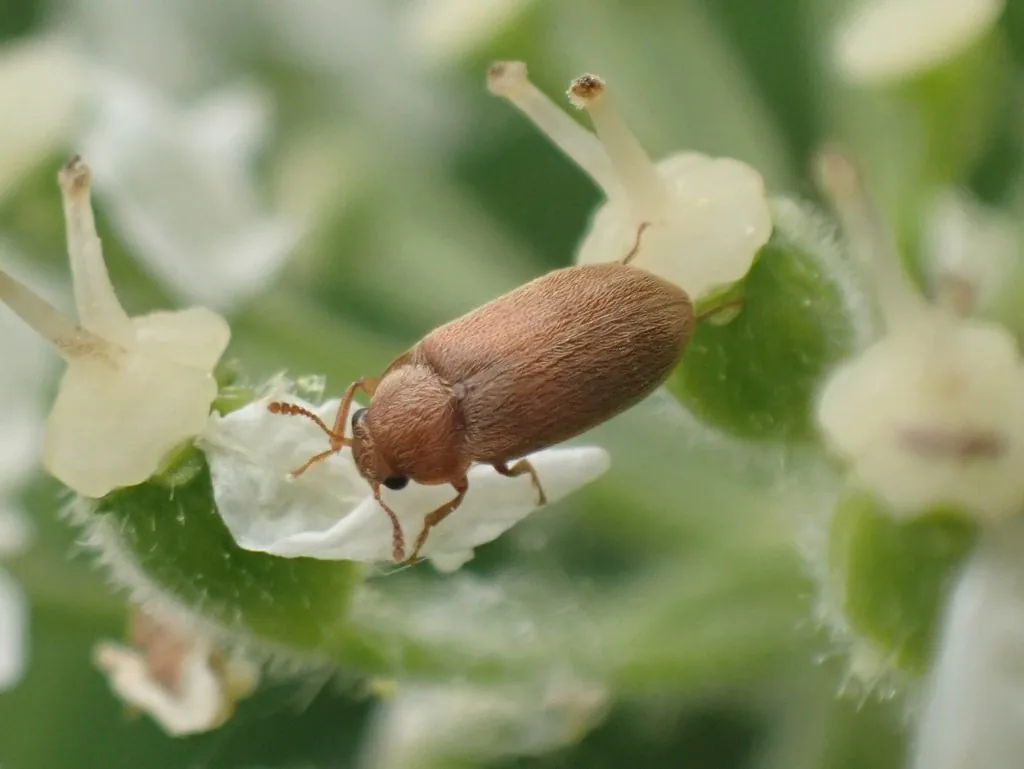
How to identify it
Where it lives
The PNW Insect Management Handbook covers it on raspberries and blackberries in the Pacific Northwest. WSU says it attacks raspberries and loganberries and also breeds on wild blackberries, thimbleberries and salmonberries.[1][2]
Biology and life cycle
Adults overwinter in the soil and emerge in late April or May to feed and lay eggs on flower buds or stems.[1]
Larvae work to the center of the fruit and feed for 30 days or more, then drop to pupate in the top 3 inches of soil; there's one generation a year.[1]
Damage and signs
Health risk
It feeds on cane berries, and no cited source describes any risk to people or pets.[1][2]
Control
Prevention
Scout for adults on new leaves and young blossoms in spring, before the flowers open. They are hard to see, and a hand lens helps.[1][2]
Sanitation
WSU suggests controlling weeds and nearby wild brambles, which are alternate hosts, and cultivating around plants in late summer to early fall to kill larvae and pupae in the soil.[2]
Traps and physical control
WSU suggests handpicking adults, which are most active in early evening, or tapping the canes over a beating tray in the cool of morning or evening, since adults drop when disturbed.[2]
Pesticides
Sources differ on home sprays. The PNW Insect Management Handbook says no products are available for home garden use. WSU HortSense lists spinosad and pyrethrin products legal for home use in Washington, applied when buds begin to swell and separate and again just before bloom, because larvae inside the fruit aren't affected. Follow the label.[1][2]
More from WSU Extension
WSU HortSense describes the adults as yellow-brown beetles about 1/6 inch long that overwinter in the soil and come out in April or May to feed on unfolding leaves, flower buds and flowers, leaving slits between the leaf veins; injured blossoms often become malformed berries. The white, brown-patched larvae, about 1/3 inch when grown, feed in the berry core for a month or more, then drop to pupate in the top 3 inches of soil, with one generation a year. It also breeds on wild blackberries, thimbleberries and salmonberries, and because adults drop when disturbed they can be caught on a beating tray held under the canes.[2]
More from the research literature
A 2001 DNA study found the American raspberry beetle is split into at least three distinct genetic groups and is more closely related to a Japanese Byturus species than to the European raspberry beetle, suggesting its lineage came from Asia and colonized the western United States.[4]
Common questions
Sources
- Pacific Northwest Pest Management Handbooks (OSU, WSU, University of Idaho), “Blackberry and Raspberry: Raspberry beetle (aka western raspberry fruitworm) (Insect Management Handbook).” pnwhandbooks.org/insect/small-fruit/blackberry-raspberry/blackberry-raspberry-raspberry-beetle-aka-western-raspberry-fruitworm (accessed 2026-11-13)
- Washington State University Extension (HortSense), “Raspberry: Raspberry beetle (raspberry fruitworm).” hortsense.cahnrs.wsu.edu/fact-sheet/raspberry-raspberry-beetle-raspberry-fruitworm/ (accessed 2026-11-13)
- Global Biodiversity Information Facility (GBIF), “Byturus unicolor Say, 1823 (GBIF Backbone Taxonomy).” api.gbif.org/v1/species/1043755 (accessed 2026-11-13)
- Insect Molecular Biology (via PubMed), “Phylogeny of raspberry beetles and other Byturidae (Coleoptera) (Malloch et al., 2001) (abstract).” pubmed.ncbi.nlm.nih.gov/11437920/ (accessed 2026-11-13)