The short answer
- The sticky stuff is honeydew from aphids, soft scales, whiteflies, mealybugs, leafhoppers or psyllids feeding above the sticky spot.[1][2]
- The black coating is sooty mold. It doesn't infect the plant, but a heavy layer blocks sunlight and can stunt growth.[1][2]
- To fix it, find and manage the insects making the honeydew; the mold can be washed off with a strong stream of water or soap and water.[1][4]
Profiles of honeydew-making insects
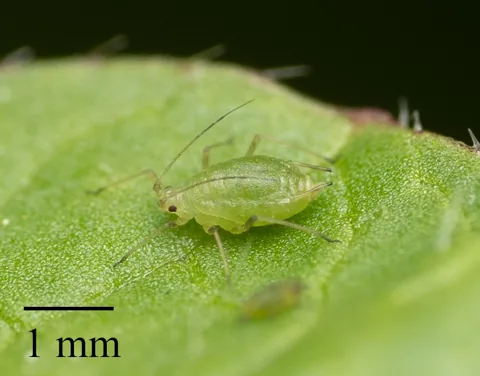 Aphids
Myzus persicae
Aphids are small, soft-bodied insects that pierce tender stems and leaves and suck out plant sap. Almost every plant hosts at least one aphid species, but established plants usually tolerate them, treating aphids for the plant's health is usually unnecessary, and natural enemies often bring numbers down.
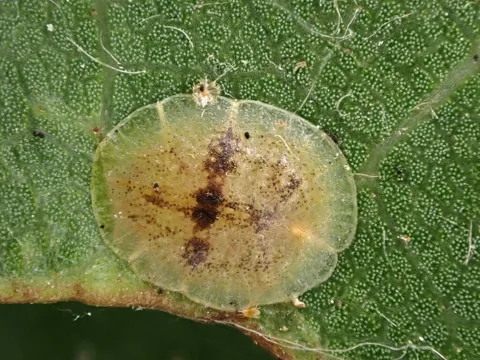 Scale Insects
Superfamily Coccoidea (representative: brown soft scale, Coccus hesperidum)
Scales are small sap-sucking insects that settle on the bark, leaves or fruit of trees, shrubs and houseplants and rarely look like insects at all. Most plants tolerate low to moderate numbers, but heavy infestations cause yellowing, leaf drop and dieback, and the soft scales drip sticky honeydew.
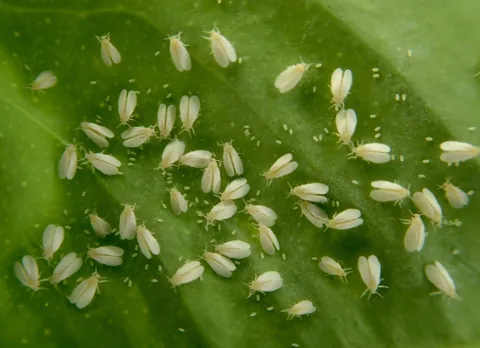 Whiteflies
Trialeurodes vaporariorum
Whiteflies are tiny sap-sucking insects that build large colonies on leaf undersides, especially in warm weather. Outbreaks usually follow disruption of their natural enemies, and heavy infestations are hard to control, so prevention matters most.
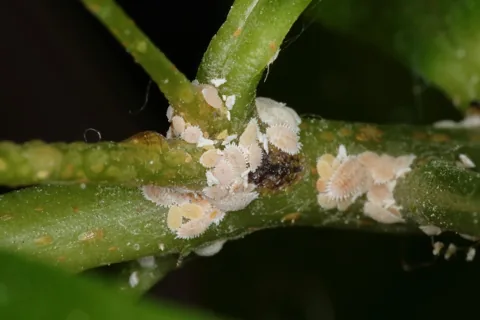 Mealybugs
Planococcus citri
Mealybugs are soft, oval insects covered in white wax that suck sap from houseplants and outdoor plants. They thrive indoors and where winters are mild, and their wax and hiding habits make them hard to reach with sprays.
Clues and the likely culprit
Honeydew drips onto whatever is below the insects: leaves, fruit, patio furniture, pavement and cars. Look up, at the leaves and twigs right above the sticky spot, and check leaf undersides and new growth.[1][6][8]
- Clusters of small, soft-bodied insects on new shoots or leaf undersides, sometimes with curled leaves, white cast skins and ants: aphids.[4][5][12]
- Immobile insects on twigs, leaves and houseplants, yellowing or dropping leaves, honeydew and sooty mold: scales. Soft scales make honeydew.[6][7]
- Tiny white insects that fly up from the plant when disturbed, nymphs on leaf undersides and sticky honeydew on leaves or under the plant: whiteflies.[8][9]
- Small oval insects covered in white, cottony wax, in groups on stems and leaves, often on houseplants and succulents: mealybugs.[10][11]
- Ants running up and down a plant: aphid honeydew attracts ants, so ants are a clue that honeydew-makers are present.[4][5]
How to confirm the cause
- Wet or sticky honeydew on leaves, pavement or cars, with black sooty mold growing on it, confirms sap-sucking insects are feeding above.[6][1]
- Check new, tender growth for aphids, psyllids and the other sucking insects.[1][4]
- Shake or brush the plant; whiteflies fly up in a white cloud when disturbed.[9][8]
- Look at the black coating: sooty mold grows on the surface, and NC State notes it sometimes forms a thin sheet that peels away like delicate black tissue paper.[3][1]
What to do next
- Manage the insects first; the mold will stop growing once honeydew stops.[1][2]
- Wash sooty mold off plants and surfaces with a strong stream of water or mild soap and water. Rain also washes off honeydew.[1][3]
- Aphids: knock them off sturdy plants with a strong stream of water. Most established plants tolerate aphids and outgrow the damage; insecticidal soaps and oils are options when numbers stay high.[4]
- Scales, whiteflies and mealybugs each have their own guide below. For mealybugs on houseplants, UC IPM suggests buying pest-free plants and discarding badly infested ones.[10][6][8]
Common questions
- Is sooty mold harmful to plants?
- Not directly. It grows on honeydew without infecting the plant, but a heavy coating blocks sunlight, reduces photosynthesis and can stunt growth.[1][2]
- Why is my car sticky under a tree?
- Insects in the tree are dropping honeydew. It lands on leaves, sidewalks, patio furniture and cars, and sooty mold can grow on it there too.[1][6]
- Can a plant be sticky without insects?
- Sometimes. UMass notes sooty mold can also grow on sugary substances exuded by leaves of some plants, such as catalpa, hibiscus and black walnut.[2]
Photo credits
- Aphids: Jesse Rorabaugh, public domain (CC0), via iNaturalist
- Scale Insects: (c) Grey Smith, some rights reserved (CC BY) — via iNaturalist, CC BY 4.0
- Whiteflies: (c) Mike Bowie, some rights reserved (CC BY) — via iNaturalist, CC BY 4.0
- Mealybugs: (c) Carlos Alexandre Mattos Raposo, some rights reserved (CC BY) — via iNaturalist, CC BY 4.0
Sources
- University of California Statewide IPM Program, “Pest Notes: Sooty Mold.” ipm.ucanr.edu/home-and-landscape/sooty-mold/ (accessed 2026-11-12)
- UMass Amherst Center for Agriculture, Food, and the Environment, “Sooty Mold (Landscape fact sheet).” www.umass.edu/agriculture-food-environment/landscape/fact-sheets/sooty-mold (accessed 2026-11-12)
- NC State Extension, “Sooty Molds (Entomology Insect Notes).” content.ces.ncsu.edu/sooty-molds (accessed 2026-11-12)
- University of California Statewide IPM Program, “Pest Notes: Aphids.” ipm.ucanr.edu/home-and-landscape/aphids/ (accessed 2026-11-12)
- University of Wisconsin-Madison Extension, “Aphids (Wisconsin Horticulture).” hort.extension.wisc.edu/articles/aphids/ (accessed 2026-11-12)
- University of California Statewide IPM Program, “Pest Notes: Scales (UC ANR Publication 7408).” ipm.ucanr.edu/home-and-landscape/scales/ (accessed 2026-11-12)
- University of Minnesota Extension, “Scale insects on Minnesota trees and shrubs.” extension.umn.edu/garden-and-home/yard-and-garden/yard-and-garden-insects/scale-insects (accessed 2026-11-12)
- University of California Statewide IPM Program, “Whiteflies (Pest Notes, Home and Landscape).” ipm.ucanr.edu/home-and-landscape/whiteflies/ (accessed 2026-11-12)
- University of Missouri Extension, “Whiteflies (G7275, B. A. Barrett).” extension.missouri.edu/sites/default/files/legacy_media/wysiwyg/Extensiondata/Pub/pdf/agguides/pests/g07275.pdf (accessed 2026-11-12)
- University of California Statewide IPM Program, “Pest Notes: Mealybugs.” ipm.ucanr.edu/home-and-landscape/mealybugs/ (accessed 2026-11-12)
- University of Wisconsin-Madison Extension, Wisconsin Horticulture, “Mealybugs.” hort.extension.wisc.edu/articles/mealybugs-2/ (accessed 2026-11-12)
- University of Minnesota Extension, “Aphids in home yards and gardens.” extension.umn.edu/yard-and-garden-insects/aphids (accessed 2026-11-12)