The short answer
- Curled leaves with clusters of small soft insects underneath, sticky honeydew or ants: aphids.[1][2]
- Distorted or curled shoot tips with silvery, flecked leaves and tiny black specks: thrips.[4][5]
- Leaves speckled with tiny light dots, turning bronze or gray, sometimes with fine webbing: spider mites.[6][7]
- New growth that is cupped, twisted or strappy with no insects present, especially on tomatoes or grapes, often after nearby weed spraying: herbicide drift.[8][9]
Profiles of pests that distort leaves
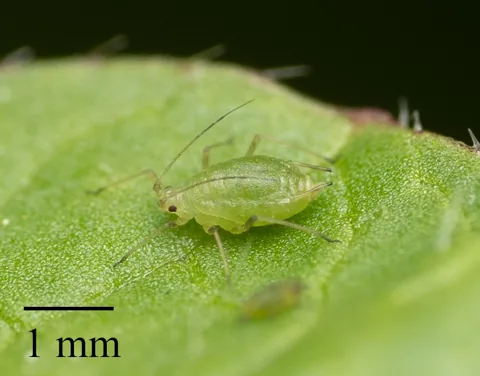 Aphids
Myzus persicae
Aphids are small, soft-bodied insects that pierce tender stems and leaves and suck out plant sap. Almost every plant hosts at least one aphid species, but established plants usually tolerate them, treating aphids for the plant's health is usually unnecessary, and natural enemies often bring numbers down.
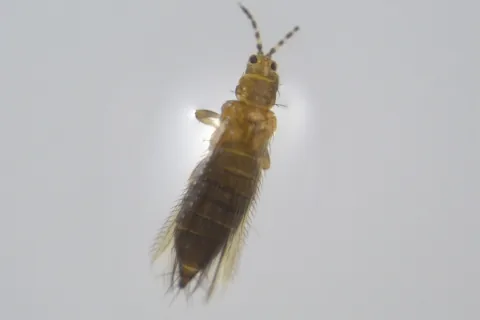 Thrips
Frankliniella occidentalis
Thrips are tiny, slender insects with fringed wings that scar and distort leaves, flowers and fruit. Woody plants usually tolerate them, but flowers, vegetables and young plants can be hurt badly, and thrips are hard to control.
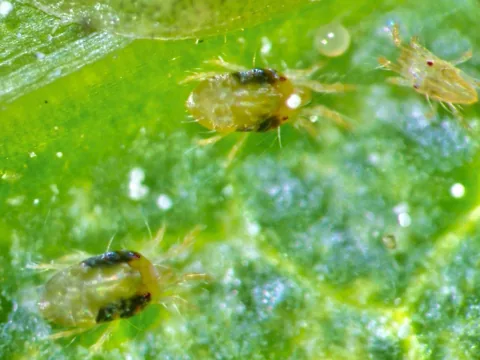 Spider Mites
Tetranychus urticae
Spider mites are tiny arachnids, relatives of spiders and ticks, that live in colonies on leaf undersides and suck out plant cells. The twospotted spider mite is the most important species in yards and gardens and on house plants, and Minnesota says it can infest over 200 species of plants.
Leaf curl clues and the likely culprit
Look at new growth and the undersides of curled leaves first. Insects leave themselves, cast skins, droppings or webbing behind; herbicide injury doesn't.[2][4][6][11]
- Twisted and curled leaves, yellowing, stunted shoots and sticky honeydew, with white cast skins and colonies of aphids on the leaves: aphids. Most established plants tolerate them.[2][1][3]
- Distorted, curled, galled or dead shoot tips, silvery or flecked leaf surfaces and black varnish-like specks of excrement: thrips. On roses they can leave deformed buds that only partly open.[4][5]
- Tiny white or yellow spots that give leaves a stippled, speckled look, later turning bronze or gray, with webbing in heavy infestations, most often in hot, dry weather: spider mites.[6][7]
- Small, misshapen leaves that may curl tightly, feel thick or rubbery, cup, crinkle or turn strappy, on tomatoes, potatoes, grapes and other sensitive plants: growth-regulator herbicide drift such as 2,4-D or dicamba.[9][8][10]
- Curling and distortion with mottling and no insects can also be a virus. Mississippi State notes 2,4-D damage can be confused with cucumber mosaic virus and tomato yellow leaf curl virus.[8]
How to confirm the cause
- Uncurl a few leaves and check the undersides and new shoots for aphids and their white cast skins.[2][1]
- For thrips, shake foliage or flowers over white paper and look for tiny insects; on roses, peel back the outer petals and check the base of the bloom.[4][5]
- For spider mites, hold white paper or cardboard under the leaves, shake them and look for tiny mites crawling on the paper.[6][7]
- For suspected herbicide injury, Purdue advises first ruling out insects, diseases and weather such as drought or cold injury, and notes that Purdue Extension county educators can help work out the cause.[11][9]
What to do next
- Aphids: spray sturdy plants with a strong stream of water; soaps and oils are options if numbers stay high.[1]
- Thrips and spider mites: see the guides below. Hot, dry conditions favor spider mites, so keep plants watered.[6][4]
- Herbicide drift: there's no insect to spray. Purdue lists steps to take, such as photographing the applicator's equipment and, in Indiana, filing a complaint with the Office of Indiana State Chemist, which starts an investigation.[11][10]
- Prevent your own drift damage: Penn State lists 2,4-D, MCPA, MCPP, triclopyr, dicamba, picloram, clopyralid, aminopyralid and quinclorac among herbicides linked to drift injury, and tomatoes and grapes are among the most sensitive plants.[10][9]
Common questions
- My tomato leaves are curling but I see no bugs. What is it?
- Check for herbicide drift and viruses. Growth-regulator herbicides such as 2,4-D cause cupped, curled and twisted leaves on tomatoes, and Mississippi State notes this can be confused with viruses such as tomato yellow leaf curl.[8][9]
- Do aphids always need to be sprayed?
- No. Treating aphids for plant health is usually unnecessary; most established plants tolerate them and outgrow the damage.[2][1]
- Do spider mites curl leaves?
- Their typical sign is stippling: many tiny light flecks, then a bronze or gray look, plus webbing when numbers are high.[6][7]
Photo credits
- Aphids: Jesse Rorabaugh, public domain (CC0), via iNaturalist
- Thrips: (c) Julia Palmer, some rights reserved (CC BY) — via iNaturalist, CC BY 4.0
- Spider Mites: (c) Mike Bowie, some rights reserved (CC BY) — via iNaturalist, CC BY 4.0
Sources
- University of California Statewide IPM Program, “Pest Notes: Aphids.” ipm.ucanr.edu/home-and-landscape/aphids/ (accessed 2026-11-12)
- University of Minnesota Extension, “Aphids in home yards and gardens.” extension.umn.edu/yard-and-garden-insects/aphids (accessed 2026-11-12)
- University of Wisconsin-Madison Extension, “Aphids (Wisconsin Horticulture).” hort.extension.wisc.edu/articles/aphids/ (accessed 2026-11-12)
- University of California Statewide IPM Program, “Pest Notes: Thrips (Publication 7429).” ipm.ucanr.edu/home-and-landscape/thrips/ (accessed 2026-11-12)
- NC State Extension, Department of Entomology, “Thrips: Biology and Rose Pests.” entomology.ces.ncsu.edu/thrips-2/ (accessed 2026-11-12)
- University of Minnesota Extension, “Twospotted spider mites in home gardens (J. Hahn, S. Wold-Burkness).” extension.umn.edu/yard-and-garden-insects/spider-mites (accessed 2026-11-12)
- Colorado State University Extension, “Spider Mites (Fact Sheet 5.507).” extension.colostate.edu/topic-areas/insects/spider-mites-5-507/ (accessed 2026-11-12)
- Mississippi State University Extension Service, “Herbicide Damage in Tomatoes.” extension.msstate.edu/publications/herbicide-damage-tomatoes (accessed 2026-11-12)
- South Dakota State University Extension, “Herbicide Damage to Fruits and Vegetables.” extension.sdstate.edu/herbicide-damage-fruits-and-vegetables (accessed 2026-11-12)
- Penn State Extension, “Herbicide Drift and Drift Related Damage (Delvalle, updated September 19, 2025).” extension.psu.edu/herbicide-drift-and-drift-related-damage (accessed 2026-11-12)
- Purdue Extension and the Office of Indiana State Chemist, “PPP-110: Options for Dealing with a Pesticide Drift Incident (O'Donnell, Ballard and Becovitz).” ag.purdue.edu/department/extension/ppp/resources/ppp-publications/mobile/ppp-110/options-for-dealing-with-a-pesticide-drift-incident.html (accessed 2026-11-12)