On this page
How to identify it
- The adult is a snout beetle about 1/8 inch long. Kentucky describes it as dark brown and Virginia Tech as red-brown. The grub is white and legless with a brown head.[1][4][3]
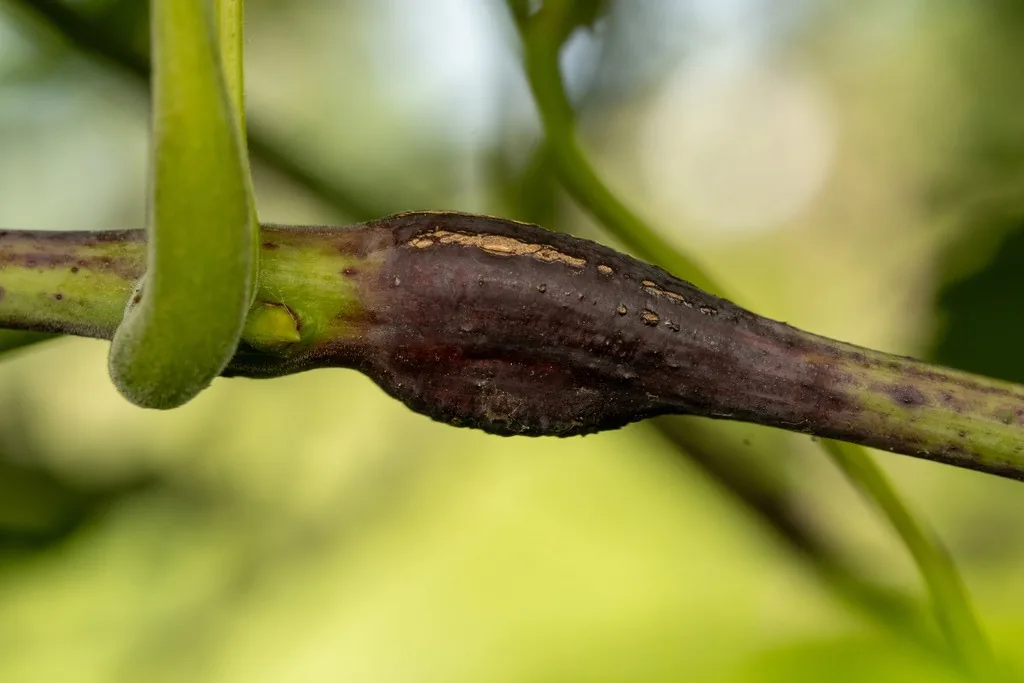
- Galls are red swellings on new shoots about twice the cane's normal width. Kentucky gives a length of 3/4 to 1 inch; Virginia Tech gives 2.5 to 5 cm, roughly 1 to 2 inches.[1][4][3]
- The female chews a row of holes along the shoot above the node but lays an egg in only one, so a line of small punctures sits above the gall.[4][3]
Look-alikes
| Look-alike | How to tell them apart |
|---|---|
| Grape cane girdler | A close relative that rings canes with punctures so the tips break off; it prefers Virginia creeper.[1] |
Where it lives
It occurs on wild and cultivated grapes throughout the eastern U.S. In Kentucky galls are usually found along vineyard borders near wooded, trashy areas or at the ends of rows, and a Pennsylvania study found infestation fading with distance from the woodline.[3][2][1]
Biology and life cycle
In May and June the female lays an egg in holes she chews just above a node when canes are 10 to 20 inches long.[1]
The larva feeds inside the swelling, pupates there, and adults emerge in August and overwinter in trashy borders.[1]
Adults are active from late May and spend the winter in debris on the ground. There is one generation a year.[3]
Damage and signs
Health risk
Kentucky, Virginia Tech and the Penn State study describe it only as a grape pest and don't mention any risk to people or pets.[1][4][2]
Control
Sanitation
Cut out and destroy galled shoots in summer. Virginia Tech says this can be done as soon as the swellings appear; Kentucky says to finish by mid-July, before adults leave the galls.[4][1][3]
Pesticides
Kentucky's ENTFACT says insecticides usually aren't needed because the injury doesn't reduce yield (see where the sources disagree).[1]
Gallmaker or girdler?
Both are small grape weevils that attack new shoots. The gallmaker leaves a single swelling above a node and the shoot keeps growing, while the girdler rings the cane with punctures so the tip breaks off.[1][4]
Virginia Tech notes the gallmaker is red-brown rather than black, which helps tell the adults apart.[4]
Where the sources disagree
Adult color: Kentucky describes a dark brown snout beetle; Virginia Tech says red-brown.[1][4]
Gall length: Kentucky's ENTFACT gives 3/4 to 1 inch, its scouting guide 1 inch, and Virginia Tech 2.5 to 5 cm.[1][3][4]
Pruning: Virginia Tech says infested canes may be destroyed as soon as the swellings are visible; Kentucky says to prune by mid-July, before adults leave the galls.[4][1]
Sprays: Kentucky's ENTFACT says insecticides are usually not needed; its scouting guide suggests late-spring sprays when infestations are heavy.[1][3]
Common questions
- What are the red swellings on my new grape shoots?
- They're likely galls from the grape cane gallmaker, a small snout beetle.[1]
- Do the galls hurt my grape crop?
- Rarely. Most galls are past the fruit clusters, and a Pennsylvania study found no significant effect on berry quality or mature vine vigor. Green canes can snap at the gall, though.[1][2][3]
Sources
- University of Kentucky Entomology (ENTFACT), “Grape Cane Gallmaker and Grape Cane Girdler (ENTFACT-223).” entomology.mgcafe.uky.edu/ef223 (accessed 2026-11-13)
- Peer-reviewed literature (PubMed), “Grape cane gallmaker (Coleoptera: Curculionidae) and its impact on cultivated grapes (Saunders MC et al., Journal of economic entomology, 2000).” pubmed.ncbi.nlm.nih.gov/10902332/ (accessed 2026-11-13)
- University of Kentucky College of Agriculture, Food and Environment, “Grape Cane Gallmaker on Grapes (Scouting Guide for Problems of Fruit).” fruitscout.ca.uky.edu/grape-cane-gallmaker-grapes (accessed 2026-11-13)
- Virginia Tech, Virginia Fruit (Department of Entomology), “Grape cane gallmaker.” www.virginiafruit.ento.vt.edu/gallmaker.html (accessed 2026-11-13)
- Global Biodiversity Information Facility (GBIF), “Ampeloglypter sesostris J.L.LeConte, 1876 (GBIF Backbone Taxonomy).” api.gbif.org/v1/species/1179636 (accessed 2026-11-13)