On this page
How to identify it
- Adults are slender, dark brown to black, 2 to 2.5 mm long, with fringed wings. Males are slightly smaller than females but look much the same.[1]
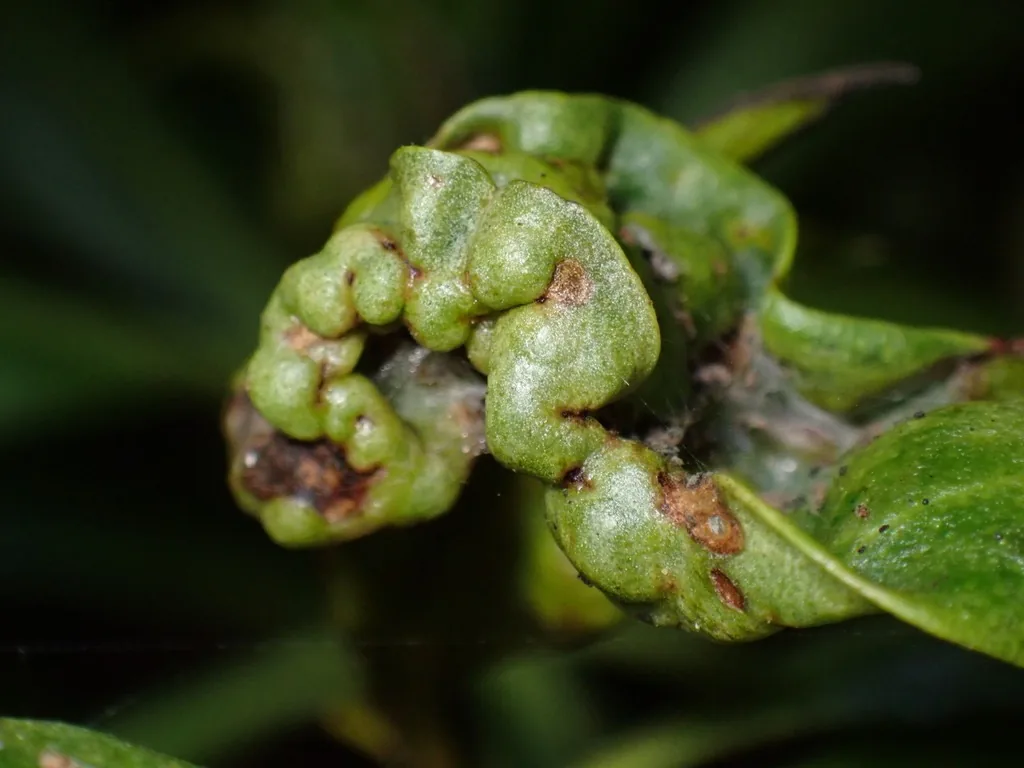
- New leaves show gall-like distortion and curling, with thrips colonies inside the folds.[1]
- The oblong white eggs are large for the size of the female. They are laid on leaf surfaces, where the distorted plant tissue closes around them.[1]
Look-alikes
| Look-alike | How to tell them apart |
|---|---|
| Cuban laurel thrips | A close relative (Gynaikothrips ficorum) with an almost identical look and life history that causes similar symptoms on Ficus.[1] |
| Greenhouse thrips | UC IPM notes adults may be confused with greenhouse thrips (Heliothrips haemorrhoidalis). Myoporum thrips appears to be limited to Myoporum.[1][2] |
Where it lives
UC IPM reports damage along the California coast from San Diego to San Francisco, and CDFA's 2022 proposal lists finds in 16 counties, from Marin, Napa and Yolo south to Riverside and San Diego. It also attacks naio (Myoporum sandwicense) in Hawaii.[1][2]
Biology and life cycle
The life cycle runs egg, two feeding larval stages, two non-feeding pupal stages and adult. At 86°F eggs take about 14 days and the larval stages about 14 more, a generation takes about 38 days, and adults live about 9 days. In warm areas it breeds year-round.[1]
In California UC IPM has seen it only on Myoporum laetum and M. pacificum, not on M. parvifolium. In UC Riverside tests of six Myoporum types, damage showed only on M. laetum and M. 'Pacificum', and the thrips failed to complete development on 'Clean n Green' and 'Putah Creek'.[1][5]
UC Riverside researchers date its arrival in California to 2005. In their lab work it completed development at constant temperatures from 15 to 35.5°C (59 to 96°F), and a climate model suggested it could establish in many regions of the world.[5][3]
Damage and signs
Health risk
It feeds on Myoporum. None of the cited sources describes any risk to people or pets.[1][2]
Control
Prevention
The best prevention is to avoid planting susceptible Myoporum (in California, M. laetum and M. pacificum) and to choose resistant Myoporum or other plants.[1]
Sanitation
Prune, bag and dispose of infested tips and dead plants, without over-pruning, which can stress or kill Myoporum.[1]
Traps and physical control
Check new growth early in the season, before females hide in leaf folds. Tap shoot tips over white paper, or shake cut tips in a jar of 70% alcohol and filter the liquid to see and count the thrips.[1]
Biological control
Minute pirate bugs, green lacewings and several predatory mites feed on it, though damage can still be severe with them present. UC Riverside surveys picked Orius and Chrysoperla as likely key predators and suggested releases early in the year, when plants flush and thrips numbers are low.[1][4]
Pesticides
Oils, soaps and spinosad can't reach thrips inside the twisted growth. UC IPM says systemic insecticides work best, naming neonicotinoids such as dinotefuran and imidacloprid, but they can harm bees and should never be used during bloom or when bees are present.[1]
Pyrethroids such as bifenthrin also kill the beneficial insects and persist a long time, so natural enemies may take a while to return. Trunk applications of dinotefuran work well, but the products labeled for that use are for licensed applicators only.[1]
Status in California
CDFA's 2022 rating proposal, written while the thrips was rated Q, proposed a C rating because it is already widespread in California and native California plants don't appear to be threatened. It is not under official control.[2]
Myoporum laetum is commonly planted along California roadsides, which CDFA says likely helps the thrips spread.[2]
Common questions
- Why are the tips of my Myoporum twisted and lumpy?
- Myoporum thrips feeding causes gall-like distortion of new leaves.[1]
- Will soap or oil sprays stop myoporum thrips?
- No. Oils, soaps and spinosad don't reach the thrips sheltering inside the twisted growth.[1]
- Which Myoporum hold up against myoporum thrips?
- In California UC IPM has not seen it on M. parvifolium, and in UC Riverside trials it failed to complete development on 'Clean n Green' and 'Putah Creek'.[1][5]
Sources
- University of California Statewide IPM Program, “Myoporum Thrips (Pest Notes).” ipm.ucanr.edu/home-and-landscape/myoporum-thrips/ (accessed 2026-11-13)
- California Department of Food and Agriculture (Pest Ratings), “California Pest Rating for Klambothrips myopori Mound & Morris: thrips.” blogs.cdfa.ca.gov/Section3162/wp-content/uploads/2022/04/Klambothrips-myopori.pdf (accessed 2026-11-13)
- Journal of Economic Entomology (via PubMed), “Predicting the potential invasive range of Klambothrips myopori (Shogren and Paine, 2020) (abstract).” pubmed.ncbi.nlm.nih.gov/32064500/ (accessed 2026-11-13)
- Environmental Entomology (via PubMed), “Identification of the Klambothrips myopori predator complex in California (Shogren and Paine, 2019) (abstract).” pubmed.ncbi.nlm.nih.gov/31260528/ (accessed 2026-11-13)
- Journal of Economic Entomology (via PubMed), “Host plant recognition and performance of Klambothrips myopori across Myoporum cultivars in southern California (Shogren and Paine, 2019) (abstract).” pubmed.ncbi.nlm.nih.gov/30937449/ (accessed 2026-11-13)
- Global Biodiversity Information Facility (GBIF), “Klambothrips myopori Mound & Morris, 2007 (GBIF Backbone Taxonomy).” api.gbif.org/v1/species/7349300 (accessed 2026-11-13)