On this page
How to identify it
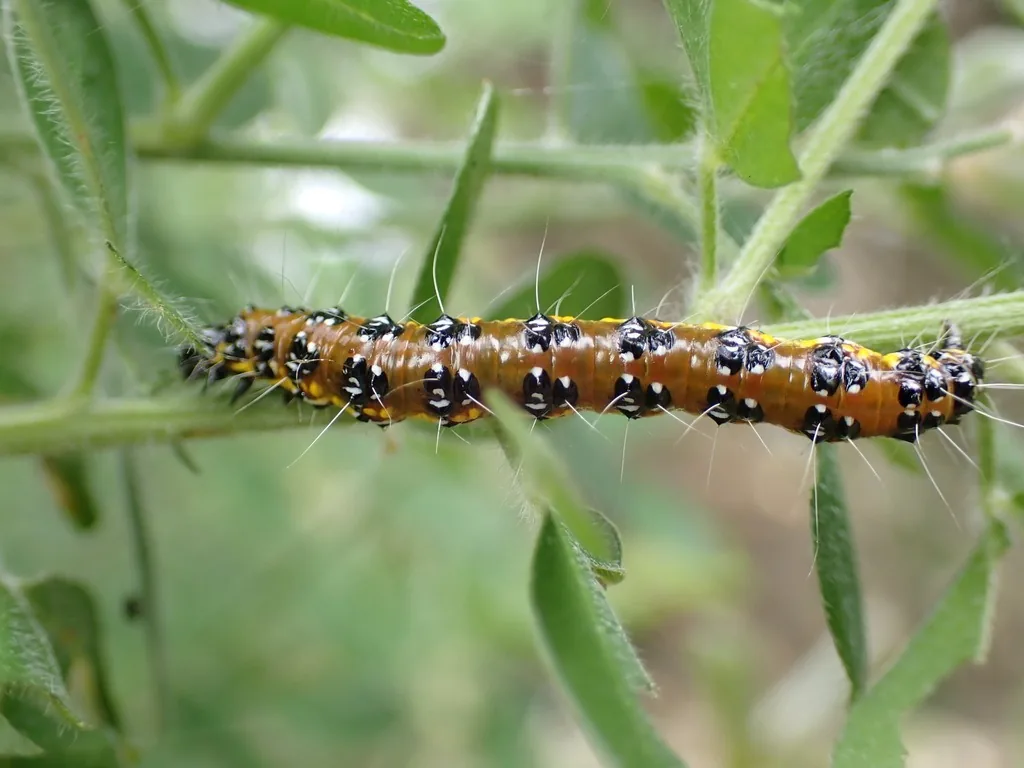
- Mature caterpillars are about 1 inch long, tan to greenish-brown with raised black spots, bright yellow patches and sparse long white hairs; the head is black with white dots.[1][2]
- Moths are light to medium brown with a dark spot on each forewing and yellow or orange hindwings.[1]
- Young caterpillars are green and feed together, often in silk webbing.[1][2]
Where it lives
A native moth. Natural Lands, a Pennsylvania land trust, says it is found from Nova Scotia south to Florida and Texas; Iowa State covers it in Iowa. GBIF holds 8192 U.S. records since 1990, the most from Texas (3790), California (2698), Florida (381) and North Carolina (243).[5][2][6]
Biology and life cycle
Females lay eggs in batches of up to about 70 on host plants.[1][2]
It overwinters as a pupa in a loose cocoon on or near the host. NC State says it has four to five generations a year in North Carolina, with caterpillars usually most abundant in late summer or early fall; Iowa State says southern states see four or more generations but Iowa's shorter season likely limits it to one or two.[1][2]
Fun fact: big caterpillars help the little ones. In a field experiment on wild lupine, Cornell researchers found that young caterpillars survived and grew better when feeding alongside older caterpillars, but not in large groups of caterpillars their own age.[3]
Damage and signs
- Hosts include baptisia (false indigo), brooms, Scotch broom, Texas mountain laurel, lupine and acacia, and it has been reported on crapemyrtle and honeysuckle.[1][2]
- Feeding in groups, caterpillars can quickly strip a plant, but established plants usually recover; repeated defoliation can stress young plants.[1][2]
Health risk
NC State says the caterpillars take up and store alkaloids from their host plants, which make them bitter or even toxic to mammals, birds and some insect predators, so don't eat them. A lab study found several of these quinolizidine alkaloids, including cytisine and anagyrine, in the skin of caterpillars fed on a broom (Cytisus) plant.[1][4]
Control
Prevention
Because damage is mainly cosmetic and sporadic, many gardeners simply let established plants recover.[2]
Watch for caterpillars again the next year: NC State notes that some may survive the winter in cocoons away from a sprayed area, since the cocoons partly protect the insects inside.[1]
Traps and physical control
Hand-pick caterpillars into soapy water or shake branches to knock them off, especially once they are nearly grown.[2]
Pesticides
Act while caterpillars are small: Bt, spinosad, insecticidal soap, horticultural oil and neem work best on young caterpillars; fully grown ones have done most of their feeding.[1][2]
For larger caterpillars NC State suggests a pyrethroid such as permethrin, bifenthrin or lambda-cyhalothrin, which it calls very toxic to caterpillars and long-lasting, and warns to keep pyrethroids away from pools, ponds and streams because they are toxic to fish. Iowa State instead says that once caterpillars are nearly full-grown most feeding is over and spraying gives limited benefit. Follow the label.[1][2]
Where sources disagree
Spraying big caterpillars: NC State suggests a pyrethroid (permethrin, bifenthrin or lambda-cyhalothrin) for larger caterpillars, while Iowa State says that by the time caterpillars are nearly full-grown, insecticides give little benefit and hand-picking is often the most practical option.[1][2]
Common questions
- What is eating my baptisia?
- Often genista broom moth caterpillars, which feed in groups and can strip plants.[1][2]
- Is it too late to spray big caterpillars?
- Iowa State says usually yes: by the time large caterpillars are found, most of the damage is done, so hand-picking works better. NC State notes that a pyrethroid can still kill larger caterpillars.[2][1]
- Why do the caterpillars feed in groups?
- Cornell researchers found that young caterpillars do better when older caterpillars feed alongside them, so mixed-age groups help the youngest survive and grow.[3]
Sources
- NC State Extension, “Genista Broom Moth (Genista Caterpillar) (PDIC Factsheet).” content.ces.ncsu.edu/genista-broom-moth-genista-caterpillar (accessed 2026-11-12)
- Iowa State University Extension and Outreach (Yard and Garden), “Genista Broom Moth (Yard and Garden encyclopedia, July 2026).” yardandgarden.extension.iastate.edu/encyclopedia/genista-broom-moth (accessed 2026-11-12)
- Oecologia 2015;177(3):715-721, via PubMed, “Benefits of gregarious feeding by aposematic caterpillars depend on group age structure.” pubmed.ncbi.nlm.nih.gov/25399243/ (accessed 2026-11-12)
- Phytochemistry 2002;61(8):987-990, via PubMed, “(+)-2,3-dehydro-10-oxo-alpha-isosparteine in Uresiphita reversalis larvae fed on Cytisus monspessulanus leaves.” pubmed.ncbi.nlm.nih.gov/12453531/ (accessed 2026-11-12)
- Natural Lands (Pennsylvania land trust), “Genista Broom Moth Caterpillar (Crow's Nest Preserve, D. Barringer, preserve manager).” www.natlands.org/news/crows-nest-genista-broom-moth-caterpillar/ (accessed 2026-11-12)
- Global Biodiversity Information Facility (GBIF), “Uresiphita reversalis: U.S. occurrence records since 1990 by state (GBIF occurrence search).” api.gbif.org/v1/occurrence/search?taxonKey=1881111&country=US&hasGeospatialIssue=false&occurrenceStatus=PRESENT&year=1990%2C2026&facet=stateProvince&facetLimit=400&limit=0 (accessed 2026-11-12)
- iNaturalist, “Uresiphita reversalis taxon page (order and family).” www.inaturalist.org/taxa/121716 (accessed 2026-10-06)