On this page
How to identify it
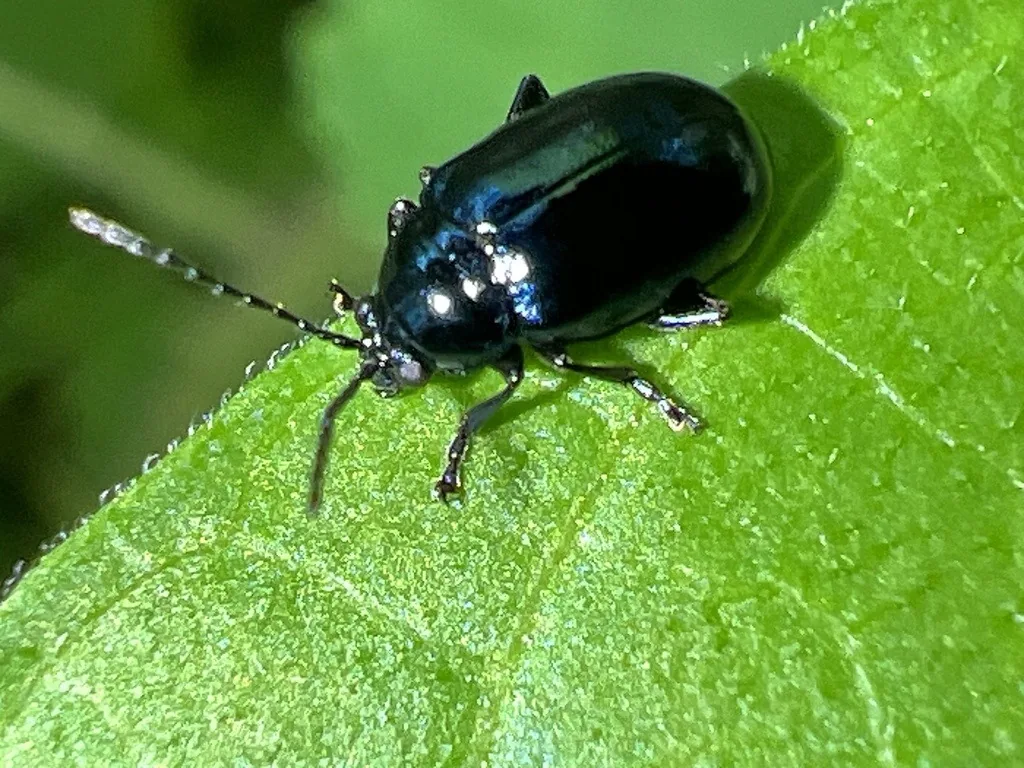
- Adults are shiny metallic blue to blue-green beetles, roughly 3/16 to 1/4 inch long, that jump when disturbed (see where the sources disagree on size and color).[1][2][3]
- Eggs are pale yellow and laid in clusters in bark cracks, at bud bases, between bud scales and on leaves. Larvae are brown with black spots, grow to about 10 mm, and leave chain-like feeding marks on leaves.[1][2]
Look-alikes
| Look-alike | How to tell them apart |
|---|---|
| Climbing cutworms | Cutworms also hollow out swelling buds, but their damage is usually more ragged. The two can overlap, so look for the beetles themselves.[2] |
Where it lives
It's found in the eastern two-thirds of the United States, mainly on wild and cultivated grapes and Virginia creeper.[1]
Biology and life cycle
Adults spend the winter in debris in and around the vineyard. In New England they become active in April and chew into buds as they swell.[1][2][3]
Larvae feed on leaves for three to four weeks, pupate in the soil, and there is one generation a year.[1]
Mature larvae drop to the soil to pupate, and new adults appear in July and August. They feed on leaves for the rest of the summer but do little harm before going into winter shelter.[2]
Damage and signs
- A hollowed bud can't produce a primary or secondary shoot, which cuts yield. Once buds reach about 1/2 inch, the beetles can't do much damage.[1][3]
- Leaves that do emerge can look ragged and tattered, and larvae skeletonize leaves, rarely to an economic level.[1]
- Injury is worst on large-budded American grapes such as Concord and Niagara. Virginia Tech says it is more common in neglected vineyards, though some Virginia growers rank it as their main insect pest.[2]
Health risk
Kentucky, Virginia Tech, UMass and Nassau County Extension describe it only as a pest of grape buds and leaves and don't mention any risk to people or pets.[1][2][3][4]
Control
Prevention
Watch vineyard borders near woods at bud swell, where damage is usually concentrated. Nassau County Extension says bud damage usually occurs on vines near wooded or trashy areas and that good plant sanitation is a must.[1][4]
Pesticides
Kentucky times sprays to bud swell when beetles are common and buds are being hit, since later sprays for other grape pests come too late. Virginia Tech agrees sprays may need to target this pest early, though berry moth sprays and fall cleanup also help.[1][2]
Checking buds in spring
Check buds from bud swell until they pass about 1/2 inch, paying most attention to rows next to woods.[1][3]
Look for holes in the ends and sides of swelling buds, and for the small blue beetles that hop away when you touch the cane.[3][2]
Where the sources disagree
Size: Kentucky says about 1/5 inch, Virginia Tech almost 5 mm, and UMass 3/16 to 1/4 inch.[1][2][3]
Color: Kentucky says dark metallic greenish-blue, Virginia Tech metallic blue-green, UMass metallic blue, and Nassau County Extension blue-black and steely.[1][2][3][4]
Where eggs go: Kentucky says under loose cane bark, occasionally on upper leaf surfaces or buds; Virginia Tech says in bark cracks, at bud bases, between bud scales and on leaves.[1][2]
Sprays: Kentucky says a spray timed at bud swell gives control when beetles are common and buds are being hit; Virginia Tech says berry moth sprays and fall cleanup help but early sprays may be needed; Nassau County Extension calls flea beetles very difficult to control and says that by the time damage is seen it is usually too late to treat.[1][2][4]
Common questions
- What hollowed out my grape buds in spring?
- Grape flea beetles, often the first insects to attack grapes, feed inside swelling buds.[1]
- Will my summer grape sprays control flea beetles?
- Not reliably. Kentucky says sprays for later pests such as grape berry moth miss the bud-swell window, though Virginia Tech says berry moth sprays and fall cleanup help control flea beetles.[1][2]
Sources
- University of Kentucky Entomology (ENTFACT), “Grape Flea Beetle (ENTFACT-224).” entomology.mgcafe.uky.edu/ef224 (accessed 2026-11-13)
- Virginia Tech, Virginia Fruit (Department of Entomology), “Grape flea beetle.” www.virginiafruit.ento.vt.edu/GFB.html (accessed 2026-11-13)
- UMass Amherst Center for Agriculture, Food, and the Environment, “Grapes: Insects (New England Small Fruit Management Guide).” www.umass.edu/agriculture-food-environment/fruit/ne-small-fruit-management-guide/grapes/insects (accessed 2026-11-13)
- Cornell Cooperative Extension of Nassau County, “Grapes: Problems (Home Grounds Fact Sheet, revised 1/09).” ccenassau.org/resources/-grapes-problems (accessed 2026-11-13)
- Global Biodiversity Information Facility (GBIF), “Altica chalybea Illiger, 1807 (GBIF Backbone Taxonomy).” api.gbif.org/v1/species/1047683 (accessed 2026-11-13)