On this page
How to identify it
- Larvae are 0.5 inch long, yellowish to greenish with black spots and a yellow-brown head.[1]
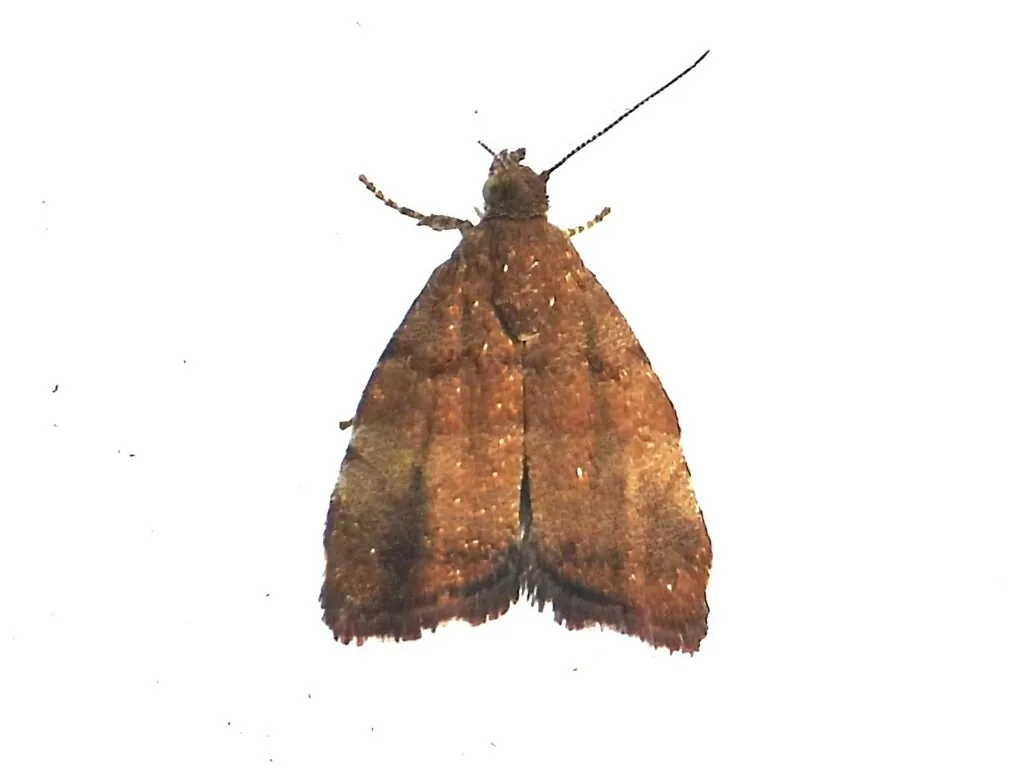
- Adults are reddish-brown moths under 1/2 inch across, with irregular light and dark wing bands.[1]
- Pupae are yellow to brown in a white silken cocoon inside the rolled leaf.[1]
- Hold a damaged leaf up to the light to see the skeletonizing clearly; the caterpillars tie the leaf edges together and feed inside.[2]
Where it lives
The PNW Insect Management Handbook and Oregon State's nursery IPM program both cover it on landscape and nursery trees in the Pacific Northwest.[1][2]
Biology and life cycle
Sources disagree on how it spends the winter: the PNW handbook says adult moths overwinter in crevices on the tree, while Oregon State's nursery program says it's reported to overwinter as a pupa there. Eggs go in small bunches under the leaves, near the midrib.[1][2]
Larvae feed under the leaf, then on top, often several to a roll; they pupate after three to four weeks, and adults emerge about two weeks later.[1]
There are at least two generations a year.[1]
Apple is preferred, but it also feeds on crabapple, cherry, pear, mountain ash, birch, plum, hawthorn and possibly willow; Oregon State lists willow as a nursery host.[1][2]
Crabapple cultivars differ: in one nursery infestation, 'Snowdrift' and 'Spring Snow' were clearly preferred, and Malus floribunda less so.[2]
Damage and signs
Health risk
It feeds on tree leaves; neither the PNW handbook nor Oregon State mentions any risk to people.[1][2]
Control
Prevention
Scout trees early for skeletonizing to see whether larval numbers are high.[1]
Traps and physical control
On small trees, pinch rolled leaves to kill larvae or pull larvae and pupae out of the rolls; remove heavily infested twigs.[1]
Biological control
Many natural enemies attack it, so avoid broad-spectrum sprays that would disrupt them.[1]
Common questions
- Why do the leaf tips on my crabapple look burned?
- Apple-and-thorn skeletonizer feeding makes leaf tips look burned from a distance.[1]
- Is the apple-and-thorn skeletonizer serious?
- It ranges from inconsequential to serious, so check larval numbers early.[1]
- Why are my crabapple leaves rolled up and see-through?
- Likely skeletonizer caterpillars, which tie the leaf edges together and feed inside. On small trees, pinch the rolls or pull the larvae and pupae out.[2][1]
Sources
- Pacific Northwest Pest Management Handbooks (OSU, WSU, University of Idaho), “Crabapple, flowering (Malus): Apple-and-thorn skeletonizer (Insect Management Handbook).” pnwhandbooks.org/insect/hort/landscape/hosts-pests-landscape-plants/crabapple-flowering-malus-apple-thorn-skeletonizer (accessed 2026-11-13)
- Oregon State University Extension Nursery IPM, “Apple and Thorn Skeletonizer (OSU Nursery IPM, Rosetta).” agsci.oregonstate.edu/nurspest/insects/apple-and-thorn-skeletonizer (accessed 2026-11-13)
- Entomological Society of America, “apple-and-thorn skeletonizer (Common Names of Insects database).” entsoc.org/apple-and-thorn-skeletonizer-1 (accessed 2026-11-13)
- Global Biodiversity Information Facility (GBIF), “Choreutis pariana (Clerck, 1759) (GBIF Backbone Taxonomy).” api.gbif.org/v1/species/5769164 (accessed 2026-11-13)