On this page
How to identify it
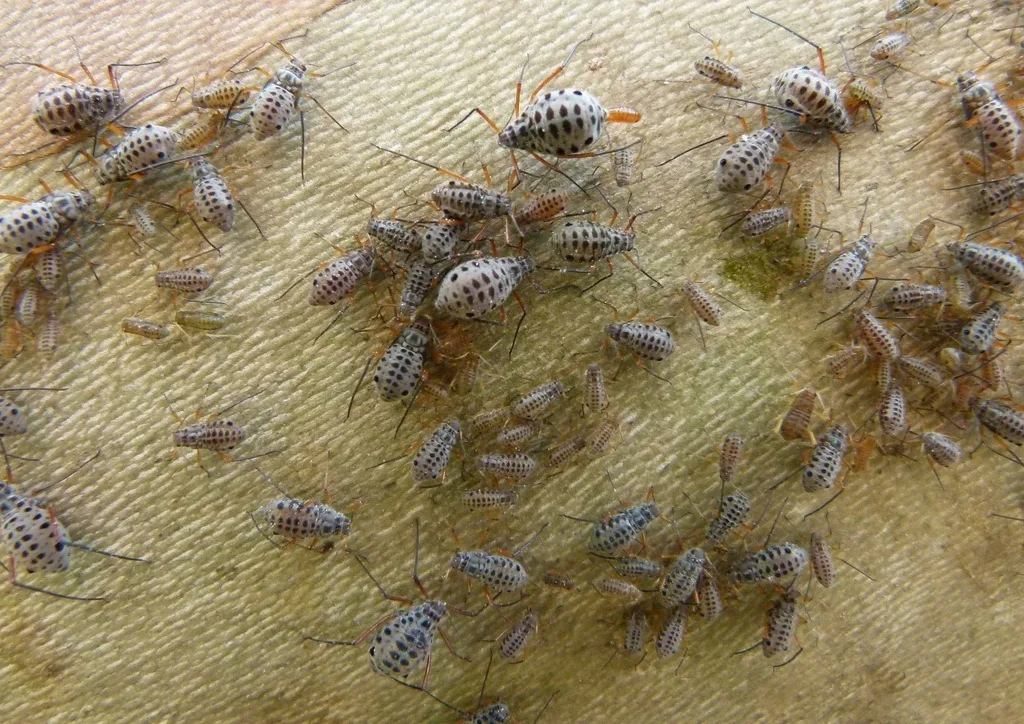
- Aphids are about 1/4 inch (6 mm) long with long, spider-like legs and four rows of black spots down the back. Sources describe the color differently: light gray (NC State), grayish black (Iowa State) or brownish gray (Texas A&M).[2][3][1]
- They cluster on the bark of one- to three-year-old stems rather than on leaves, and leave an iodine-colored stain when crushed.[3]
- Males and some females have translucent gray wings; egg-laying females are wingless. Texas A&M notes a bluish-white waxy coating.[2][1]
Look-alikes
| Look-alike | How to tell them apart |
|---|---|
| Giant willow aphid | Iowa State says it is smaller, about 3/16 inch, has a large bump on its back and lives only on willow.[3] |
Where it lives
NC State, Iowa State and Texas A&M extension all report it. Texas A&M says numbers are usually low, with outbreaks in 2012 and 2002 that both came in springs after mild winters; Iowa State says populations are largest and most noticed in late summer. GBIF holds about 1,190 U.S. records since 1990, the most from Virginia (157), Texas (111) and Maryland (93), and 21 records from Canada.[1][3][2][5]
Biology and life cycle
During the growing season females give birth to females without mating, so numbers can rise quickly.[2]
In fall, males and egg-laying females appear, and the eggs overwinter on twigs, turning shiny black.[2]
They insert their mouthparts through the bark into the sap-carrying tissue and excrete the excess sugar as honeydew.[2][3]
Damage and signs
- Hosts include basswood, birch, elm, hickory, maple, oak, pecan, sycamore, walnut, wax myrtle and willow; Texas A&M adds redbud, cedar elm and live oak.[2][3][1]
- Heavy honeydew grows sooty mold, and NC State says leaves coated heavily enough may die. Sources disagree on how harmful the aphid is: Iowa State says healthy trees often show no effects, while Texas A&M says branch and limb dieback is not unusual and reports a tree farm that lost redbuds and Shumard red oaks.[2][3][1]
- Aphids may wander from infested trees onto sidewalks, decks and patios.[3]
Health risk
It feeds on tree sap, and no cited source describes any risk to people or pets.[2][3][1]
Control
Traps and physical control
On small trees, Texas A&M suggests a stiff stream of water to knock the aphids off.[1]
Biological control
Parasitic wasps, lady beetles, syrphid fly maggots, lacewings and an aphid-killing fungus often reduce populations rapidly; NC State suggests waiting to see whether they do.[2]
Pesticides
Advice on timing differs. Iowa State says control in late summer or fall is usually not warranted and suggests treating early-summer populations only on young or stressed plants; Texas A&M advises prompt action when aphids or sap pools appear. Insecticidal soap or horticultural oil must wet the aphids to work, and NC State says oils also help loosen sooty mold.[3][1][2]
Honeydew and sooty mold
Aphids feed on sap and pass the excess sugar as honeydew, which Texas A&M says can collect as sticky pools under trees.[3][1]
Sooty mold grows on the honeydew and can cling to plants for months; NC State notes that a winter oil spray to kill the overwintering eggs is probably not worth the effort.[2]
Where the sources disagree
Color: NC State says light gray, Iowa State grayish black, and Texas A&M brownish gray.[2][3][1]
Hosts: NC State lists basswood, hickory, oak, pecan, sycamore, walnut and wax myrtle; Iowa State lists elm, sycamore, oak, maple, basswood, birch, walnut and willow; Texas A&M reports redbud, Shumard red oak, wax myrtle, cedar elm, pecan, hickory, willow and live oak.[2][3][1]
Harm to trees: Iowa State says otherwise healthy trees often carry very large populations with no observable effects, NC State that aphids plus sooty mold may drastically reduce vigor, and Texas A&M that branch and limb dieback is not unusual.[3][2][1]
When to act: Iowa State says late-summer or fall control is usually not warranted and early-summer populations on young or stressed plants should be controlled, NC State suggests waiting to see whether natural enemies bring numbers down, and Texas A&M suggests prompt action when clusters or sap pools appear.[3][2][1]
The willow aphid: Iowa State calls it the giant willow aphid, a separate species found only on willow; Texas A&M calls Tuberolachnus salignus another type of giant bark aphid, specific to willow.[3][1]
Common questions
- What are the big gray bugs clustered on my tree branches?
- In late summer they are often giant bark aphids, the largest aphid in North America, feeding through the bark.[2][3][1]
- Why is everything under my tree sticky and black?
- Honeydew from the aphids, with sooty mold growing on it.[2][1]
- Should I spray giant bark aphids?
- Usually not in late summer or fall on healthy trees, and natural enemies often knock them back. Texas A&M recommends prompt action when you find clusters or sap pools, and a strong spray of water on small trees.[2][3][1]
Sources
- Texas A&M AgriLife Extension, “Giant bark aphids (Insects in the City, April 2012).” citybugs.tamu.edu/2012/04/20/giant-bark-aphids (accessed 2026-11-13)
- NC State Extension, “Giant Bark Aphid (PDIC Factsheet).” content.ces.ncsu.edu/giant-bark-aphid (accessed 2026-11-13)
- Iowa State University Extension and Outreach (Yard and Garden), “Giant Bark Aphid.” yardandgarden.extension.iastate.edu/encyclopedia/giant-bark-aphid (accessed 2026-11-13)
- Global Biodiversity Information Facility (GBIF), “Longistigma caryae (Harris, 1841) (GBIF Backbone Taxonomy).” api.gbif.org/v1/species/2076456 (accessed 2026-11-13)
- Global Biodiversity Information Facility (GBIF), “Longistigma caryae: occurrence records in the U.S. since 1990 and by country (GBIF occurrence search).” api.gbif.org/v1/occurrence/search?taxonKey=2076456&hasGeospatialIssue=false&occurrenceStatus=PRESENT&country=US&year=1990%2C2026&facet=stateProvince&facetLimit=80&limit=0 (accessed 2026-11-13). Exact count at access: 1,190 U.S. records since 1990 (Virginia 157; Texas 111; Maryland 93; Georgia 74). All-years country facet: United States 1,295; Canada 21; Mexico 9. Records reported, not abundance.