On this page
How to identify it
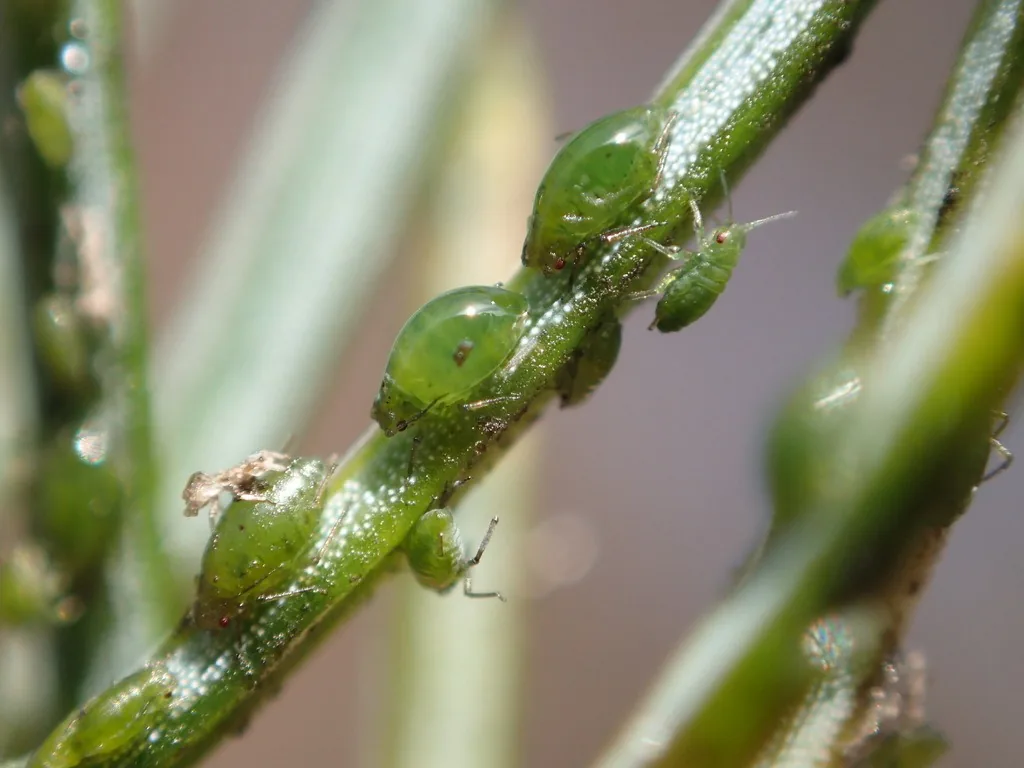
- Adults are green to olive and tiny, about 1/16 inch; winged forms are rare. See where the sources disagree on size.[1][2][4]
- Needles first show yellow bands or blotches, sometimes with honeydew or sooty growth, then turn yellow or brown and drop; damage starts in the shaded lower and inner crown.[1][3][2][4]
- Current-year needles aren't affected, so trees end up with bare centers and green tips. To check, Oregon State suggests beating a branch over white paper.[1][2][3]
Look-alikes
| Look-alike | How to tell them apart |
|---|---|
| Giant conifer aphids | Forest Research says Cinara aphids are much larger, about 5 to 6 mm, dark brown or black, and feed on the bark rather than the needles.[4] |
Where it lives
Native to continental Europe, it now occurs in North America, Australia, New Zealand and Chile. In North America it's a problem on Sitka spruce along the Pacific coast, including Southeast Alaska, and on ornamental spruces, especially blue spruce; Norway spruce, its native host, is little affected.[4][3][2][1]
Biology and life cycle
In North America all are females that give birth to live young. They feed through mild winters, building up from late winter into spring; Oregon State says they're most visible from late fall to early spring, and numbers drop by midsummer.[2][3][1][4]
Mild winters favor outbreaks and hard cold kills the aphids. Outbreaks last a few years, and damage usually shows only after the aphids have peaked.[3][2][4][1]
Damage and signs
Health risk
It feeds on spruce needles. The PNW handbook, the USDA Forest Service, Oregon State and Forest Research describe tree damage only and don't mention any risk to people or pets.[1][3][2][4]
Control
Prevention
Check valued trees for aphids on older needles starting in fall or late winter, especially after a mild winter; see where the sources disagree on when to start.[1][3]
Keep trees healthy by avoiding root injury and soil compaction; see where the sources disagree on watering and fertilizer.[3][1]
Traps and physical control
Wash aphids off with a strong stream of water, repeated as needed.[1][3]
Biological control
Lady beetles, syrphid fly larvae and lacewings attack them, and Forest Research says a diversity of predators in the landscape helps. Avoid broad-spectrum insecticides.[1][4]
Pesticides
Sprays only help early, before needles drop; see where the sources disagree on whether to spray at all.[3][2][4]
More from the research literature
A 2001 Journal of Invertebrate Pathology study from Iceland found green spruce aphid populations infected by insect-killing fungi, with different fungus species in the island's west and east that matched two separate aphid populations.[5]
Where the sources disagree
Size: the PNW handbook says 0.05 to 0.1 inch, Oregon State about 1/16 inch (1.5 mm), and Forest Research 1 to 2 mm.[1][2][4]
Water and fertilizer: the PNW handbook says to avoid excess water and nitrogen; the USDA Forest Service in Alaska suggests adequate water through the growing season and spring fertilization.[1][3]
When to start checking: the PNW handbook says weekly from about November on important trees; the Alaska Forest Service says from February after a mild winter.[1][3]
Spraying: Forest Research doesn't recommend chemical control, since the damage is done by the time symptoms show and sprays harm other wildlife. The Alaska Forest Service says insecticides work if applied early, before needles drop, and Oregon State says ornamental spruce can be treated in late March or early April if the owner is very concerned.[4][3][2]
Tree death: Oregon State says continued infestations can kill trees, though as one of several stresses; the Alaska Forest Service says it rarely kills trees, and Forest Research says trees are seldom killed.[2][3][4]
Common questions
- Why is my spruce bare inside but green at the tips?
- Spruce aphids feed on older needles from fall to spring, and the damage shows after they've peaked, leaving green tips on bare branches.[1][2][3]
- When should I check for spruce aphids?
- From fall or late winter, especially after a mild winter; the PNW handbook says weekly from about November on important trees, and the Alaska Forest Service says from February.[1][3]
Sources
- Pacific Northwest Pest Management Handbooks (OSU, WSU, University of Idaho), “Spruce (Picea): Spruce aphid (Insect Management Handbook).” pnwhandbooks.org/insect/hort/landscape/hosts-pests-landscape-plants/spruce-picea-spruce-aphid (accessed 2026-11-13)
- Oregon State University Extension Service, “Common Insect Pests and Diseases of Sitka Spruce on the Oregon Coast (EM 9105; J. Reeb and D. Shaw, 2015).” extension.oregonstate.edu/sites/extd8/files/documents/em9105.pdf (accessed 2026-11-13)
- USDA Forest Service, Alaska Region, “Spruce Aphid (Alaska Region forest health, updated February 2026).” www.fs.usda.gov/r10/natural-resources/forest-health/spruce-aphid (accessed 2026-11-13)
- Forest Research (Great Britain), “Green spruce aphid (Elatobium abietinum).” www.forestresearch.gov.uk/tools-and-resources/fthr/pest-and-disease-resources/green-spruce-aphid-elatobium-abietinum/ (accessed 2026-11-13)
- Peer-reviewed literature (PubMed), “Geographical distribution and host range of entomophthorales infecting the green spruce aphid Elatobium abietinum Walker in Iceland (Nielsen C et al., Journal of invertebrate pathology, 2001).” pubmed.ncbi.nlm.nih.gov/11812109/ (accessed 2026-11-13)
- Global Biodiversity Information Facility (GBIF), “Elatobium abietinum (Walker, 1849) (GBIF Backbone Taxonomy).” api.gbif.org/v1/species/2076533 (accessed 2026-11-13)
- iNaturalist, “Elatobium abietinum taxon page (order and family).” www.inaturalist.org/taxa/388940 (accessed 2026-10-06)