The short answer
- Three ticks spread Powassan virus, CDC says: the blacklegged (deer) tick, the groundhog tick and the squirrel tick. US cases come mostly from the Northeast and the Great Lakes region, from late spring through mid-fall.[2][5]
- Unlike Lyme disease, Powassan may not need a long bite. In a lab study, infected deer tick nymphs passed the virus to mice after as few as 15 minutes of attachment, and a CDC scientist's review says the virus can be transmitted within minutes.[11][12]
- Get medical care if fever, headache, vomiting or weakness follows a tick bite, and go urgently for confusion, loss of coordination, trouble speaking or seizures. CDC lists those as signs of severe illness, and Minnesota's health department says anyone who suspects Powassan should contact a doctor immediately.[3][9]
The ticks behind Powassan virus
What Powassan virus is
- Powassan is a flavivirus, a relative of mosquito-borne viruses such as West Nile, according to Minnesota's health department. It is named after Powassan, Ontario, where it was first found in 1958.[9]
- There are two types in North America. Minnesota's health department calls lineage 2 "deer tick virus" and says the blacklegged tick carries it; lineage 1 is carried by a similar tick that usually feeds on woodchucks and squirrels instead of people.[9]
- CDC says no vaccine or medicine prevents Powassan and no medicine treats it. Antibiotics do not work against viruses.[2][8]
Which ticks carry it
- Blacklegged or deer tick (Ixodes scapularis): the same tick that spreads Lyme disease, anaplasmosis and babesiosis, per Minnesota's health department. It lives in wooded and brushy areas and grabs people as they brush past; it does not jump, fly or drop from trees. CDC's clinical page names it as the main tick to consider.[9][6]
- Groundhog tick (Ixodes cookei): CDC lists it as one of the three Powassan ticks. Minnesota's health department says the tick carrying lineage 1 usually feeds on woodchucks and squirrels rather than people, and people rarely come into contact with it.[2][9]
- Squirrel tick (Ixodes marxi): also on CDC's list of three, and named on CDC's clinician page alongside the other two.[2][6]
- Size matters for spotting them. Minnesota's health department says adult blacklegged ticks are about the size of a sesame seed and nymphs about the size of a poppy seed, so you may not know you were bitten.[9]
Why even a short bite counts
- Powassan is different from the other germs of the blacklegged tick. A New York State Department of Health laboratory study found infected deer tick nymphs transmitted the virus to mice after as few as 15 minutes of attachment and concluded that, unlike the germs behind Lyme disease, babesiosis and anaplasmosis, there is no grace period between attachment and transmission.[11]
- A review by a CDC vector-borne disease scientist agrees that Powassan virus can be transmitted within minutes of attachment, the notable exception among the germs the blacklegged tick carries.[12]
- Minnesota's health department puts it more cautiously: the attachment time needed for Powassan is not known, but it is likely shorter than 12 to 24 hours. Either way, prompt tick checks and removal still help, but they do not guarantee protection the way they do for Lyme disease.[9]
- Rarely, Powassan virus has also spread through a blood transfusion, CDC says.[2][6]
Where and when people catch it
- Where: CDC says Powassan infections have been identified in the United States, Canada and Russia, and US cases have come mainly from northeastern states and the Great Lakes region. Wisconsin's health department calls it very rare in that state.[5][10]
- When: CDC says cases occur mainly in late spring, early summer and mid-fall, when ticks are most active. In Minnesota, blacklegged tick risk is highest April through July and September through October, peaking in June or July, according to the state health department.[5][9]
- Who is at risk: CDC says all residents of and visitors to areas with Powassan activity are at risk, and people who work or play outdoors in those areas are at higher risk. Cases are rare, but reported numbers have gone up in recent years. Powassan is a nationally notifiable disease, so state health departments report cases to CDC.[5]
Symptoms
- Many people infected with Powassan virus never have symptoms, CDC and Minnesota's health department both say.[3][9]
- Timing: CDC's public page says symptoms start 1 week to 1 month after the tick bite, and its clinician page gives an incubation period of 1 to 5 weeks. Minnesota's health department says symptoms usually appear within 1 to 4 weeks.[3][6][9]
- First symptoms, per CDC: fever, headache, vomiting and weakness.[3][2]
Severe illness and who is at higher risk
- Powassan can cause encephalitis (inflammation of the brain) or meningitis (inflammation of the membranes around the brain and spinal cord). CDC lists confusion, loss of coordination, difficulty speaking and seizures as symptoms of severe illness; its clinician page adds weakness or paralysis and movement problems.[3][6]
- Outcomes: CDC says about 1 in 10 people with severe illness die and about half of survivors have long-term problems such as recurring headaches, loss of muscle mass and strength, or memory problems. Minnesota's health department likewise puts deaths at about 10% of cases with encephalitis.[3][6][9]
- Anyone can become severely ill, but CDC names older adults, children including infants, and people with weakened immune systems (including those on immune-suppressing treatments) as being at higher risk.[3][8]
When to get care
- Call a doctor if you get fever, headache, vomiting or weakness in the weeks after a tick bite or time in tick habitat in an area where Powassan occurs. CDC says to see a healthcare provider if you have symptoms after being exposed to ticks there.[2][3]
- Get emergency care for confusion, loss of coordination, difficulty speaking or seizures. CDC lists these as signs of severe illness, and people with severe disease often need hospital care for breathing, fluids or brain swelling.[3][2]
- Tell the doctor about the tick bite, where you were and when. CDC says diagnosis rests on symptoms, living in or traveling to an area where the virus circulates, and possible exposure to the ticks that carry it.[3][7]
- Treatment is supportive. CDC says rest, fluids and over-the-counter pain relievers may ease some symptoms, and Minnesota's health department says severely ill patients may need hospitalization and help with breathing.[2][9]
How it is diagnosed
- CDC says blood tests looking for antibodies are the main way doctors confirm Powassan, using blood or spinal fluid. A positive first test should be confirmed with a second antibody test at a state public health laboratory or CDC, and some people with weak immune systems may need tests that look for the virus itself.[7]
- Doctors also rule out other causes of brain or meningitis symptoms, CDC's clinician page says, including West Nile virus and other viruses.[6]
- CDC says people who have had a confirmed Powassan infection should not donate blood for 4 months after their illness.[8]
Preventing Powassan
- With no vaccine, CDC says preventing tick bites is the best way to prevent Powassan. CDC's Powassan page lists insect repellent, long sleeves and pants, avoiding bushy and wooded areas, and thorough tick checks after time outdoors.[4][8]
- For repellents, CDC recommends EPA-registered products containing DEET, picaridin, IR3535, oil of lemon eucalyptus (OLE), para-menthane-diol (PMD) or 2-undecanone, and treating boots, clothing and gear with 0.5% permethrin. Minnesota's health department adds: do not put permethrin on your skin.[1][9]
- After coming inside, CDC suggests showering soon and doing a full-body tick check after time in tick habitat, including your own backyard. For drying clothes to kill ticks, CDC says 10 minutes on high heat for dry clothing, with more time if damp; Minnesota's health department advises at least 60 minutes on high heat for clothing and gear.[1][9]
- CDC's clinician guidance also lists avoiding wooded and bushy areas with high grass where the virus occurs, alongside repellents and checks.[8]
Common questions
- How long does a tick have to be attached to spread Powassan?
- Possibly only minutes. A lab study saw transmission to mice after as few as 15 minutes, and a CDC scientist's review agrees it can pass within minutes. Minnesota's health department says the exact time isn't known but is likely shorter than 12 to 24 hours.[11][12][9]
- Is there a vaccine or treatment for Powassan?
- No. CDC says no vaccines or medicines prevent or treat Powassan virus disease; care focuses on rest, fluids and, for severe cases, hospital support.[2][8]
- Is Powassan the same as Lyme disease?
- No. Powassan is a virus and Lyme disease is caused by bacteria, though the blacklegged tick can carry both. Minnesota's health department notes it is the same tick that spreads Lyme disease, anaplasmosis and babesiosis, and CDC says antibiotics do not treat viruses.[9][2]
- Where in the US is Powassan found?
- Mostly the northeastern states and the Great Lakes region, CDC says, with cases peaking in late spring, early summer and mid-fall.[5][2]
- Does every tick bite in those areas mean Powassan?
- No. Minnesota's health department says not all ticks carry the virus and not everyone bitten gets sick, and CDC calls the disease uncommon.[9][2]
- Can Powassan spread from person to person?
- CDC lists the bite of an infected tick as the way it spreads to people, and rarely a blood transfusion, which is why people who had it are asked not to donate blood for 4 months.[2][8]
Sources
- Centers for Disease Control and Prevention, “Preventing Tick Bites.” www.cdc.gov/ticks/prevention/index.html (accessed 2026-11-14)
- Centers for Disease Control and Prevention, “About Powassan Virus.” www.cdc.gov/powassan/about/index.html (accessed 2026-11-14)
- Centers for Disease Control and Prevention, “Symptoms of Powassan.” www.cdc.gov/powassan/signs-symptoms/index.html (accessed 2026-11-14)
- Centers for Disease Control and Prevention, “Preventing Powassan.” www.cdc.gov/powassan/prevention/index.html (accessed 2026-11-14)
- Centers for Disease Control and Prevention, “Data and Maps for Powassan.” www.cdc.gov/powassan/data-maps/index.html (accessed 2026-11-14)
- Centers for Disease Control and Prevention, “Clinical Signs and Symptoms of Powassan Virus Disease.” www.cdc.gov/powassan/hcp/clinical-signs/index.html (accessed 2026-11-14)
- Centers for Disease Control and Prevention, “Clinical Testing and Diagnosis for Powassan Virus Disease.” www.cdc.gov/powassan/hcp/diagnosis-testing/index.html (accessed 2026-11-14)
- Centers for Disease Control and Prevention, “Treatment and Prevention of Powassan Virus Disease.” www.cdc.gov/powassan/hcp/treatment-prevention/index.html (accessed 2026-11-14)
- Minnesota Department of Health, “About Powassan Virus Disease.” www.health.state.mn.us/diseases/powassan/basics.html (accessed 2026-11-14)
- Wisconsin Department of Health Services, “Powassan Virus.” www.dhs.wisconsin.gov/tick/powassan.htm (accessed 2026-11-14)
- American Journal of Tropical Medicine and Hygiene (PubMed), “Short report: duration of tick attachment required for transmission of Powassan virus by deer ticks (Ebel and Kramer, Am J Trop Med Hyg 2004).” pubmed.ncbi.nlm.nih.gov/15381804/ (accessed 2026-11-14)
- Ticks and Tick-borne Diseases (PubMed), “Pathogen transmission in relation to duration of attachment by Ixodes scapularis ticks (Eisen, Ticks Tick Borne Dis 2018).” pubmed.ncbi.nlm.nih.gov/29398603/ (accessed 2026-11-14)
Updated 2026-11-14. Built from sourced records. Spot an error? Tell us.
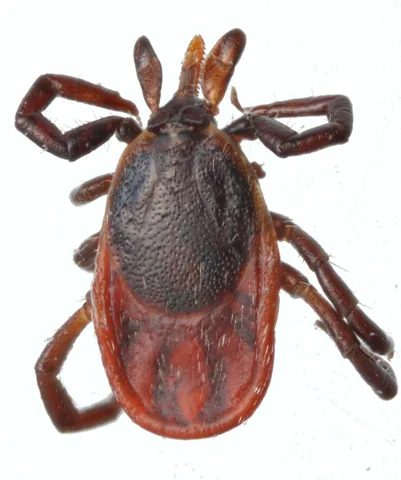 Blacklegged Tick
Ixodes scapularis
The blacklegged tick, often called the deer tick, is widely distributed across the eastern United States and spreads the bacteria that cause Lyme disease along with several other infections.
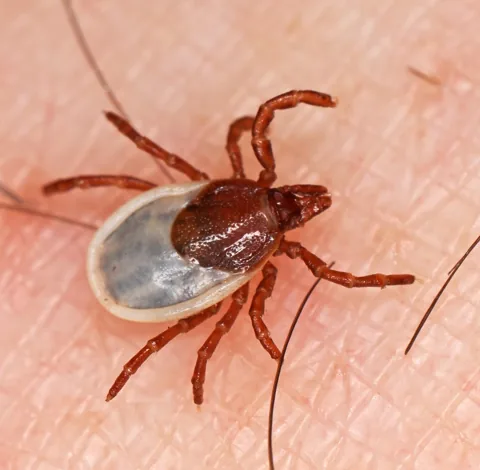 Groundhog tick
Ixodes cookei
The groundhog tick, also called the woodchuck tick, is a hard tick of eastern North America that lives in the dens and nests of groundhogs and other mammals. It bites people far less readily than the blacklegged tick, but it is the tick that keeps lineage I of Powassan virus circulating among groundhogs and weasel-family mammals.
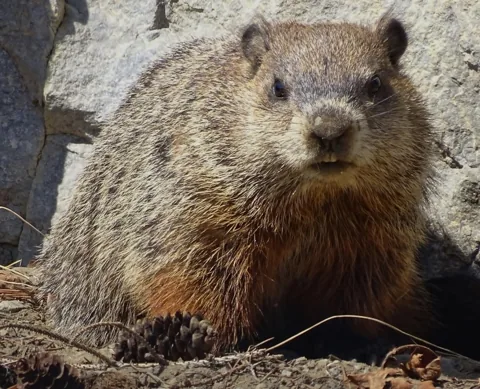 Groundhog (woodchuck)
Marmota monax
The groundhog, or woodchuck, is a burrowing member of the squirrel family found across eastern and central North America. It feeds on garden vegetables and clover by day and digs extensive burrows that can undermine foundations, sidewalks and pools.