The short answer
- What spreads it: blacklegged (deer) ticks, Ixodes scapularis, and usually the poppy-seed-sized nymphs. Less often it is passed through a blood transfusion, and very rarely from a pregnant parent to the baby. It does not spread person to person like a cold.[2][1][15]
- Where: most US cases occur in the Northeast and upper Midwest. CDC lists New England, New York, New Jersey, Wisconsin and Minnesota as places where time outdoors can expose you, and peer-reviewed reviews put the highest incidence in the same regions.[1][2][16]
- Many infected people never feel sick. Others get flu-like illness (fever, chills, sweats, headache, body aches, tiredness) that usually builds over a few weeks or months after the bite.[1][3]
- See a doctor promptly if you get fever or flu-like illness after time in tick country, and especially if you have no spleen, a weakened immune system, serious heart, liver or kidney disease, or are over 50. Those groups can become severely, even fatally, ill. Yellow skin or dark urine are warning signs of red blood cell breakdown.[3][5][10]
- Prevention is avoiding deer tick bites. CDC notes the nymphs usually must stay attached for more than 36 to 48 hours to pass the parasite, so daily tick checks and quick removal help. There is no vaccine.[4][5]
The tick that spreads babesiosis
What babesiosis is
Babesia is a parasite, not a bacterium or virus. CDC says many species infect animals but only a few infect people, and Babesia microti, which usually lives in white-footed mice and other small mammals, is the main one found in US patients. Occasional cases from other Babesia species have been detected.[1][5]
Because the parasites invade and destroy red blood cells, the illness can cause hemolytic anemia, where red cells are destroyed faster than the body replaces them. A review in Infectious Disease Clinics of North America notes its clinical features resemble malaria, another red-cell parasite.[1][3][16]
Babesiosis is a separate disease from Lyme disease, but CDC lists both, along with anaplasmosis, ehrlichiosis and Powassan virus, among the germs the blacklegged tick transmits. Minnesota's health department warns that some people are infected with two or more tickborne diseases at the same time, which can make diagnosis and treatment harder. Our Lyme disease page covers that infection.[10][12]
The blacklegged (deer) tick
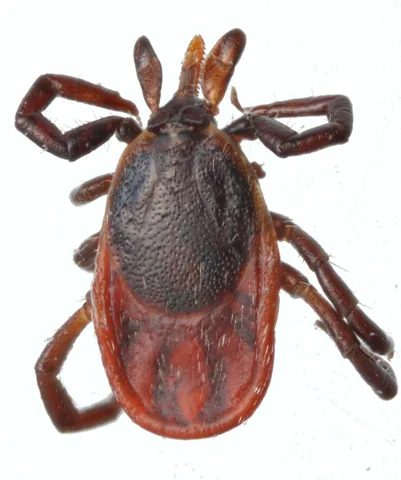
CDC names the blacklegged or deer tick (Ixodes scapularis) as the tick that spreads Babesia microti. Wisconsin's health department says the ticks that spread babesiosis are found in every county in that state.[2][14]
The young stage does most of the damage. CDC says it is typically the nymph that spreads the parasite. Nymphs are most active in warmer months such as spring and summer, in woods, bushes and tall grass, and at about the size of a poppy seed they and their bites are easy to miss.[2][4]
For field marks, the tick's life cycle and how to tell it from other ticks, see the blacklegged tick profile and the deer ticks vs dog ticks guide linked below.[2]
Where and when babesiosis happens
CDC lists Connecticut, Maine, Massachusetts, New Hampshire, Rhode Island, Vermont, New York, New Jersey, Wisconsin and Minnesota as areas where outdoor time can expose people. In the Northeast, infected ticks are found inland, on the coast, and on islands including Nantucket and Martha's Vineyard, Block Island, Shelter Island, Fire Island and eastern Long Island. Cases have also occurred in several neighboring states with large deer populations.[2]
Babesiosis is nationally notifiable, and CDC says 41 states and the District of Columbia notify it of cases. Between 2012 and 2023, yearly US counts ranged from 900 to 3,500. CDC's state table shows 3,586 reported cases in 2023, with New York (1,169), Massachusetts (841), New Jersey (406) and Connecticut (246) among the largest counts that year.[6][7]
Those counts are by the patient's state of residence, which is not always where the bite happened, and some states (Pennsylvania among them) do not require reporting. Minnesota's health department describes the infection as uncommon there but increasing in frequency, and a 2019 review describes babesiosis as increasing in frequency and geographic range.[7][11][13]
Spread by blood transfusion
CDC and Connecticut's health department list blood transfusion as a less common way people get babesiosis, and Merck Veterinary Manual also names contaminated blood from an infected donor. Peer-reviewed work explains why: many infected people have no symptoms and the parasite can stay in the blood for months or even years, so a healthy-feeling donor may not know they carry it.[1][15][18][17]
That review says transfusion recipients are at high risk of severe babesiosis. CDC's clinical overview also lists newborns exposed through transfusion among those at risk of severe disease.[17][5]
FDA has determined babesiosis to be a relevant transfusion-transmitted infection and issued guidance to blood collectors for donor screening, donation testing, donor deferral and product management. The same peer-reviewed review describes the resulting adoption of regional blood donor testing in the US.[9][17]
Symptoms
CDC says symptoms, if any, can start about a week after infection but usually develop over a few weeks or months, and sometimes longer. CDC's clinical guidance adds that illness may first appear or come back many months later, especially in people whose immune system is or becomes weakened.[3][5]
- Flu-like symptoms: fever, chills, sweats, headache, body aches, loss of appetite, nausea and fatigue. Minnesota's health department lists high fever and muscle aches.[1][3][10]
- Signs of red blood cell destruction: hemolytic anemia, which can cause jaundice (yellowing of the skin) and dark urine.[3][10]
- Severe disease can bring low and unstable blood pressure, severe anemia, a very low platelet count, widespread clotting and bleeding (DIC), kidneys, lungs or liver not working properly, and death.[3][5]
- No symptoms at all: CDC says many infected people do not feel sick, and Minnesota's health department notes symptoms may go away without treatment.[1][10]
Who is at risk of severe babesiosis
Most of the danger is concentrated in a few groups. CDC lists people who:[3][1]
- Do not have a spleen (CDC's clinician page also lists a spleen that works poorly).[3][5]
- Have a weak immune system from cancer, lymphoma, HIV or AIDS, immune-suppressing medicines or other causes.[3][1][5]
- Have serious heart, liver or kidney disease.[1][5]
- Are older: CDC's public pages say over 50, and reviews say older and immunocompromised patients face the risk of death.[3][16]
- Are newborns exposed through transfusion, before birth or through a tick bite, per CDC's clinical overview.[5]
When to get care
Minnesota's health department says to see your doctor immediately if babesiosis is suspected, and that early diagnosis and treatment can shorten the illness and reduce its severity.[10]
CDC's prevention page says people at high risk of severe babesiosis, such as those without a spleen, should take special care with tick-bite prevention. If you are in one of the high-risk groups above, don't wait out a fever after tick exposure.[4][3]
Signs of severe illness such as yellow skin, dark urine, trouble breathing or confusion need urgent care; CDC's clinical guidance lists acute respiratory distress and altered mental status among severe complications.[3][5][10]
How it is diagnosed
CDC says a healthcare provider can diagnose babesiosis by looking at a small blood sample under a microscope to find the parasites inside red blood cells, or by sending blood to a special lab such as CDC or a health department. Peer-reviewed reviews add that Babesia DNA can be detected with a PCR test.[1][16]
CDC says effective treatment exists and that people with no symptoms usually do not need treatment. Treatment decisions belong to your healthcare provider; this page doesn't cover drugs or doses.[1][10]
Preventing babesiosis
CDC's babesiosis prevention advice is the same tick-bite routine used for Lyme disease, with extra care for high-risk people. If a tick is already attached, our tick bite guide has the removal steps; the yard guide covers cutting ticks around the house.[4][8]
- Use repellent. CDC's babesiosis page names DEET for skin and clothes; its general tick page also lists EPA-registered picaridin, IR3535, oil of lemon eucalyptus, PMD and 2-undecanone. Follow the label.[4][8]
- Treat clothes and gear with permethrin or buy pre-treated clothing, especially in wooded or brushy areas or where there are deer.[4][8]
- Stay in the center of clear trails, away from leaf litter and brush. Wear socks, long pants tucked into socks and long sleeves; light colors make ticks easier to spot.[4][1]
- Remove ticks from clothes and pets before going inside, then do a full-body check with a mirror, including behind the knees, groin, underarms and scalp.[4]
- Pull attached ticks out quickly with fine-tipped tweezers, straight out and steady. Never crush a live tick with your fingers; put it in alcohol, seal it in a bag or container, wrap it tightly in tape, or flush it.[4]
- Shower soon after being outdoors and tumble dry dry clothes on high heat for 10 minutes to kill ticks riding on them.[8]
Babesiosis in dogs
Dogs get babesiosis too, but mostly from different Babesia species. Merck Veterinary Manual lists Babesia canis, B. vogeli and B. rossi, each spread by different ticks, plus Babesia gibsoni, a smaller parasite that tends to cause long-lasting disease with progressive, severe anemia.[18]
Signs in dogs range from a mild illness that passes quickly to severe disease that kills quickly, and some dogs develop long-term anemia. Merck says it can be confused with other causes of fever, anemia, jaundice or red urine, so lab tests are needed to confirm it.[19][18]
Merck says it is unclear whether the Babesia species that infect dogs are the same as those that cause human infection. A vaccine based on some types of Babesia exists but does not cover all types; tick control products and prompt tick removal help keep dogs from being exposed. Ask your veterinarian about both, and see our dog tick removal guide.[19]
Common questions
- Can you get babesiosis from a deer tick bite?
- Yes. CDC says most US infections come from blacklegged (deer) tick bites, usually from nymphs, mainly in the Northeast and upper Midwest.[1][2]
- How long does a tick have to be attached to spread babesiosis?
- CDC says blacklegged tick nymphs usually must stay attached for more than 36 to 48 hours to transmit the parasite, so finding and removing ticks quickly lowers the risk.[4]
- Can babesiosis spread through blood transfusion?
- Yes, though it is less common than tick bites. CDC lists transfusion of blood carrying the parasite as a route, and FDA has issued donor screening and testing recommendations to reduce transfusion-transmitted babesiosis.[1][9]
- Is babesiosis contagious?
- Not person to person like the flu or a cold, CDC says. Besides tick bites, it can pass through blood transfusion and, very rarely, from a pregnant parent to the baby.[2][15]
- Can my dog give me babesiosis?
- Merck Veterinary Manual says human infections come from infected tick bites or contaminated transfusions, and it is unclear whether dog Babesia species are the same ones that infect people.[19][18]
- Can I have babesiosis and Lyme disease at the same time?
- Yes. The same deer tick carries both, and Minnesota's health department notes some people get two or more tickborne infections at once, which can complicate diagnosis.[10][2]
Photo credits
- Blacklegged Tick: (c) Christian Back, some rights reserved (CC BY) — via iNaturalist, CC BY 4.0
Sources
- Centers for Disease Control and Prevention, “About Babesiosis.” www.cdc.gov/babesiosis/about/index.html (accessed 2026-11-14)
- Centers for Disease Control and Prevention, “How Babesiosis Spreads.” www.cdc.gov/babesiosis/spreads/index.html (accessed 2026-11-14)
- Centers for Disease Control and Prevention, “Signs and Symptoms of Babesiosis.” www.cdc.gov/babesiosis/signs-symptoms/index.html (accessed 2026-11-14)
- Centers for Disease Control and Prevention, “Preventing Babesiosis.” www.cdc.gov/babesiosis/prevention/index.html (accessed 2026-11-14)
- Centers for Disease Control and Prevention, “Clinical Overview of Babesiosis.” www.cdc.gov/babesiosis/hcp/clinical-overview/index.html (accessed 2026-11-14)
- Centers for Disease Control and Prevention, “Babesiosis Maps and Graphs.” www.cdc.gov/babesiosis/maps-graphs/index.html (accessed 2026-11-14)
- Centers for Disease Control and Prevention, “Data and Statistics on Babesiosis.” www.cdc.gov/babesiosis/php/data-stats/index.html (accessed 2026-11-14)
- Centers for Disease Control and Prevention, “Preventing Tick Bites.” www.cdc.gov/ticks/prevention/index.html (accessed 2026-11-14)
- U.S. Food and Drug Administration, “Recommendations for Reducing the Risk of Transfusion-Transmitted Babesiosis (guidance, May 2019).” www.fda.gov/regulatory-information/search-fda-guidance-documents/recommendations-reducing-risk-transfusion-transmitted-babesiosis (accessed 2026-11-14)
- Minnesota Department of Health, “About Babesiosis.” www.health.state.mn.us/diseases/babesiosis/basics.html (accessed 2026-11-14)
- Minnesota Department of Health, “Babesiosis (Babesia microti).” www.health.state.mn.us/diseases/babesiosis/index.html (accessed 2026-11-14)
- Centers for Disease Control and Prevention, “Where Ticks Live.” www.cdc.gov/ticks/about/where-ticks-live.html (accessed 2026-11-14)
- International Journal for Parasitology, “Krause PJ. Human babesiosis. Int J Parasitol 2019;49(2):165-174 (PMID 30690090).” pubmed.ncbi.nlm.nih.gov/30690090/ (accessed 2026-11-14)
- Wisconsin Department of Health Services, “Babesiosis.” www.dhs.wisconsin.gov/tick/babesiosis.htm (accessed 2026-11-14)
- Connecticut Department of Public Health, “Babesiosis.” portal.ct.gov/dph/epidemiology-and-emerging-infections/babesiosis (accessed 2026-11-14)
- Infectious Disease Clinics of North America, “Waked R, Krause PJ. Human Babesiosis. Infect Dis Clin North Am 2022;36(3):655-670 (PMID 36116841).” pubmed.ncbi.nlm.nih.gov/36116841/ (accessed 2026-11-14)
- Pathogens, “Bloch EM, Krause PJ, Tonnetti L. Preventing Transfusion-Transmitted Babesiosis. Pathogens 2021;10(9):1176 (PMID 34578209).” pubmed.ncbi.nlm.nih.gov/34578209/ (accessed 2026-11-14)
- Merck Veterinary Manual, “Babesiosis in Animals.” www.merckvetmanual.com/circulatory-system/blood-parasites/babesiosis-in-animals (accessed 2026-11-14)
- Merck Veterinary Manual, “Blood Parasites of Dogs (Babesiosis).” www.merckvetmanual.com/dog-owners/blood-disorders-of-dogs/blood-parasites-of-dogs (accessed 2026-11-14)