On this page
How to identify it
- Orb weavers spin round webs of spokes and spirals and usually rest at the center or in a retreat at the edge, sensing prey by vibration because their eyesight is poor.[1][5]
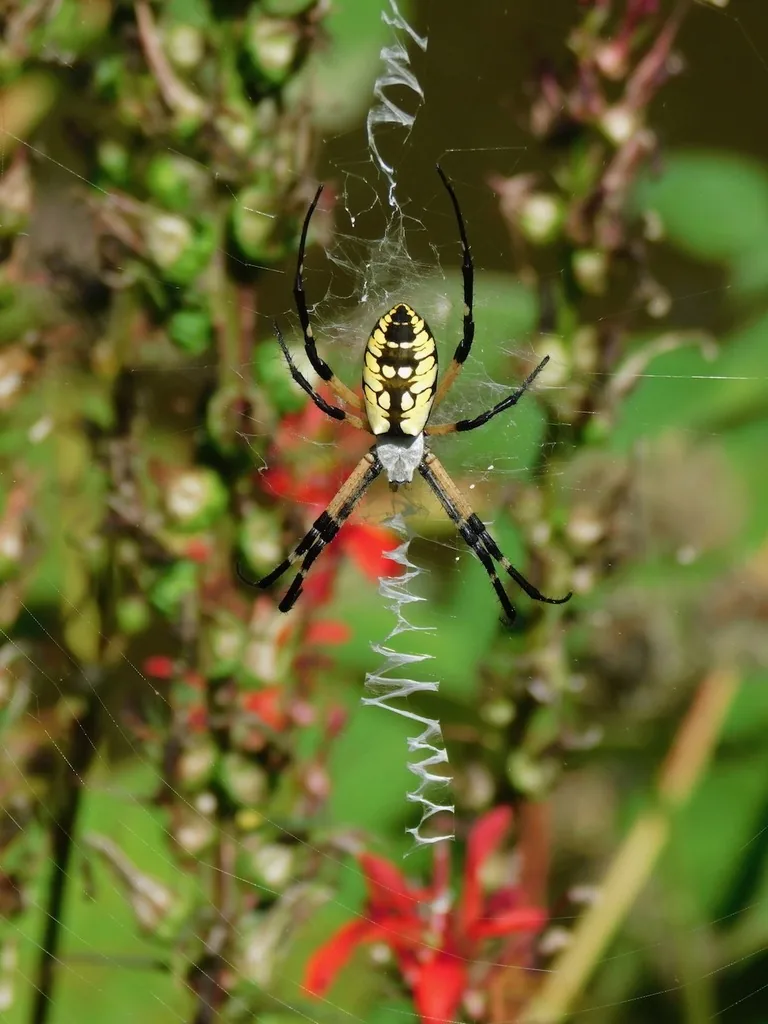
- Female yellow garden spiders have an egg-shaped abdomen boldly patterned black and yellow, a body about 3/4 to 1 inch long, and silvery hairs on the front body section. UF/IFAS says the female's carapace has yellow and black bands and the eyes are covered with silver hairs.[3][2][6][4][7]
- Their webs are large and vertical, often about 2 feet across in sunny open spots, with a thick white zigzag band of silk called a stabilimentum down the center. The spider rests head-down at the hub.[2][3][6][4]
- Males are much smaller, about 1/4 inch, and duller; young females have a narrower abdomen and banded legs. UF/IFAS says males are under 6 mm and brown, with enlarged, swollen pedipalps, and that juveniles have orange-and-black banded legs, unlike the solid black legs of adults.[6][2][4][7]
- At rest the spider often holds its legs paired in an X shape.[6][3]
Look-alikes
| Look-alike | How to tell them apart |
|---|---|
| Banded garden spider (Argiope trifasciata) | A close relative with thin yellow, white and black bands across the abdomen and black-striped yellow legs. It lays a single egg sac, while the yellow garden spider lays up to four.[6] |
| Golden silk orbweaver (Trichonephila clavipes) | Larger, with a white front body section, a yellow abdomen, hairy bottlebrush tufts on its legs and golden-colored silk.[6] |
| Joro spider (Trichonephila clavata) | An invasive Asian orb weaver with golden webs and horizontal silver stripes on the abdomen; it lays egg sacs outside the web, unlike garden spiders.[6] |
Where it lives
The yellow garden spider occurs across most of the United States; UC IPM counts about 200 orb weaver species in North America. GBIF holds about 69,000 US records of the yellow garden spider since 1990 from 43 states, counting the District of Columbia, most from Texas, North Carolina, Virginia and Florida. UF/IFAS says Argiope aurantia lives in Central and North America and is most common in the eastern part of its range, along the edges of water, on grassy hillsides and in woodlands; it is densest where two habitats meet and is often seen along roadsides and on farms and gardens.[2][5][8][7]
Biology and life cycle
There is one generation a year; adults are seen mostly from July to October.[3][6]
After mating in late summer or early fall, females lay several hundred to a thousand or more eggs in a brown, papery sac hung in the web or attached to nearby plants, and a female may make about four sacs. UF/IFAS says the eggs sit in a white, multilayered, teardrop-shaped sac with a wool-like layer of silk that buffers them from short-term temperature swings, preferably attached to webbing under vegetation or broad-leaved plants.[3][2][6][4][7]
Spiderlings hatch but stay in the sac over winter and emerge in spring, then disperse by ballooning on silk; many are lost to cannibalism, birds and mud dauber wasps, and birds such as titmice and chickadees eat the egg sacs in winter. UF/IFAS says the youngest spiders balloon vertically, older ones horizontally, and adults are too large to balloon.[3][2][4][7]
Females often eat the sticky web at night and spin a new one, and an individual spider tends to stay in the same area all season.[3][4]
They catch a variety of insects, especially grasshoppers and katydids, and wrap larger prey in silk. UF/IFAS says dragonflies and damselflies, and wasps and bees, are the main prey, with flies, mayflies, beetles, true bugs, grasshoppers, and butterflies and moths caught less often. The spider wraps prey in silk by throwing it, by rotating it or by walking around it, then bites it.[4][6][7]
When disturbed, the spider often makes its web vibrate, a blur that makes it harder for predators to target. The female dies with the first frosts. UF/IFAS adds that a provoked spider may flex the zigzag silk to threaten the intruder or drop from the web onto vegetation or the ground.[4][7]
UF/IFAS says the yellow garden spider is crepuscular, active in the morning and at nightfall. Young spiders first place webs about 15 cm (5.9 in) off the ground in spots sheltered from wind and build higher as they age; webs face away from dense vegetation, are angled downhill, and bush clover is a preferred attachment site.[7]
Jumping spiders attack young yellow garden spiders, but adults are large enough to deter them and may even eat them, and mud daubers commonly prey on the species. UF/IFAS says the spider may add up to two barrier webs at the edges of its orb, which block some predators and alert it to disturbances.[7]
Damage and signs
Health risk
Not considered medically important; they are docile and would rather run than bite. A bite usually requires careless handling, such as handling a female with an egg sac in her web, and would feel like a bee or wasp sting.[2][3][6]
Control
Prevention
Because these spiders are beneficial, no control is necessary.[3][4]
Outdoor lights attract the insects spiders hunt, so keep fixtures off walls and away from doors and windows where possible.[5]
Traps and physical control
If webs on the house are a nuisance, remove them with a broom or high-pressure hose, and trim plants back from the walls.[5]
Pesticides
Insecticides won't give long-term control and generally shouldn't be used against spiders outdoors.[5]
Where sources disagree
What the zigzag is for: Penn State calls its function unclear, and NC State says experts disagree, noting it was once thought to stabilize the web. Clemson lists attracting prey, making the spider look bigger and warning animals away from the web. In a 1983 experiment, webs given artificial zigzags were less often destroyed, suggesting a warning to birds, while a 2001 study found the decorations can also draw spider-eating predators to the web. UF/IFAS describes the zigzag stabilimentum as a defensive structure the spider may flex to threaten an intruder.[2][3][6][9][10][7]
Egg sac shape: Penn State and NC State describe a spherical sac, Clemson a somewhat teardrop-shaped one, and Missouri says it is a little smaller than a ping-pong ball. UF/IFAS describes a white, multilayered, teardrop-shaped sac.[2][3][6][4][7]
Web size: Penn State says webs 50 to 100 cm (about 20 to 40 inches) across are common, while Missouri gives about 2 feet.[2][4]
Prey: Missouri and Clemson say it catches a variety of insects, especially grasshoppers and katydids, while UF/IFAS says dragonflies and damselflies, and wasps and bees, are its main prey, with grasshoppers caught less often.[4][6][7]
Female size: NC State, Penn State, Clemson and Missouri give a body about 3/4 to 1 inch long, while UF/IFAS gives 14 to 24 mm, about 1/2 to 1 inch.[3][2][6][4][7]
Common questions
- Why is it called a writing spider?
- Because of the white zigzag band of silk it weaves down the middle of its web, which looks like writing. UF/IFAS says the zigzag pattern is why it is also called the writing spider.[6][3][7]
- Should I kill the big yellow spider in my garden?
- There's no need. Garden spiders aren't aggressive, eat insects that include pests, and are considered beneficial. UF/IFAS says it will generally flee rather than attack when disturbed.[3][6][4][7]
- Do orb weavers come into the house?
- Rarely. They often live on or near outside walls but have poor eyesight and have trouble walking anywhere but webs.[1]
Sources
- University of Kentucky Entomology, “ENTFACT-622: Common Spiders Found Around Homes and Buildings.” entomology.mgcafe.uky.edu/ef622 (accessed 2026-11-11)
- Penn State Extension, “Yellow Garden Spider (updated June 24, 2026).” extension.psu.edu/yellow-garden-spider (accessed 2026-11-11)
- NC State Extension, “Black and Yellow Garden Spider (reviewed May 8, 2023).” content.ces.ncsu.edu/black-and-yellow-garden-spider (accessed 2026-11-11)
- Missouri Department of Conservation, “Black-and-Yellow Garden Spider (Field Guide).” mdc.mo.gov/discover-nature/field-guide/black-and-yellow-garden-spider (accessed 2026-11-11)
- University of California Statewide IPM Program, “Spiders (Pest Notes, Home and Landscape).” ipm.ucanr.edu/home-and-landscape/spiders/ (accessed 2026-11-11)
- Clemson Cooperative Extension Home and Garden Information Center, “Big Yellow Spiders in South Carolina (HGIC 2503, revised November 20, 2024).” hgic.clemson.edu/factsheet/big-yellow-spiders-in-south-carolina/ (accessed 2026-11-11)
- University of Florida IFAS Extension (EDIS), “Yellow Garden Spider, Writing Spider, Argiope aurantia (Lucas), EENY-743/IN1273 (Featured Creatures; T. B. Griffith and J. Gillett-Kaufman).” ask.ifas.ufl.edu/publication/IN1273 (accessed 2026-11-14)
- Global Biodiversity Information Facility (GBIF), “Argiope aurantia: US occurrence records since 1990 by state (GBIF occurrence search API).” api.gbif.org/v1/occurrence/search?taxonKey=5171022&country=US&hasGeospatialIssue=false&occurrenceStatus=PRESENT&year=1990%2C2026&facet=stateProvince&facetLimit=400&limit=0 (accessed 2026-11-11)
- Science, via PubMed, “Spider web protection through visual advertisement: role of the stabilimentum (Eisner and Nowicki 1983).” pubmed.ncbi.nlm.nih.gov/17841687/ (accessed 2026-11-11)
- Proceedings of the Royal Society B, via PubMed, “Stabilimenta attract unwelcome predators to orb-webs (Seah and Li 2001).” pubmed.ncbi.nlm.nih.gov/11487401/ (accessed 2026-11-11)
- iNaturalist, “Argiope aurantia taxon page (order and family).” www.inaturalist.org/taxa/67707 (accessed 2026-11-11)