On this page
How to identify it
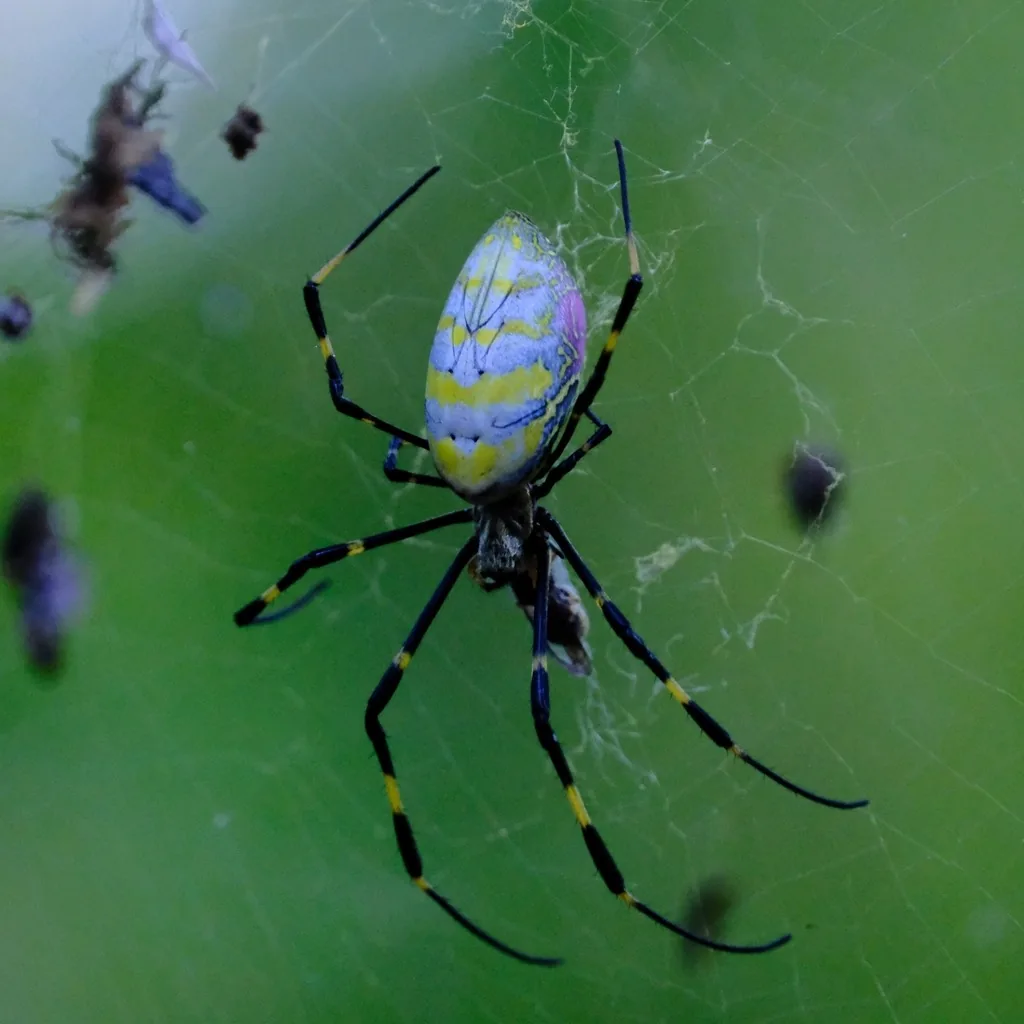
- Adult females are very large, with a body that can exceed 1 inch and black-and-yellow banded legs up to 3 inches long.[1]
- From above, the female has a silver or white front body section and a bright yellow abdomen crossed by teal bands; Clemson describes horizontal silver stripes on the abdomen.[1][4]
- The underside is checkered black and white, with red splotches near the tail end.[1]
- Males are much smaller, slender and drab brown, yellow and black, and are often not recognized as the same species.[1]
- Mature females spin strong, sticky golden webs that can span 10 feet or more, with support strands reaching 20 feet or longer between treetops.[1]
Look-alikes
| Look-alike | How to tell them apart |
|---|---|
| Golden silk orbweaver (banana spider) | A native relative with golden webs, first recorded in Charleston, South Carolina, in 1863. Its abdomen lacks the Joro's silver stripes, and the female has hairy 'bottlebrush' tufts on its black leg segments.[4] |
| Yellow garden spider | Smaller, with a black-and-yellow patterned abdomen. Argiope garden spiders usually add a zigzag decoration (stabilimentum) to the web, which Trichonephila species such as the Joro do not.[4][2] |
Where it lives
Native to East Asia, including Japan, Korea and China, it was first found in three Georgia counties in 2014 and had spread about 75 miles in all directions by 2022 (UGA). Penn State Extension says it has since spread through northern Georgia and nearby Alabama, North Carolina, South Carolina and Tennessee, with an established, expanding population around Elkridge, Maryland; single spiders found in Oklahoma (2021) and California (2025) don't mean it is established there.[4][1][2]
Biology and life cycle
There is one generation a year: eggs overwinter, hatch in April and May, and spiders mature in August and September. Penn State notes mature females have been photographed in Georgia from late August to early December.[1][2]
In fall, females lay eggs in fuzzy, off-white silk egg masses attached to leaves, tree bark or structures such as deck slats. UGA gives batches of several hundred to more than 1,000 eggs, while Clemson and Penn State say a female lays a single sac of 400 to 500.[1][4][2]
Spiderlings spread by ballooning on silk carried by the wind, which can move them tens to hundreds of miles; spiders have also hitched rides on cars and trucks.[2][5]
Their webs catch many flying insects; a UGA Extension agent noticed many stink bugs caught in them, and UGA advises removing webs near beehives and pollinator gardens.[5][1]
Damage and signs
- No damage to homes; the main complaint is large, sticky webs across porches, walkways, decks and doorways.[1]
Health risk
Joro spiders are timid and run away rather than bite. In a 2025 study, bites happened mainly when spiders were forcibly restrained, and volunteers bitten under medical supervision reported low pain and only brief, local redness and swelling. Penn State says the venom is weak and not medically important.[1][3][2]
Control
Prevention
Extension specialists suggest leaving Joros alone at the edges of the yard and in shrub beds, and removing only those near walkways, doors, decks and porches.[1]
Traps and physical control
Wrap the spider up in its web with a broom, rake or stick and step on it; just knocking down the web doesn't work because they rebuild quickly.[1]
Remove webs near beehives and pollinator or flower gardens. Penn State notes that egg sacs found in fall and winter can be destroyed before the spiderlings hatch.[1][2]
Pesticides
In UGA spray trials of garden-center products labeled for spiders, Black Flag Spider and Scorpion Killer (lambda-cyhalothrin and prallethrin) killed every treated spider, and Zevo Insect Killer Spray for Ant, Roach and Spider (then geraniol and cinnamon oil), Sevin ready-to-use spray (lambda-cyhalothrin) and Green Light Insecticidal Soap also worked; current versions may differ. Dried pyrethroid residues do little against web spiders, which don't contact them.[1]
Avoid area-wide sprays and fogging, which kill pollinators and natural enemies; scale insects have increased after such treatments.[1]
Penn State Extension says pesticide controls are not recommended at this point. A 2025 study found high-dose pyrethroid, essential-oil and detergent-based pesticides highly effective, but urged weighing whether Joro control is warranted in the first place.[2][6]
How far it is spreading
Researchers think the Joro was likely introduced to northern Georgia around 2010. Climate models built from its Asian range predict the most suitable North American habitat lies north of its current range, and it appears to be spreading faster north than south.[7]
Penn State estimates it spread 50 to 80 miles outward between 2014 and 2026, about 10 miles a year, and expects it can spread through eastern North America at least as far north as Pennsylvania; ballooning spiderlings carried by storms could jump much farther.[2]
In Atlanta-area forests at the front of the spread, Joro numbers doubled each year from 2022 to 2024 while native orb weavers declined by about 40 percent a year.[8]
Common questions
- Are Joro spiders dangerous?
- No. They are shy and rarely bite even when handled; Penn State says their small fangs have trouble piercing human skin, and bites cause only mild, local symptoms.[2][3][1]
- Should I spray my yard for Joro spiders?
- UGA Extension advises against broad sprays. Remove the spiders in your way by hand, and leave those in out-of-the-way spots alone.[1]
- How do I tell a Joro spider from a golden silk orbweaver?
- Look at the abdomen and legs: the Joro has silvery cross stripes on a yellow abdomen, while the golden silk orbweaver has hairy tufts on its legs.[4]
Sources
- University of Georgia Cooperative Extension, “Managing Joro Spiders in the Landscape (Circular 1289, full review August 27, 2026).” fieldreport.caes.uga.edu/publications/C1289/managing-joro-spiders-in-the-landscape/ (accessed 2026-11-12)
- Penn State Extension, “Jorō Spiders.” extension.psu.edu/joro-spiders (accessed 2026-11-12)
- J Med Entomol 2025;62(6):1396-1408, via PubMed, “Keep calm and carry on: bites from Trichonephila clavata are unlikely and cause minimal discomfort (2025).” pubmed.ncbi.nlm.nih.gov/41123166/ (accessed 2026-11-12)
- Clemson Cooperative Extension, Home & Garden Information Center, “Big Yellow Spiders in South Carolina (HGIC 2503, revised November 20, 2024).” hgic.clemson.edu/factsheet/big-yellow-spiders-in-south-carolina/ (accessed 2026-11-12)
- University of Georgia College of Agricultural and Environmental Sciences, “New spiders in north Georgia are hard to miss but pose no threat (October 11, 2018).” fieldreport.caes.uga.edu/news/new-spiders-in-north-georgia-are-hard-to-miss-but-pose-no-threat/ (accessed 2026-11-12)
- J Econ Entomol 2025;118(6):3127-3138, via PubMed, “Chemical management strategies for the invasive Jorō spider, Trichonephila clavata (Araneae: Araneidae) (2025).” pubmed.ncbi.nlm.nih.gov/41123172/ (accessed 2026-11-12)
- Ecol Evol 2023;13(11):e10728, via PubMed, “Veni, vidi, vici? Future spread and ecological impacts of a rapidly expanding invasive predator population (2023).” pubmed.ncbi.nlm.nih.gov/38020683/ (accessed 2026-11-12)
- Insects 2025;16(5):443, via PubMed, “Explosive Growth of the Jorō Spider and Concurrent Decline of Native Orbweaving Spiders in Atlanta, Georgia Forests (2025).” pubmed.ncbi.nlm.nih.gov/40429156/ (accessed 2026-11-12)
- iNaturalist, “Trichonephila clavata taxon page (order and family).” www.inaturalist.org/taxa/904334 (accessed 2026-11-12)