On this page
How to identify it
- The Missouri Department of Conservation gives a length of usually about ½ inch, not counting the legs; Mississippi State gives ½ to ¾ inch for mature females. Males are smaller and rarely seen. UF/IFAS gives females 8.5 to 19.7 mm (1/3 to ¾ inch) and males 4.5 to 15 mm long, and says Florida spiders are usually at the large end, making it one of the largest orbweavers in the state.[1][2][6]
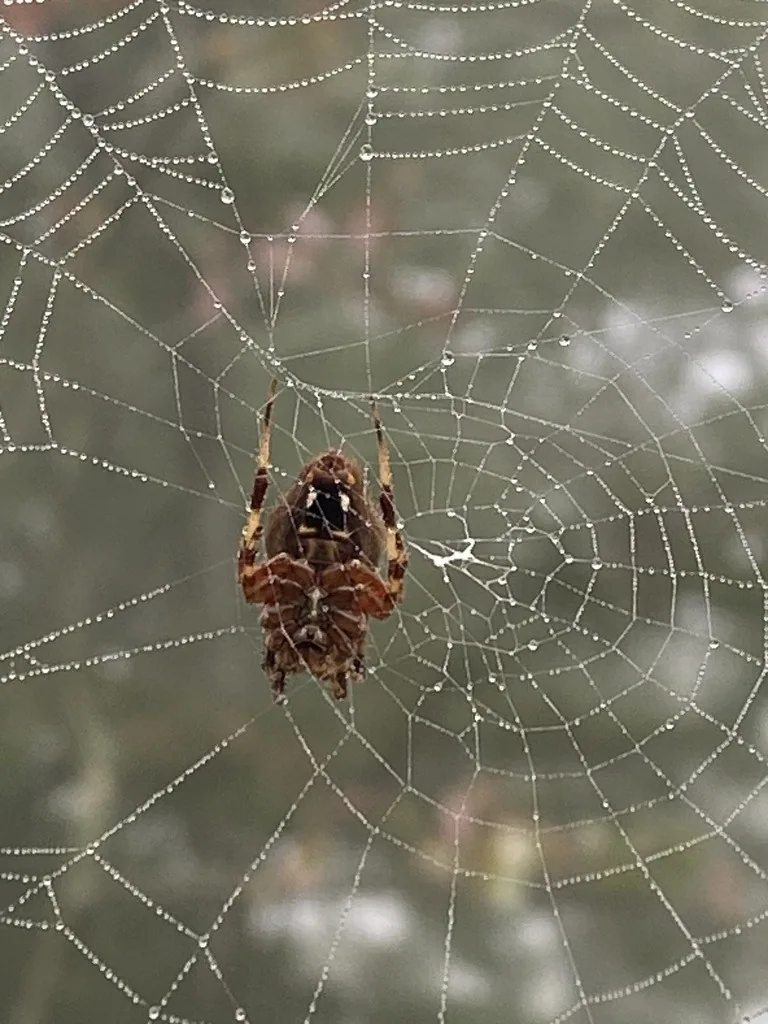
- The name spotted orbweaver comes from two distinct white spots on the underside of the abdomen, and the species name crucifera from an embossed cross shape on top.[2]
- Like other Neoscona orbweavers it has camouflage colors: a slightly triangular-oval abdomen with a pattern like an upside-down spruce tree, legs usually gray with brown rings, and a gray carapace with brown markings.[1]
- UF/IFAS describes females as reddish brown to brown (northern females are occasionally white) and males as lighter brown with the sides of the carapace nearly black. The legs are banded reddish brown and pale yellow with brown femora, and a double row of black slash marks runs along the back half of the abdomen, though it is sometimes obscured.[6]
Look-alikes
| Look-alike | How to tell them apart |
|---|---|
| Other Neoscona and Araneus orbweavers | Missouri has four Neoscona species, including the arabesque orbweaver, and Araneus orbweavers such as the marbled and openfield orbweavers look similar; these spiders are hard to tell apart, even for specialists. Furrow orbweavers (Larinioides) are another camouflage-patterned group common near homes.[1] |
| Neoscona domiciliorum | This close relative is usually smaller and less common. Females have a bright white or grayish-yellow abdomen with a wide black stripe down each side and red femora, and UF/IFAS says the two species have long been confused. It occurs southeast of a line from Massachusetts to Indiana and southwest to Texas.[6] |
Where it lives
The Missouri Department of Conservation calls it widespread and the most common Neoscona in Missouri, where it is found statewide. Mississippi State describes it as familiar to anyone outdoors in the fall in Mississippi. UF/IFAS gives the range as Lake Okeechobee in southern Florida north to New England, west to Minnesota and southwest to Arizona and central Mexico.[1][2][6]
Biology and life cycle
The Missouri Department of Conservation says the female builds her web at dusk, hunts at night, eats the web at dawn and hides in cracks and corners by day. Mississippi State adds that young spiders take their webs down early in the morning, partly to avoid mud daubers, but mature females in fall start leaving webs up during the day.[1][2]
Webs are often strung about chest high along woods edges and across paths, and around homes near entryways, porches, decks and outdoor lights that draw insects at night. UF/IFAS says the edge of an eave is often the upper support, with the bottom lines tied to a shrub or the ground, and a simple silk retreat under the eave serves as the daytime shelter.[2][1][6]
Moths and crane flies are the main prey. The spiders themselves are a favorite prey of mud dauber wasps. UF/IFAS names the mud dauber Trypargilum politum as a frequent predator of the young spiders.[1][2][6]
Spiderlings hatch early in the growing season and reach full size by late summer and fall. Adults die with the first freeze, and the young spend the winter in egg cases.[1]
UF/IFAS says it is more common in moist woodland than dry woods, especially where hardwoods dominate. Young spiders spin vertical orbs about dusk, take them down shortly after dawn and spend the day in a retreat of leaves curled together and tied with silk.[6]
The orb can be nearly 2 feet (60 cm) across. The egg sac is fluffy yellow silk inside a rolled leaf, around an egg mass 5 to 12 mm across that may hold up to 1,000 eggs.[6]
In the northern states males may mature as early as late June and females in July, but in Florida adults usually aren't noticeable until late August.[6]
Damage and signs
Health risk
The CDC names the black widow and brown recluse as the venomous spiders of concern in the U.S., and notes that spiders are usually not aggressive: most bites happen when a spider is trapped or touched. MedlinePlus says most spider bites are harmless. CDC first aid for a spider bite is to wash the area with soap and water and apply a cold, damp cloth or ice to reduce swelling.[3][4]
Control
Prevention
Webs tend to collect around outdoor lights left on at night, because the lights draw the insects these spiders eat.[2][1]
Traps and physical control
Control is not usually needed or recommended. If a web is too close to a door or deck, use a broom to move the spider elsewhere.[2]
Where the sources disagree
Size: Missouri gives females usually about ½ inch and Mississippi State ½ to ¾ inch; UF/IFAS gives 8.5 to 19.7 mm and says Florida spiders run larger than northern ones.[1][2][6]
Common questions
- What is the big brown spider that makes a web on my porch every night?
- Likely a spotted orbweaver, which often builds webs near porches and outdoor lights and, for much of the season, spins a new web each evening.[1][2]
- Is the spotted orbweaver dangerous?
- No. The CDC lists only the black widow and brown recluse as venomous spiders of concern in the U.S., and MedlinePlus says most spider bites are harmless.[3][4]
- Where does it go during the day?
- It hides in nearby cracks, corners or vegetation. In fall, mature females may stay on the web during the day.[1][2]
- Why is the spider sitting in its web in daylight?
- In fall, adult females often leave their webs up and hunt during the day. UF/IFAS suggests they need extra food for developing eggs while night-flying prey drops off on cooler fall nights.[6][2]
Sources
- Missouri Department of Conservation, “Arboreal Orbweaver (Spotted Orbweaver) (Field Guide).” mdc.mo.gov/discover-nature/field-guide/arboreal-orbweaver-spotted-orbweaver (accessed 2026-11-11)
- Mississippi State University Extension, “Hentz Orbweaver (Bug's Eye View, Vol. 2, No. 33).” extension.msstate.edu/newsletters/bugs-eye-view/2016/hentz-orbweaver-vol-2-no-33 (accessed 2026-11-11)
- CDC, National Institute for Occupational Safety and Health, “Venomous Spiders at Work.” www.cdc.gov/niosh/outdoor-workers/about/venomous-spiders.html (accessed 2026-11-11)
- MedlinePlus, U.S. National Library of Medicine, “Insect bites and stings (Medical Encyclopedia).” medlineplus.gov/ency/article/000033.htm (accessed 2026-11-11)
- iNaturalist, “Neoscona crucifera taxon page (order and family).” www.inaturalist.org/taxa/85034 (accessed 2026-10-06)
- University of Florida IFAS Extension, EDIS (Featured Creatures), “Orb Weavers, Neoscona crucifera (Lucas 1839) and Neoscona domiciliorum (Hentz), EENY316/IN569 (Featured Creatures).” ask.ifas.ufl.edu/publication/IN569 (accessed 2026-11-14)