On this page
How to identify it
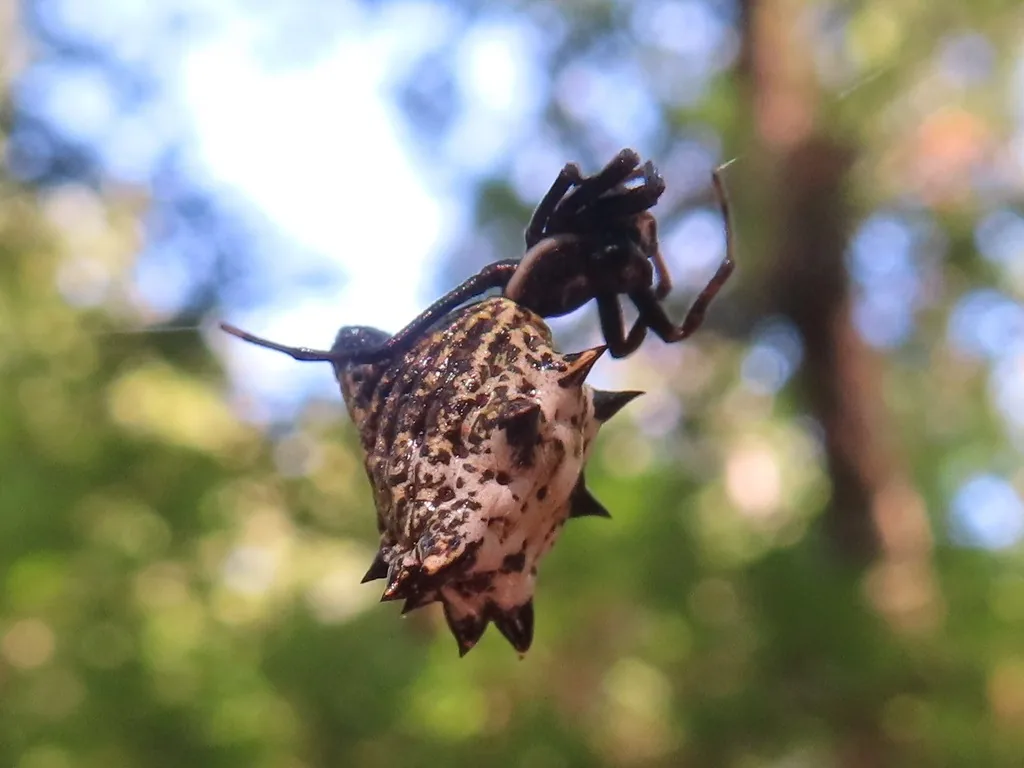
- Females have a chunky abdomen ringed with five pairs of black spines (cones), and the underside of the abdomen is cone-shaped. Missouri gives females as about 3/8 inch long; Penn State gives 7.5 to 10 millimeters.[1][2]
- Color varies a lot. Penn State says most are black with white markings, though many are mostly white with orange or brown spots; Missouri describes them as whitish to yellowish, mottled with black or brown, with an amber head region and glossy black legs.[1][2]
- In the web the female hangs with her back toward the ground and spinnerets pointing up, so the abdomen looks like a tiny pyramid.[2]
- Males look quite different: smaller, with an elongated, flattened abdomen and no spines. Missouri gives them as only about 1/8 inch long; Penn State gives 4.5 to 5 millimeters. Males don't spin webs and are mostly seen courting in females' webs.[1][2]
Look-alikes
| Look-alike | How to tell them apart |
|---|---|
| Other micrathenas and the arrowhead spider | Missouri has two other micrathenas (arrowshaped and white) and the similar arrowhead spider; females are easily told apart by comparing photos.[2] |
Where it lives
Penn State says it is found in most states east of the Rocky Mountains, in wooded places including landscaped yards. Missouri finds it statewide in woodland, more commonly in the central and southern part of the state where timber is more extensive. GBIF's public U.S. records since 1990 (about 14,500) come from 33 states on the map, most from Ohio, Virginia and Pennsylvania. Most of its relatives are tropical: a 2024 study of the genus covered 117 Micrathena species, a genus diverse and widespread in the forests of Central and South America.[1][2][7][6]
Biology and life cycle
It overwinters as eggs; adults mature in early summer and females are found until October, most often in August and September.[1][2]
Females build their orbs along flyways and trails where bushes and other plants are about 6 feet apart, and hikers often meet the strong dragline stretched across a trail at about eye level. Missouri says this and the arrowhead spider are two of the spiders hikers most often run into.[1][2]
The web is a delicate, closely woven orb built to catch tiny flying insects such as gnats, mosquitoes and leafhoppers. Like other orbweavers, it usually keeps a long escape line running from the web to a leaf or branch above.[2]
In one study, spined micrathena web sections intercepted more insects than those of a cribellate orbweaver, whether held upright or flat, and held many small flies; the authors credit its stickier, more closely spaced capture spirals.[4]
It builds in shaded forest, and in a lab test a day's worth of summer ultraviolet B light weakened the glue on its capture threads, while glue from species of sunny habitats was not affected.[5]
Damage and signs
- Missouri says micrathenas almost never enter houses, and credits these small predators with helping limit gnats and mosquitoes.[2]
Health risk
Penn State says it is not known to bite people and is probably not medically important.[1]
Control
Prevention
Neither source recommends control. Penn State says it is not known to bite people, and Missouri says it helps limit gnats and mosquitoes.[1][2]
Common questions
- What is the spiky spider in the web across the trail?
- Likely a female spined micrathena.[1][2]
- Does the spined micrathena bite?
- It is not known to bite people.[1]
- Will it come in the house?
- Almost never. Missouri says micrathenas almost never enter houses.[2]
- Why do I keep walking into spider webs on woodland trails?
- Females of this spider set their webs in the open space along trails, which flying insects also use as corridors, and the dragline often crosses at about eye level. Webs are most noticeable in August and September.[2][1]
Sources
- Penn State Extension, “Spined Micrathena.” extension.psu.edu/spined-micrathena/ (accessed 2026-11-11)
- Missouri Department of Conservation, “Spined Micrathena (Field Guide).” mdc.mo.gov/discover-nature/field-guide/spined-micrathena (accessed 2026-11-11)
- iNaturalist, “Micrathena gracilis taxon page (order and family).” www.inaturalist.org/taxa/85333 (accessed 2026-11-11)
- Zoology (Jena), via PubMed, “The effects of capture spiral composition and orb-web orientation on prey interception (Opell, Bond and Warner 2006).” pubmed.ncbi.nlm.nih.gov/16962752/ (accessed 2026-11-11). Cited from the PubMed abstract.
- Journal of Experimental Biology, via PubMed, “The impact of UVB radiation on the glycoprotein glue of orb-weaving spider capture thread (Stellwagen, Opell and Clouse 2015).” pubmed.ncbi.nlm.nih.gov/26333924/ (accessed 2026-11-11). Cited from the PubMed abstract.
- Cladistics, via PubMed, “Complete phylogeny of Micrathena spiders (Magalhaes et al. 2024).” pubmed.ncbi.nlm.nih.gov/38861251/ (accessed 2026-11-11). Cited from the PubMed abstract.
- Global Biodiversity Information Facility (GBIF), “Micrathena gracilis: occurrence records in the U.S., 1990-2026 (GBIF occurrence search).” api.gbif.org/v1/occurrence/search?taxonKey=2159593&country=US&hasGeospatialIssue=false&occurrenceStatus=PRESENT&year=1990%2C2026&facet=stateProvince&facetLimit=400&limit=0 (accessed 2026-11-11). State counts are records reported (iNaturalist research-grade, museum specimens, surveys), not abundance.