On this page
How to identify it
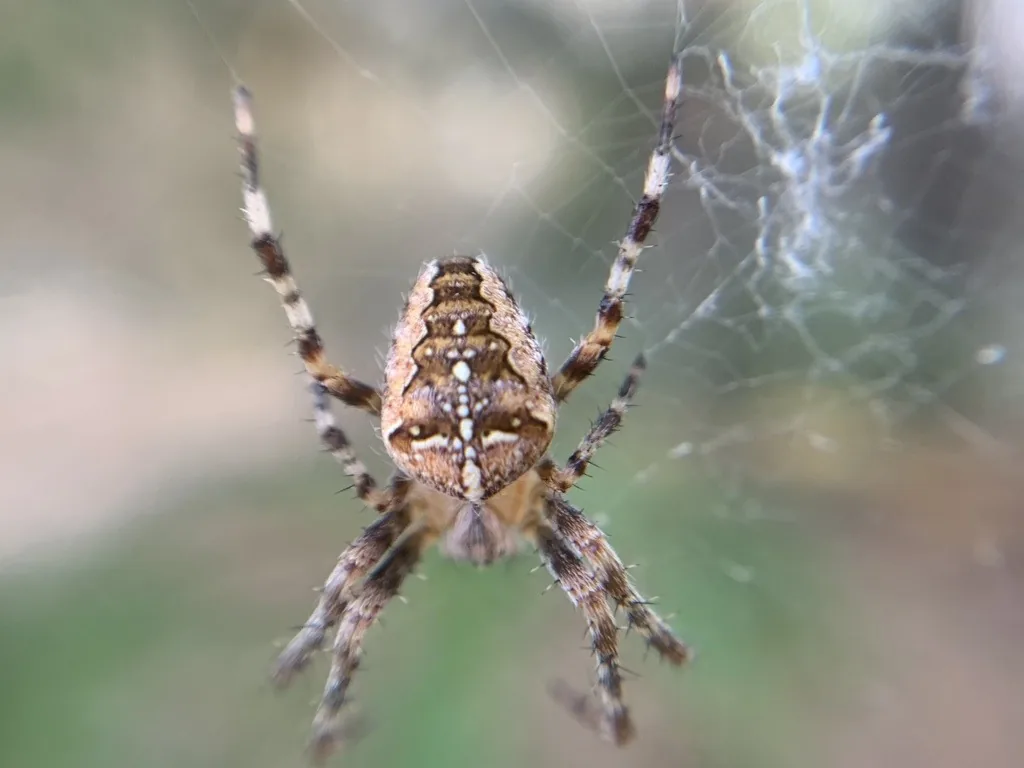
- Adult females are 6.5 to 20 mm long and males 5.5 to 13 mm; smaller, younger spiders are darker and adult females lighter.[1]
- The abdomen is yellow to brown with two wavy lengthwise lines and white or yellow spots; four long spots near the front form a cross.[1]
- The front body section has three dark lengthwise bands.[1]
Look-alikes
| Look-alike | How to tell them apart |
|---|---|
| Banded garden spider | Has the same three dark bands on the front body section, but its abdomen is pale yellow to silver with many black crosswise bands.[1][2] |
Where it lives
Penn State says it is known from Pennsylvania north through New England and Canada, and south into Washington and Oregon. GBIF's public U.S. records since 1990 (about 22,700) come from 19 states on the map, most from Washington, California and Oregon, with many also from New England, New York and Great Lakes states such as Michigan, Wisconsin and Illinois.[1][10]
Biology and life cycle
Adults are found from late summer through autumn.[1]
In late September females leave their webs to lay 300 to 900 eggs in a yellow silk cocoon under dead bark or in cracks and crevices.[1]
It's commonly found on or next to buildings with exterior lighting, including lighted stairwells in rural areas.[1]
Males find mates by scent: in choice tests, males were drawn to the odor of adult females but not to that of females that weren't yet mature.[9]
In a Belgian study of 63 populations, spiders in heavily built-up sites were smaller and spun webs with less surface area and narrower mesh, yet the species was about as abundant across the whole range from rural to urban.[7]
It depends on flying insects for food. Where those have declined, so has the spider: a 2019 survey in Switzerland's midlands found it at less than 1% of the densities recorded there in the last century.[8]
Damage and signs
Health risk
Cross orbweavers can bite. In a study of 33 verified spider bites in Oregon by researchers at the Oregon Poison Center, six were from Araneus orb weavers, and none of the 33 bites caused significant medical symptoms. MedlinePlus says most spider bites are harmless and look like a bee sting, with redness, pain and swelling. Wash the bite with soap and water, apply an ice pack or wet compress, take an over-the-counter pain reliever if needed, and get medical care for small children or anyone with severe symptoms.[6][5]
Control
Prevention
Outdoor lights attract insects and, in turn, spiders; keep fixtures off walls and away from windows and doorways where possible.[3]
Keep the area next to the foundation free of trash, leaf litter and heavy vegetation, and trim plants back from the house so spiders have fewer places to hide and build webs.[3]
Traps and physical control
Sweep, hose or vacuum webs and spiders off buildings regularly.[3]
Pesticides
UC IPM advises against spraying spiders outdoors in general, since insecticides don't give long-term control.[3]
Common questions
- Why are there big orb webs around my porch light every fall?
- Cross orbweavers are commonly found on buildings with exterior lighting from late summer through autumn.[1]
- Is a cross orbweaver bite dangerous?
- Not usually. In an Oregon study of verified bites, none of the six Araneus orb weaver bites caused significant medical symptoms, and MedlinePlus says most spider bites cause only redness, pain and swelling, like a bee sting.[6][5]
- Should I spray them?
- UC IPM says insecticides don't give long-term control of spiders outdoors. It suggests focusing on removing webs and hiding places, and keeping light fixtures off walls and away from doors and windows.[3]
Sources
- Penn State Extension, “Cross Orbweaver Spider.” extension.psu.edu/cross-orbweaver-spider (accessed 2026-11-11)
- Penn State Extension, “Banded Garden Spider.” extension.psu.edu/banded-garden-spider (accessed 2026-11-11)
- University of California Statewide IPM Program, “Spiders (Pest Notes, Home and Landscape).” ipm.ucanr.edu/home-and-landscape/spiders/ (accessed 2026-11-11)
- iNaturalist, “Araneus diadematus taxon page (order and family).” www.inaturalist.org/taxa/52628 (accessed 2026-11-11)
- MedlinePlus, U.S. National Library of Medicine, “Spider Bites (Health Topic).” medlineplus.gov/spiderbites.html (accessed 2026-11-11)
- Toxicon, via PubMed, “Verified spider bites in Oregon (USA) with the intent to assess hobo spider venom toxicity (McKeown, Vetter and Hendrickson 2014; Oregon Poison Center).” pubmed.ncbi.nlm.nih.gov/24726469/ (accessed 2026-11-11). Cited from the PubMed abstract.
- Journal of Animal Ecology, via PubMed, “Urbanization-driven changes in web building and body size in an orb web spider (Dahirel et al. 2019).” pubmed.ncbi.nlm.nih.gov/30280386/ (accessed 2026-11-11). Cited from the PubMed abstract.
- Insects, via PubMed, “Where have all the spiders gone? A dramatic population density decline in the garden spider Araneus diadematus in the Swiss Midland (Nyffeler and Bonte 2020).” pubmed.ncbi.nlm.nih.gov/32326490/ (accessed 2026-11-11). Cited from the PubMed abstract.
- Naturwissenschaften, via PubMed, “Pheromone communication among sexes of the garden cross spider Araneus diadematus (Fischer et al. 2021).” pubmed.ncbi.nlm.nih.gov/34448943/ (accessed 2026-11-11). Cited from the PubMed abstract.
- Global Biodiversity Information Facility (GBIF), “Araneus diadematus: occurrence records in the U.S., 1990-2026 (GBIF occurrence search).” api.gbif.org/v1/occurrence/search?taxonKey=2160133&country=US&hasGeospatialIssue=false&occurrenceStatus=PRESENT&year=1990%2C2026&facet=stateProvince&facetLimit=400&limit=0 (accessed 2026-11-11). State counts are records reported (iNaturalist research-grade, museum specimens, surveys), not abundance.