On this page
How to identify it
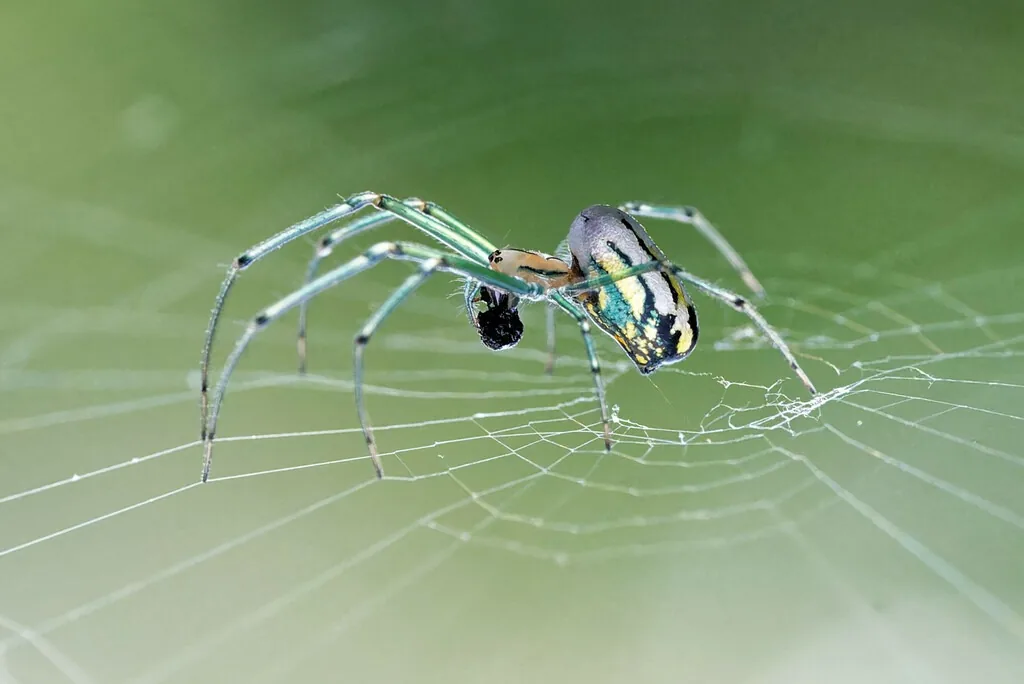
- Small: Missouri gives a female body length of about 1/8 to just over 1/4 inch, not counting legs, and Mississippi State about 1/4 inch for mature females. Males are smaller and more silvery-golden. UF/IFAS gives body lengths of 5.5 to 7.5 mm for females and 3.5 to 4.0 mm for males, which have longer legs and large, bulbous palps.[1][2][3]
- The carapace is yellowish green with brown side stripes, and the legs are green, long and slender. UF/IFAS describes the legs as green or greenish-black with black bands at the joints.[1][3]
- The top of the abdomen is silvery with dark stripes. The underside, which usually faces up, mixes silver, green, yellow, red and blue, often with a yellow, orange or red crescent, and there are orangish spots near the spinnerets. UF/IFAS says the silvery-white abdomen has dark lines running nearly its full length, yellow areas on the sides and reddish-orange spots near the tip, and that females carry reddish-orange triangular marks underneath while males have a crosswise band. The silver comes from thin, light-reflecting guanine crystals.[1][2][3]
Look-alikes
| Look-alike | How to tell them apart |
|---|---|
| Black widow | The orange mark on an orchard orbweaver's belly occasionally gets it mistaken for a male or immature black widow, but orchard orbweavers are silvery and green and sit in an open, wheel-shaped web, not a tangled one. UF/IFAS confirms the reddish-orange marks underneath occasionally get Leucauge spiders mistaken for black widows.[2][1][3] |
| Leucauge argyra | The only other Leucauge in the eastern US, restricted to central and southern Florida. UF/IFAS says its dark abdominal lines turn inward at a 90-degree angle at mid-abdomen and it lacks the bright reddish-orange spots.[3] |
Where it lives
Leucauge venusta, as now defined, is known only from the United States; Missouri describes it across much of the eastern US and statewide in Missouri, and Mississippi State calls it common throughout that state. Leucauge argyrobapta covers Florida, Mexico and Brazil. UF/IFAS places Leucauge venusta from Canada through the eastern half of the United States to Georgia, with a small separate population in southern California, and L. argyrobapta from Florida south to Brazil; the exact dividing line between the two is unknown.[4][1][2][3]
Biology and life cycle
Webs are small, about 12 inches across in Mississippi State's account, usually horizontal or angled, and often about waist high in low shrubs, woodland edges and landscape plantings.[2][1]
Why horizontal? Lab tests found tilted webs suffered more damage from falling debris than horizontal ones, though in the field damage didn't track web angle, and vertical webs intercept more prey.[5][6]
Females build a new web each morning before dawn and take it down at night. A disturbed spider drops quickly into the leaf litter, which is one reason it goes unnoticed.[1]
It catches small flying insects such as flies and leafhoppers.[1]
Females lay egg masses on leaves and twigs near the web and keep making them until cold weather. Adults generally die at freezing; the egg cases overwinter and spiderlings emerge in spring.[1]
UF/IFAS calls the two species together some of the most common spiders in the eastern United States and one of the most common spiders in Florida citrus groves. They are most often found in shrubby meadows and along woodland edges, and in wooded suburbs between hedges and houses under the eaves; when prey is plentiful they often link their webs together.[3]
Webs are usually tilted fewer than 45 degrees from horizontal, with a central hub of loops, typically 30 or more radii and more than 60 sticky spirals, an open zone between hub and spirals, and a loose barrier web below. The spider rests under the hub and also molts there.[3]
Webs are often attached to those of the golden silk orbweaver; there they sit higher and more upright and lack barrier webs, which a study linked to lower building costs. Prey comes from many insect orders, but small flies, including mosquitoes, are most common.[3]
An egg sac described from Virginia was fluffy orange-white silk about 8 to 9 mm across holding several hundred reddish-orange eggs about 0.4 mm wide; sacs are usually attached to a leaf or twig near the edge of the web.[3]
Mud dauber wasps occasionally stock their nests with orchard orbweavers, and Rhomphaea spiders enter their webs undetected and eat them. An alarmed orchard orbweaver runs to the edge of the web or, more often, drops on a silk line that it later climbs back up.[3]
Damage and signs
Health risk
Mississippi State calls orchard orbweavers harmless to humans. Most spiders don't try to bite, and MedlinePlus notes most spider bites are harmless; for any spider bite, CDC/NIOSH advises washing it with soap and water, applying a cold, damp cloth or ice, raising the bitten area if possible, and seeking medical attention.[2][7][8][9]
Control
Prevention
Outdoor lights draw the insects spiders eat, so keep light fixtures off the house and away from windows and doors where you can.[10]
Traps and physical control
Knock unwanted webs off the house with a broom or a strong spray of water, or vacuum them up. Insecticides do not give long-term control of spiders outdoors.[10]
One spider or two?
A 2018 DNA study split the orchard orbweaver in two. Leucauge venusta now means the northern populations, known only from the United States; Florida, Mexico and Brazil populations are Leucauge argyrobapta. The two look alike, and this page covers both. UF/IFAS adds that males differ only very slightly in the palps and females are virtually indistinguishable, and that preliminary DNA data suggest L. argyrobapta may hide at least three more species.[4][3]
Where sources disagree
Size: Missouri gives females about 1/8 to just over 1/4 inch long, Mississippi State about 1/4 inch.[1][2]
Size: UF/IFAS gives females 5.5 to 7.5 mm and males 3.5 to 4.0 mm.[3]
Range: the 2018 DNA study treats Leucauge venusta as known only from the United States, while UF/IFAS places it from Canada to Georgia.[4][3]
Cephalothorax: Missouri describes it as yellowish green with brown side stripes, UF/IFAS as tan.[1][3]
Common questions
- Is the little silver spider with orange spots a black widow?
- Probably not. Orchard orbweavers carry an orange mark on the belly that is sometimes mistaken for a widow's, but they are silvery with green legs and are harmless to people.[2][1]
- Where do orchard orbweavers build their webs?
- In low bushes, shrubs and small trees, at woodland edges and in damp woods, and in landscape shrubs, usually about waist high.[1][2]
- Are orchard orbweavers useful?
- They catch small insects, mostly small flies; UF/IFAS shows one eating an Aedes albopictus mosquito. They are among the most common spiders in Florida citrus groves.[3]
Sources
- Missouri Department of Conservation, “Orchard Orbweaver (Field Guide).” mdc.mo.gov/discover-nature/field-guide/orchard-orbweaver (accessed 2026-11-11)
- Mississippi State University Extension Service, “Orchard Orb Weaver (Bug's Eye View, Vol. 3, No. 9).” extension.msstate.edu/newsletters/bugs-eye-view/2017/orchard-orb-weaver-vol-3-no-9 (accessed 2026-11-11)
- University of Florida IFAS Extension (EDIS), “Orchard Orbweaver, Orchard Spider, Leucauge argyrobapta (White) and Leucauge venusta (Walckenaer), EENY-728/IN1243 (D. Hall; Featured Creatures).” ask.ifas.ufl.edu/publication/IN1243 (accessed 2026-11-14)
- Molecular Phylogenetics and Evolution, via PubMed, “Species delimitation of the North American orchard-spider Leucauge venusta (Ballesteros and Hormiga 2018).” pubmed.ncbi.nlm.nih.gov/29337274/ (accessed 2026-11-11)
- Environmental Entomology, via PubMed, “Effect of web inclination on debris-induced damage in Leucauge venusta webs (Fortner et al. 2026).” pubmed.ncbi.nlm.nih.gov/41904741/ (accessed 2026-11-11)
- Zoology, via PubMed, “The effects of capture spiral composition and orb-web orientation on prey interception (Opell et al. 2006).” pubmed.ncbi.nlm.nih.gov/16962752/ (accessed 2026-11-11)
- University of Kentucky Entomology (ENTFACT), “ENTFACT-622: Common Spiders Found Around Homes and Buildings.” entomology.mgcafe.uky.edu/ef622 (accessed 2026-11-11)
- MedlinePlus, U.S. National Library of Medicine, “Insect bites and stings (Medical Encyclopedia).” medlineplus.gov/ency/article/000033.htm (accessed 2026-11-11)
- CDC, National Institute for Occupational Safety and Health, “Venomous Spiders at Work.” www.cdc.gov/niosh/outdoor-workers/about/venomous-spiders.html (accessed 2026-11-11)
- University of California Statewide IPM Program, “Spiders (Pest Notes, Home and Landscape).” ipm.ucanr.edu/home-and-landscape/spiders/ (accessed 2026-11-11)
- iNaturalist, “Leucauge venusta taxon page (order and family).” www.inaturalist.org/taxa/778499 (accessed 2026-11-11)