On this page
How to identify it
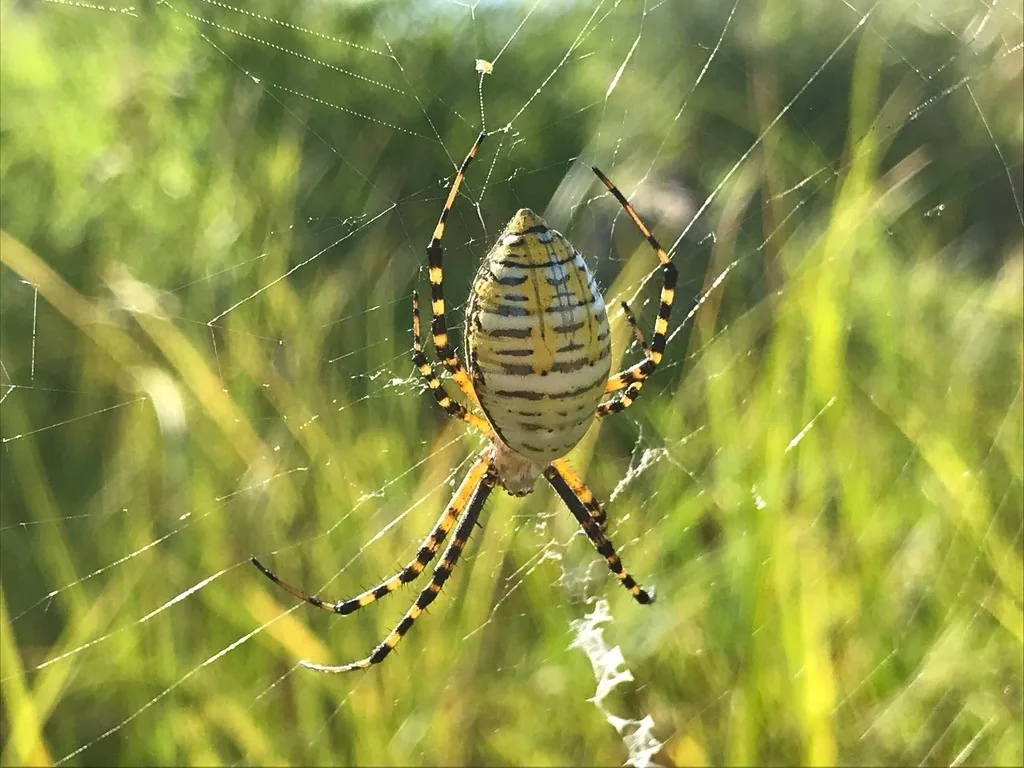
- Females are 15 to 25 mm long (Penn State) or 1/2 to 1 inch (Missouri), slightly smaller than the yellow garden spider, with a pointier hind end. Males are much smaller, 4 to 5 mm (Penn State) or up to 1/4 inch (Missouri), with mostly white abdomens.[1][5]
- The front body section is small and covered in silvery hairs, and the oval abdomen is pale yellow to silver with many thin crosswise black bands.[1][5]
- The legs are pale yellow with darker spots or bands, and the egg sac is shaped like a kettledrum.[1][5]
- Young spiders also have a mostly white back to the abdomen.[1]
Look-alikes
| Look-alike | How to tell them apart |
|---|---|
| Yellow garden spider | Slightly larger, with humps or a notch at the front of the abdomen that the banded garden spider lacks. The banded garden spider tends to put its web a little lower in the vegetation and in sunnier, drier, more open places.[1][5] |
Where it lives
Where the habitat suits it, it is found throughout the United States; Missouri reports it statewide and Penn State notes it is less common in Pennsylvania than the yellow garden spider. GBIF's 1990-2026 U.S. records (about 19,000) come from 46 states on the map, most from California, Ohio and Texas.[1][5][8]
Biology and life cycle
Webs are built vertically in fairly open places such as grasslands and prairies, and often carry a thick zigzag band of silk (the stabilimentum) at the center, though in this species it may be missing or vary in shape.[5][1]
Most webs run east to west, and the spider hangs head-down at the center with its abdomen facing south, which is thought to help it soak up warmth late in the year.[1]
It eats a variety of insects, including grasshoppers, cicadas and katydids. Once prey is caught it shakes the web, bites, wraps the prey in silk, and often repairs the web before feeding. In an Illinois grassland study of four orb weavers including this one, the species split the available prey largely by body size, with larger spiders catching larger prey.[5][6]
Adults are seen from mid- to late summer until the first freeze. Egg sacs are laid from summer into early fall, and counts differ: Penn State says several hundred eggs per sac, Missouri says a 3/4-inch sac can hold over 1,000. Spiderlings emerge in spring and disperse by ballooning on silk.[1][5]
Damage and signs
Health risk
Penn State says it is not known to be medically important and a bite is unlikely unless someone handles a female guarding her egg sac. MedlinePlus says most spider bites are harmless and look like a bee sting, with redness, pain and swelling; wash the bite with soap and water and use an ice pack or wet compress. Occasionally a spider bite causes an allergic reaction.[1][7]
Control
Prevention
Usually none needed: these spiders help control insect pests and are particularly appreciated by gardeners, and spiders in general are beneficial predators.[5][3]
Outdoor lights draw the insects spiders eat, so keep light fixtures off walls and away from windows and doors where you can.[3]
Traps and physical control
Sweep, hose or vacuum unwanted webs off the house.[3]
Pesticides
UC IPM advises that insecticides won't give long-term spider control and generally shouldn't be used against spiders outdoors.[3]
Common questions
- Is the yellow, silver and black striped spider in my garden dangerous?
- A banded garden spider is not known to be medically important and is unlikely to bite unless handled. MedlinePlus notes most spider bites are harmless.[1][7]
- How is it different from the yellow garden spider?
- It's a bit smaller with a pointier rear, its abdomen is crossed by many thin black bands, and it lacks the yellow garden spider's humps.[1][5]
- What is the zigzag in the web?
- It is a band of thick silk called a stabilimentum, built at the center of the web by spiders in this genus; in the banded garden spider it is sometimes missing.[5][1]
Sources
- Penn State Extension, “Banded Garden Spider.” extension.psu.edu/banded-garden-spider (accessed 2026-11-11)
- University of Kentucky Entomology (ENTFACT), “ENTFACT-622: Common Spiders Found Around Homes and Buildings.” entomology.mgcafe.uky.edu/ef622 (accessed 2026-11-11)
- University of California Statewide IPM Program, “Spiders (Pest Notes, Home and Landscape).” ipm.ucanr.edu/home-and-landscape/spiders/ (accessed 2026-11-11)
- iNaturalist, “Argiope trifasciata taxon page (order and family).” www.inaturalist.org/taxa/67708 (accessed 2026-11-11)
- Missouri Department of Conservation, “Banded Garden Spider (Field Guide).” mdc.mo.gov/discover-nature/field-guide/banded-garden-spider (accessed 2026-11-11)
- Environmental Entomology, via PubMed, “Richardson ML, Hanks LM (2009), Partitioning of niches among four species of orb-weaving spiders in a grassland habitat, Environmental Entomology 38(3):651-656.” pubmed.ncbi.nlm.nih.gov/19508773/ (accessed 2026-11-11). Cited from the PubMed abstract.
- MedlinePlus, U.S. National Library of Medicine, “Spider Bites (health topic).” medlineplus.gov/spiderbites.html (accessed 2026-11-11)
- Global Biodiversity Information Facility (GBIF), “Argiope trifasciata: occurrence records in the U.S., 1990-2026 (GBIF occurrence search).” api.gbif.org/v1/occurrence/search?taxonKey=5170973&country=US&hasGeospatialIssue=false&occurrenceStatus=PRESENT&year=1990%2C2026&facet=stateProvince&facetLimit=400&limit=0 (accessed 2026-11-11). State counts are records reported (iNaturalist research-grade, museum specimens, surveys), not abundance.