On this page
How to identify it
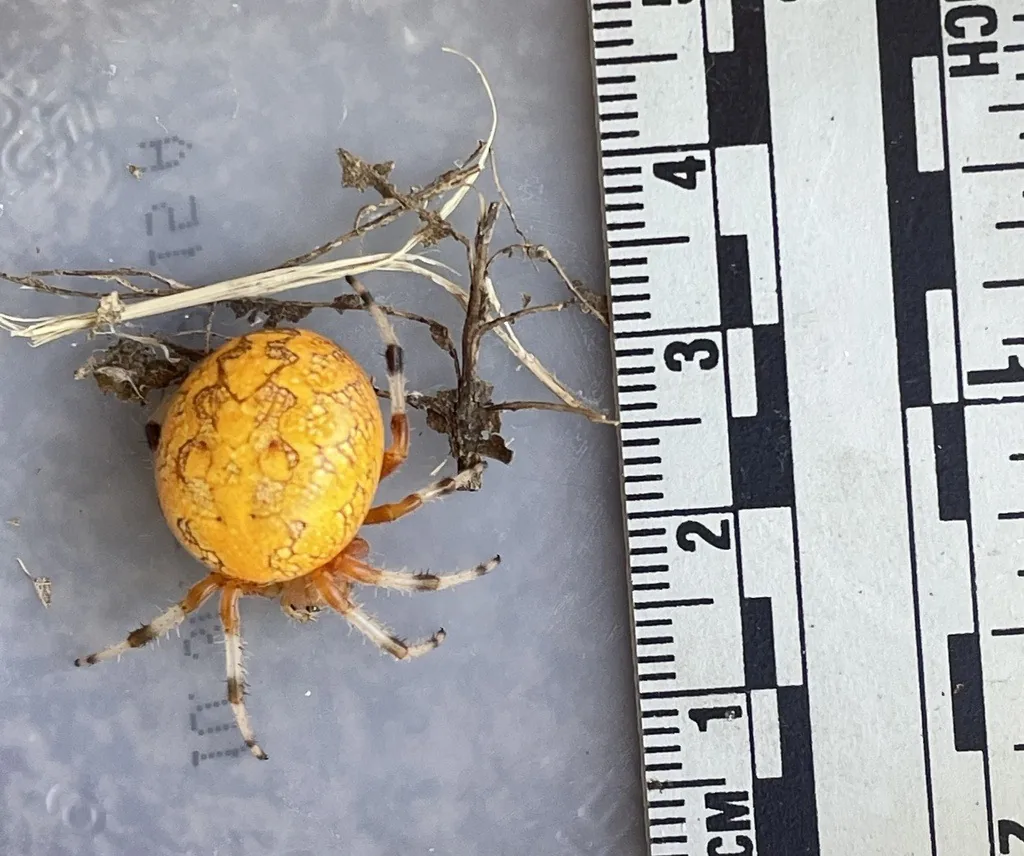
- Sizes vary by source. Penn State gives adult females 9 to 20 mm; Animal Diversity Web gives females 9 to 18 mm and males 5.9 to 8.4 mm; the Missouri Department of Conservation gives usually 1/2 to 3/4 inch, with males only about 1/4 to 1/2 inch.[1][3][2]
- Penn State describes the abdomen as mostly orange with brown to purple markings and pale yellow spots, occasionally nearly white. Missouri describes a more variable spider: yellow, orange, tan, grayish or even white, with marbled swirls, zigzags, fir-tree shapes or a big black spot.[1][2]
- A female full of eggs has a nearly spherical abdomen, which shrivels after she makes an egg case until the next batch of eggs develops.[2]
- The front body section is yellow to burnt orange with a dark central line and a dark line down each side.[1]
- The femurs and kneecap segments of the legs are orange, and the rest is yellow, turning brown at the tips.[1]
Look-alikes
| Look-alike | How to tell them apart |
|---|---|
| Black and yellow garden spider | Unlike garden spiders, the marbled orbweaver hides in a retreat off to the side of its web, at the end of a signal thread. The garden spider also prefers open, sunny spots, the marbled spider wooded ones.[1][5] |
| Openfield orbweaver | Another common Araneus in Missouri, smaller than the marbled orbweaver and found in more open habitats.[2] |
Where it lives
Penn State says it is found across Canada to Alaska, in the northern Rockies, and from North Dakota to Texas and east to the Atlantic; Missouri finds it statewide. Beyond North America it occurs across Europe and northern Asia. GBIF holds about 14,000 U.S. records since 1990, most of them from North Carolina, Virginia and Maryland.[1][2][3][4]
Biology and life cycle
Webs are vertical, in trees, shrubs, tall weeds and grasses in moist woods, often along stream banks. Missouri finds it most often in rich bottomland forest and thickets; Animal Diversity Web lists a wider set of habitats, from forest edges and meadows to orchards, bogs and suburban areas, and even mailboxes.[1][2][3]
A signal thread runs from the web's center to the female's retreat, a leaf folded and tied with silk, and tells her when prey is caught. Young spiders make retreats of silk only.[1][2]
Prey is mostly flying insects such as moths and flies; Animal Diversity Web says most are small, up to about 4 mm, and reports one study in which a single spider caught about 14 insects a day.[2][3]
Males do not spin webs; once mature they wander in search of females.[2]
Females lay several hundred eggs in white silk sacs, usually in October; Animal Diversity Web cites one sac that held 653 eggs. The first freezes kill the adults, the eggs overwinter, and young spiders emerge in spring.[1][3][2]
Adult season is given differently: Penn State says midsummer until the first hard freeze, Animal Diversity Web says June to September, and Missouri says it is most often seen from late summer through fall.[1][3][2]
Its own predators include spider wasps and mud daubers, which paralyze the spiders to feed their young, and birds, which also eat the egg sacs in winter.[3][2]
Damage and signs
Health risk
A bite is unlikely: Penn State says it would take handling a female with an egg sac, and Missouri says orbweavers don't bite unless molested. Penn State adds that the bite would likely feel no worse than a bee or wasp sting for most people.[1][2]
Control
Prevention
Trim plants back from the house so spiders don't settle against it and then move indoors.[6]
Traps and physical control
Sweep, hose or vacuum unwanted webs off buildings; insecticides will not give long-term control of spiders outdoors.[6]
Why moist woods?
Its web glue works best in humid air. In lab tests, the glue droplets on its capture threads performed best at 72% relative humidity, and strands of its capture thread held house flies 11 seconds longer at 72% than at 37% or 55%.[7]
Those seconds matter: the researchers note that the short time between an insect hitting the web and the spider starting to wrap it is the insect's only chance to escape.[7]
If someone is bitten
MedlinePlus says most spider bites are harmless; only certain spiders, such as the black widow and brown recluse, cause serious illness.[8]
For an ordinary bite, wash the site with soap and water and apply ice wrapped in a washcloth, 10 minutes on and 10 minutes off. Call 911 for signs of a severe allergic reaction, such as trouble breathing or swelling of the face or mouth.[8]
Common questions
- What is the big orange spider in the woods in fall?
- It may be a marbled orbweaver, also called the pumpkin spider; adults are seen until the first hard freeze.[1][2]
- Do marbled orbweavers bite?
- Only if handled or molested, typically a female with an egg sac, and Penn State says the bite would feel about like a bee or wasp sting.[1][2]
- Where do they go in winter?
- The adults die with the first freezes; the eggs spend the winter in silk sacs and the young emerge in spring.[2][1][3]
Sources
- Penn State Extension, “Marbled Orbweaver Spider.” extension.psu.edu/marbled-orbweaver-spider (accessed 2026-11-11)
- Missouri Department of Conservation, “Marbled Orbweaver (Field Guide).” mdc.mo.gov/discover-nature/field-guide/marbled-orbweaver (accessed 2026-11-11)
- Animal Diversity Web, University of Michigan Museum of Zoology, “Araneus marmoreus (marbled orb-weaver).” animaldiversity.org/accounts/Araneus_marmoreus/ (accessed 2026-11-11)
- Global Biodiversity Information Facility (GBIF), “Araneus marmoreus: U.S. occurrence records since 1990 by state (GBIF occurrence search).” api.gbif.org/v1/occurrence/search?taxonKey=2159970&country=US&hasGeospatialIssue=false&occurrenceStatus=PRESENT&year=1990%2C2026&facet=stateProvince&facetLimit=400&limit=0 (accessed 2026-11-11)
- University of Kentucky Entomology (ENTFACT), “ENTFACT-622: Common Spiders Found Around Homes and Buildings.” entomology.mgcafe.uky.edu/ef622 (accessed 2026-11-11)
- University of California Statewide IPM Program, “Spiders (Pest Notes, Home and Landscape).” ipm.ucanr.edu/home-and-landscape/spiders/ (accessed 2026-11-11)
- Journal of Experimental Biology, via PubMed, “Humidity-mediated changes in an orb spider's glycoprotein adhesive impact prey retention time (Opell et al. 2017).” pubmed.ncbi.nlm.nih.gov/28356367/ (accessed 2026-11-11)
- MedlinePlus, U.S. National Library of Medicine, “Insect bites and stings (Medical Encyclopedia).” medlineplus.gov/ency/article/000033.htm (accessed 2026-11-11)
- iNaturalist, “Araneus marmoreus taxon page (order and family).” www.inaturalist.org/taxa/120183 (accessed 2026-10-06)