On this page
How to identify it
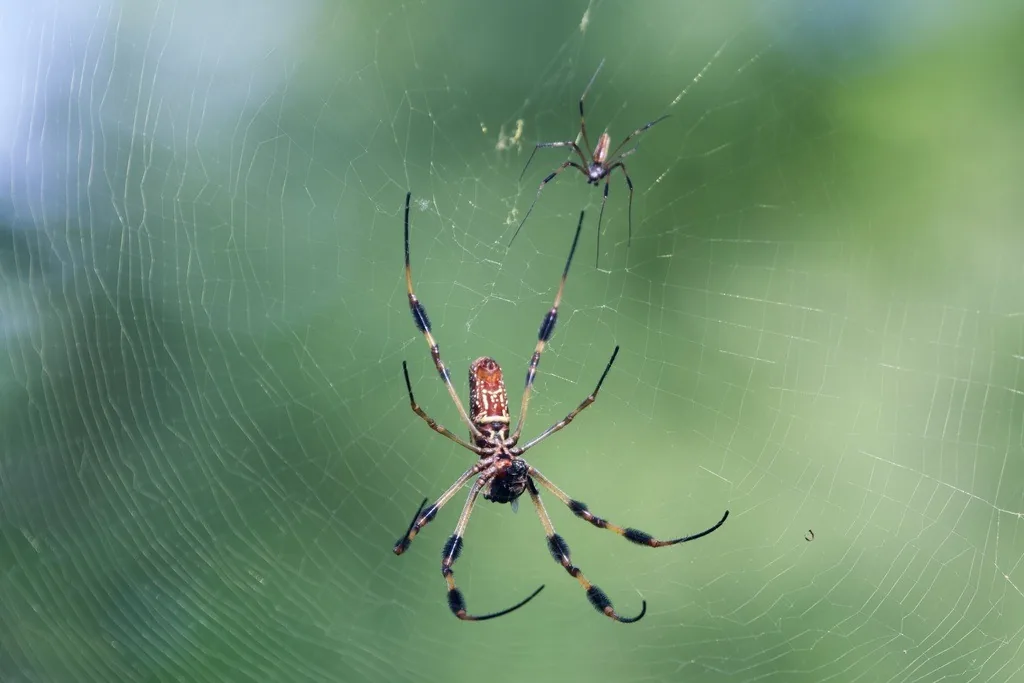
- It is the largest web-building spider in North America. Clemson Extension gives female bodies of 1½ to 2 inches, and with legs spread a female can be larger than a person's palm. UF/IFAS gives females 24 to 40 mm long and calls them perhaps the largest orb weavers in the country, rivaled in size only by the yellow garden spider and the largest Araneus species.[1][3]
- The front body section is covered in silvery white hairs. The long abdomen is dull orange to tan with yellow spots in Penn State's description; Clemson calls it bright yellow. UF/IFAS describes a silvery carapace and yellow spots on a dull orange to tan cylindrical body.[2][1][3]
- The legs are brown with orange bands, and some leg segments carry tufts of hair that look like bottlebrushes or fuzzy leg warmers. UF/IFAS says these hair brushes, or gaiters, are on the tibia of the first, second and fourth pairs of legs.[2][1][3]
- Males are much smaller, a little under 1 inch long overall. Mature males don't build webs; they wander in search of a female's web. UF/IFAS describes males as inconspicuous, slender and dark brown, averaging 6 mm long, and says they would often go unnoticed if they weren't so often found in females' webs.[1][3]
- Spiderlings look different from adults: their legs are dark green to yellowish, the abdomen is mottled white, yellow and black, and their webs lack the golden color.[1]
- Adult females spin webs of golden-colored silk. UF/IFAS describes the web as finely meshed and often 1 to 2 meters across, with the hub where the spider waits near the top, making a lopsided orb.[1][3]
Look-alikes
| Look-alike | How to tell them apart |
|---|---|
| Joro spider | The Joro, an invasive relative from East Asia, also spins golden webs, but its abdomen has horizontal silver stripes and a reddish patch near the tip underneath, and its legs lack the bottlebrush tufts.[1][2] |
| Yellow garden spider | A black-and-yellow garden spider that builds webs near open, sunny areas at about knee height, with a thick white zigzag running down the middle.[1] |
Where it lives
Penn State Extension, drawing on iNaturalist and GBIF records, places it in the Southeast from Virginia to Florida, mostly on the Coastal Plain, west into Texas, and south through Central and South America. It was not recorded north of southern North Carolina before 2000 and has since moved into southern Virginia; stray records from Pennsylvania, New Jersey, New York and southern Canada probably arrived as ballooning spiderlings. The National Park Service gives its range as the southeastern United States through Argentina and Peru. UF/IFAS says it is the only species of its genus in the Western Hemisphere, occurring throughout Florida and the West Indies, north to North Carolina, across the Gulf States and through Central America into South America as far south as Argentina.[2][4][3]
Biology and life cycle
Clemson Extension says spiders in its family are often found in areas with dense vegetation and a humid climate, and that this species was first documented in South Carolina at Charleston in 1863. UF/IFAS says webs are usually in open woods or at the edges of dense forest, attached to trees and low shrubs, but may be in treetops or between utility wires. It is not usually found in row crops, which lack web supports, but was one of the two most common orb weavers in citrus groves in one study.[1][3]
The National Park Service says it is mostly seen in the middle of its web, which can be up to 3 feet across, and that it feeds on grasshoppers, flies and other small insects. UF/IFAS lists small to medium flying insects such as flies, bees, wasps, and small moths and butterflies, plus small beetles and dragonflies. The web is semipermanent: rather than tearing it down and rebuilding like many orb weavers, the spider repairs large portions and leaves the rest. It subdues prey by biting and always carries it back to the hub.[4][3]
A male approaches carefully, strumming the female's web, ideally while she is busy feeding or molting. Several males may compete for one female, and some are eaten after mating.[1]
The female lays her egg sac in a well-covered spot such as under leaves, which protects it from predators. UF/IFAS says there is one generation a year in temperate North America; adult males appear July to September and most females mature in August. Late into fall, females make at least two egg sacs 2.5 to 3 cm across, each with several hundred eggs in a basket of curly yellow silk.[1][3]
The white front body section helps the spider manage heat on hot days. UF/IFAS says the silvery carapace reflects sunlight and the spider can point its long body straight at the sun to reduce exposed surface; cooling responses generally start above 35°C.[1][3]
Small silvery thief spiders of the genus Argyrodes steal food from its webs; the UF/IFAS authors once counted over 40 in an abandoned web.[3]
Damage and signs
- It does no harm to homes or plants. Like other spiders it is a predator that eats insects, both crop pests and pollinators, and Clemson lists it among spiders that are not harmful to humans. UF/IFAS notes that its large webs are a sticky nuisance for hikers and hunters in late summer and fall.[1][5][3]
Health risk
Clemson and Penn State describe golden silk orb weavers as docile spiders that would rather run than bite and are reluctant to bite even when handled. See the bite section below for first aid from MedlinePlus and CDC NIOSH.[1][2]
Control
Prevention
Where webs aren't in the way, leave them; spiders feed on insects, including pests of crops, people and pets.[1][5]
Traps and physical control
Remove webs from doorways or the outside of the house with a broom or a strong spray of water.[5]
Pesticides
UC IPM says insecticides won't give long-term control and generally shouldn't be used against spiders outdoors.[5]
If someone is bitten
MedlinePlus says spiders rarely bite people unless threatened and most spider bites are harmless, though a bite can cause redness, pain and swelling like a bee sting and occasionally an allergic reaction.[6]
Wash the bite with soap and water and apply an ice pack or a cloth dampened with cold water to reduce swelling. Seek medical care for small children and for adults with severe symptoms.[6][7]
Where sources disagree
Size: Clemson Extension gives female bodies of 1½ to 2 inches, while the National Park Service lists an average size of up to 3 inches. UF/IFAS gives 24 to 40 mm.[1][4][3]
Abdomen color: Penn State describes it as dull orange to tan with yellow spots, while Clemson calls it bright yellow, which it suggests is why people call it the banana spider. UF/IFAS, like Penn State, says dull orange to tan with yellow spots.[2][1][3]
Web size and where the spider sits: the National Park Service says webs are up to 3 feet across and the spider is mostly seen in the middle; UF/IFAS says webs are often 1 to 2 meters across with the hub where it waits near the top.[4][3]
Male size: Clemson says males are a little under 1 inch long overall; UF/IFAS says they average 6 mm.[1][3]
Common questions
- Why is it called a banana spider?
- Clemson Extension notes that the bright yellow abdomen is likely why people call it a banana spider.[1]
- Is the golden silk orb weaver dangerous?
- No. Clemson and Penn State describe it as docile and reluctant to bite, even when handled; it would rather run away. UF/IFAS says it bites only if held or pinched.[1][2][3]
- Is it the same as the Joro spider?
- No. They are close relatives that both spin golden webs, but the golden silk orb weaver is native while the Joro spider is an invasive species from East Asia.[1][2]
- When are the big golden webs most noticeable?
- In late summer and fall. UF/IFAS says most females mature in August and stay late into fall, when their webs across trails catch hikers and hunters.[3]
Sources
- Clemson Cooperative Extension Home and Garden Information Center, “Big Yellow Spiders in South Carolina (HGIC 2503, revised November 20, 2024).” hgic.clemson.edu/factsheet/big-yellow-spiders-in-south-carolina/ (accessed 2026-11-14)
- Penn State Extension, “Jorō Spiders (includes golden silk orb-weaver comparison and range).” extension.psu.edu/joro-spiders (accessed 2026-11-14)
- University of Florida/IFAS Extension (Featured Creatures), “Golden Silk Spider, Trichonephila clavipes (Linnaeus), EENY-229/IN467.” ask.ifas.ufl.edu/publication/IN467 (accessed 2026-11-14). Used for identification, range, web, biology and behavior; its bite-symptom description is not used (medical-source rule).
- U.S. National Park Service, “Golden Silk Orb Weaver (Gulf Islands National Seashore, last updated December 11, 2019).” www.nps.gov/articles/golden-silk-orb-weaver.htm (accessed 2026-11-14)
- University of California Statewide IPM Program, “Spiders (Pest Notes, Home and Landscape).” ipm.ucanr.edu/home-and-landscape/spiders/ (accessed 2026-11-14)
- MedlinePlus, U.S. National Library of Medicine, “Spider Bites (health topic).” medlineplus.gov/spiderbites.html (accessed 2026-11-14)
- U.S. Centers for Disease Control and Prevention, “Venomous Spiders at Work (NIOSH).” www.cdc.gov/niosh/outdoor-workers/about/venomous-spiders.html (accessed 2026-11-14)
- iNaturalist, “Trichonephila clavipes taxon page (order and family).” www.inaturalist.org/taxa/904336 (accessed 2026-11-14)