On this page
How to identify it
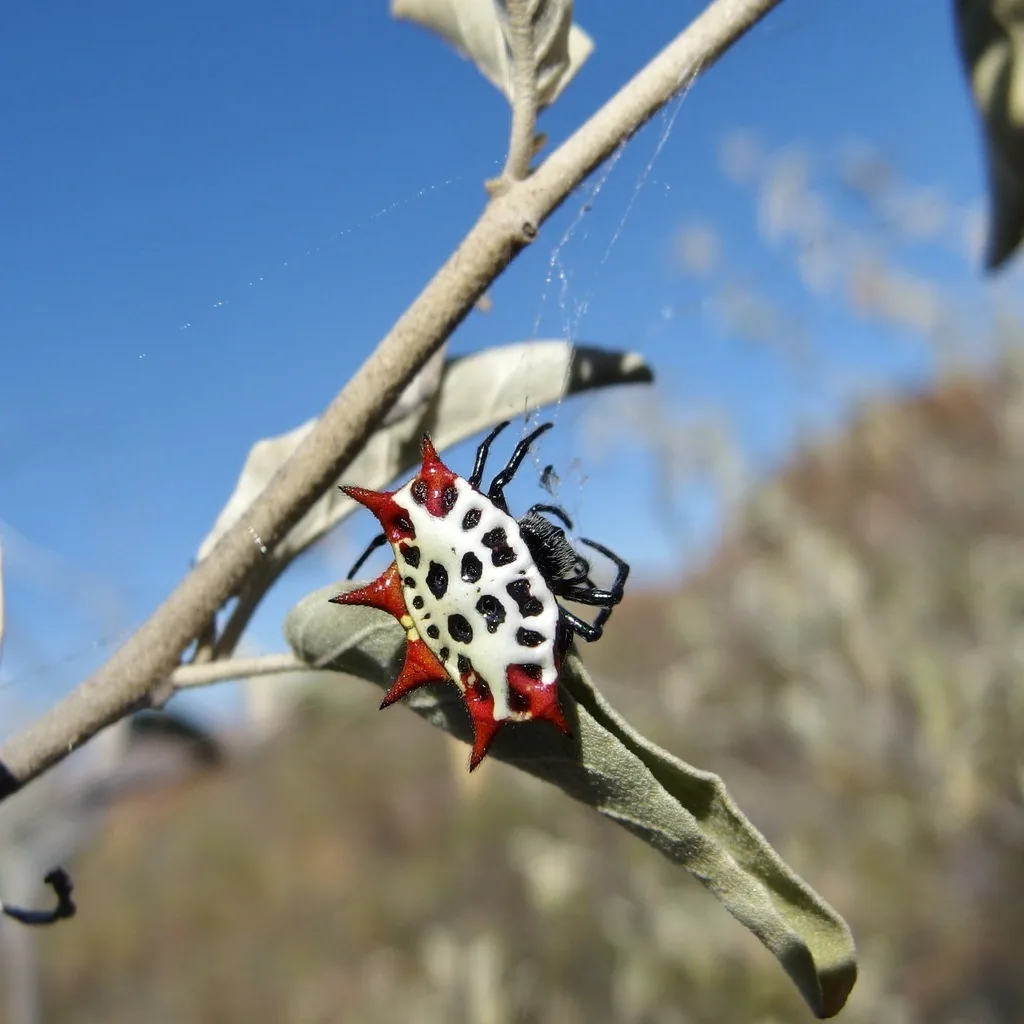
- The female's abdomen is wider than it is long and carries six pointed spines. Connecticut's experiment station puts females at about 1/2 inch long, with males about a third of that size. UF/IFAS gives females as 5 to nearly 9 mm (3/16 to 1/3 inch) long but 10 to 13 mm (3/8 to 1/2 inch) wide.[2][1][3]
- Color varies a lot. The shell is white, yellow or orange and the spines are black or red. Researchers working with yellow, orange, white and black female color forms found genes for several pigment pathways behind the differences. UF/IFAS says Florida specimens are typically white on top with black spots and red spines, with a black head region, legs and underside and white spots under the abdomen; elsewhere the top may be yellow, the spines black, or the spider almost entirely black.[1][2][4][3]
- Males are much smaller and lack the spines. UF/IFAS gives males as 2 to 3 mm (1/16 to 1/8 inch), slightly longer than wide, with a gray abdomen spotted white and four or five small humps at the rear instead of spines.[1][2][3]
- It stays on its web in plain view during the day; orb weavers rest at the center of the web or in a shelter near its edge. UF/IFAS says the web carries conspicuous tufts of silk, mostly on the foundation lines; their purpose is unknown, but one idea is that they make the web easier for birds to see so they don't fly through it.[1][5][3]
Look-alikes
| Look-alike | How to tell them apart |
|---|---|
| Other orb weavers | A few other orb weavers, the spiny-bellied spiders, also have thorn-like points on the abdomen, but their body shape is different and they are easy to tell apart from this one. UF/IFAS says it is easily told from all other spiders in Florida and is smaller than other common orb weavers such as Argiope and Neoscona.[1][6][3] |
| Crab spiders | Its crab-like look gives it the species name cancriformis, but the name crab spider belongs to a different group: hunters with long, crab-like front legs that make no web. UF/IFAS notes that people in parts of Florida call it a crab spider, though it is not related to any of the families commonly called crab spiders.[1][5][3] |
Where it lives
Common throughout the southern US, especially in late summer and fall, and found through the American tropics and the Caribbean. Connecticut's experiment station includes it as an infrequent species in its guide to Northeastern landscape spiders. UF/IFAS says it is the only species of its genus found from the southern United States to northern Argentina, with the possible exception of the West Indian Gasteracantha tetracantha, which may be only a geographic race.[1][7][2][3]
Biology and life cycle
Webs go up along the edges of wooded areas and in home landscapes, often anchored to low tree branches or shrubs, and often at just the height where people walk into them. UF/IFAS says citrus workers often run into it, it turns up on trees and shrubs around houses and nurseries, and in Florida it is found most often in mixed woodlands and citrus groves; webs may be less than 1 to more than 6 m (3 ft 3 in to 19 ft 8 in) above the ground.[1][2][3]
Like other orb weavers, it catches insects that fly, fall or are blown into the web and finds them by feeling the web vibrate. UF/IFAS lists whiteflies, flies, moths and beetles as prey. Larger webs have 10 to 30 radii and a catching area 30 to 60 cm (11 3/4 to 23 2/3 inches) across, with the spider's resting spot separated from the sticky spiral by an open zone.[5][1][3]
The hard, spiny shell protects a spider that sits in plain view: birds and other predators find it too hard and spiny to swallow. Studies of its bright colors suggest they work at least partly as a warning to predators, and may also help lure prey.[1][8][4]
In Florida, UF/IFAS says adult females occur all year but are most common from October through January. Males turn up in every month except December and January, are most common in October and November, and hang by single threads from the female's web before mating.[3]
From October through January, females lay egg sacs 20 to 25 mm (3/4 to 1 inch) long on the undersides of leaves next to the web. One egg mass holds 101 to 256 eggs (a mean of 169 in 15 masses), laid on a white silk sheet and covered with loose white or yellowish silk, dark green strands and a net-like canopy of coarse green and yellow threads.[3]
Eggs take 11 to 13 days to hatch. Spiderlings darken five to seven days later and, in the field, stay in the egg sac an extra two to five weeks before dispersing; they make tiny webs or hang from single strands, and both spider and web grow much larger in late summer and early fall. A phorid fly, Phalacrotophora epeirae, is the main specialized predator of the eggs.[3]
Damage and signs
Health risk
Bites are rare. They usually happen when someone walks into a web and then swats the spider crawling on their skin, and Mississippi State compares the pain to a fire ant sting with no lasting ill effects. Connecticut's experiment station says none of the spiders in its landscape guide, this one included, has a medically significant bite, and that orb weaver bites are very infrequent and usually come from rough handling.[1][2]
Control
Prevention
Outdoors, no control is needed: spiders outdoors are part of the ecosystem and help control garden pests.[2][5][6]
Traps and physical control
If a web is in a doorway or path, knock it down with a broom or a strong spray of water.[5]
Pesticides
UC IPM says insecticides won't provide long-term control and generally shouldn't be used against spiders outdoors.[5]
One spider, many looks
It is the only Gasteracantha species recognized in the Americas, despite large differences in size, color and shape between populations. A 2020 genetic study found a single widespread species across the Caribbean islands, while two mainland populations may be diverging.[7][4]
Older books use the name Gasteracantha elipsoides; UF/IFAS says a 1978 review examined the species and found that name to be a synonym of G. cancriformis, which had been described under many names because of its varied colors and spine shapes.[3]
Common questions
- Is the spiny-backed orb weaver poisonous?
- No serious effects are known. A bite is uncommon, feels about like a fire ant sting and usually leaves no lasting effects.[1][2]
- Why does it have spines?
- The hard, spiny shell makes it too hard and prickly for birds and other predators to swallow, which lets it sit in the open on its web all day.[1][4]
- Is it a crab spider?
- No. It looks crab-like, but true crab spiders are a separate family of hunters that make no web; this one is an orb weaver.[1][5]
- When are spiny-backed orb weavers most common?
- Mississippi State says late summer and fall across the South. In Florida, UF/IFAS says adult females can be found all year but are most common from October through January, which is also when they lay egg sacs.[1][3]
- What are the little tufts of silk on its web?
- Their purpose is unknown. UF/IFAS says one hypothesis is that they make the web more conspicuous to birds, so birds don't fly into it and destroy it.[3]
Sources
- Mississippi State University Extension Service, “Spinybacked Orbweaver (Bug's Eye View, Vol. 4, No. 31), by Blake Layton.” extension.msstate.edu/newsletters/bugs-eye-view/2018/spinybacked-orbweaver-vol-4-no-31 (accessed 2026-11-14)
- The Connecticut Agricultural Experiment Station, “Common Spiders in the Landscape (fact sheet, Katherine Dugas).” portal.ct.gov/-/media/caes/documents/publications/fact_sheets/entomology/spiders_in_the_landscape.pdf (accessed 2026-11-14)
- University of Florida/IFAS Extension (Featured Creatures), “Spiny Orb Weaver Spider, Gasteracantha cancriformis (Linnaeus), EENY-167/IN324.” ask.ifas.ufl.edu/publication/IN324 (accessed 2026-11-14). Used for identification, range, biology and web details; its bite line is not used (medical-source rule).
- Ecology and Evolution, via PubMed, “The Genetic Basis of Color Polymorphism in the Orb-Web Spider Gasteracantha cancriformis (Torres-Quintero et al. 2026).” pubmed.ncbi.nlm.nih.gov/42016943/ (accessed 2026-11-14)
- University of California Statewide IPM Program, “Spiders (Pest Notes, Home and Landscape).” ipm.ucanr.edu/home-and-landscape/spiders/ (accessed 2026-11-14)
- University of Kentucky Entomology, “ENTFACT-622: Common Spiders Found Around Homes and Buildings.” entomology.mgcafe.uky.edu/ef622 (accessed 2026-11-14)
- PeerJ, via PubMed, “Phylogeography of the widespread Caribbean spiny orb weaver Gasteracantha cancriformis (Chamberland et al. 2020).” pubmed.ncbi.nlm.nih.gov/32391201/ (accessed 2026-11-14)
- Current Zoology, via PubMed, “Prey and predators perceive orb-web spider conspicuousness differently (Ximenes and Gawryszewski 2019).” pubmed.ncbi.nlm.nih.gov/31616487/ (accessed 2026-11-14)
- iNaturalist, “Gasteracantha cancriformis taxon page (order and family).” www.inaturalist.org/taxa/49540 (accessed 2026-11-14)