The short answer
- Scaly face and leg mites cause white, crusty, flaky buildup on the beak, face, legs or toes. They are common in budgies; canaries and finches get crusty legs and toes, Merck says.[1][4]
- Red mites feed on birds at night and hide by day in cracks, nest boxes and perches, Merck says. They mostly turn up in outdoor aviaries.[6][4][1]
- Air sac mites live in the airways, especially of canaries and Gouldian finches. Clicking, high-pitched breathing sounds, tail bobbing, sneezing or open-mouth breathing mean call your avian vet now: Merck says heavy infestations can be fatal.[2][4]
- Do not spray insecticide around a bird. Merck says birds' respiratory tracts are very sensitive to chemical fumes, including pesticides and other sprays.[3][5]
- Your vet confirms the mite and prescribes the treatment; you do the cage cleaning, Merck says.[1][2]
The same mites and lice on chickens
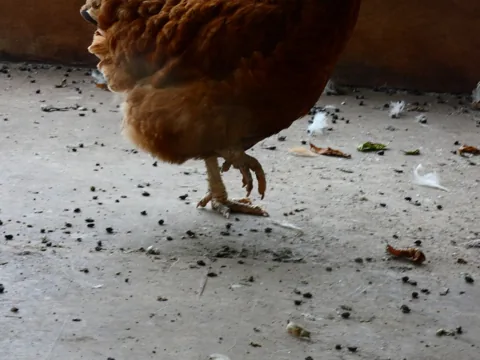 Scaly Leg Mite
Knemidokoptes mutans
The scaly leg mite is a mite too small to see that burrows into the skin under the scales of chickens' legs and feet, leaving the legs thick, crusty and, in bad cases, deformed.
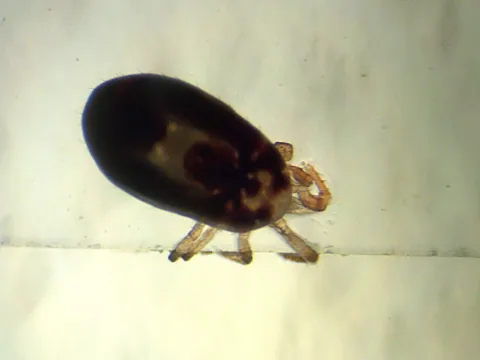 Chicken Mite
Dermanyssus gallinae
The chicken mite (poultry red mite, roost mite) is a tiny blood-feeding mite that hides in cracks, nests and litter by day and crawls onto chickens and wild birds to feed at night. Mites from coops or bird nests can also crawl onto people and bite.
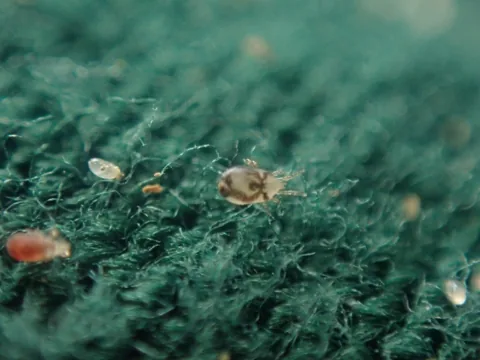 Northern Fowl Mite
Ornithonyssus sylviarum
The northern fowl mite is a tiny blood-feeding mite that Mississippi State Extension calls the most serious external parasite of poultry in North America. It lives its whole life on chickens and other birds, crowding around the vent, and heavy infestations cause anemia, fewer eggs and even death.
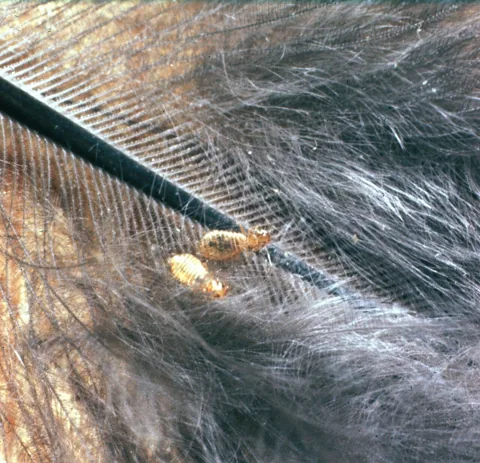 Poultry Lice
Several chewing lice, including the chicken body louse (Menacanthus stramineus) and the shaft louse (Menopon gallinae)
Poultry lice are small, flat, wingless, straw-colored insects that live their entire lives on the bird, chewing on feathers, dry skin scales and scab tissue. Heavy infestations irritate birds, damage feathers and can cut growth and egg production.
Scaly face and leg mites (Knemidokoptes)
Merck says scaly face and leg mites are common in budgerigars (budgies) and less common in other parrots; the professional chapter calls them rare in other parrot species.[1][4]
What you see: a buildup of flaky, dry material, often white crusts around the corners of the mouth, the nostrils (cere), beak, eyes, legs or vent. Merck describes the crusts in budgies as white and porous, and says itching is usually mild or absent.[1][4]
In canaries and finches the crusts form on the legs and toes, a condition called tassel foot, Merck says.[1][4]
Don't wait. Merck says the crusts can lead to deformities if untreated, and beak deformities may stay even after the mites are gone.[1][4]
Your vet may confirm it with a skin scraping under the microscope, though Merck says the look in budgies is usually distinctive. In canaries and finches, Merck says leg scrapings often bleed and are generally not recommended, so let the vet decide.[1][4]
Red mites that hide in the cage by day
The red mite (Dermanyssus gallinae) feeds on blood. Merck says it infests chickens, pigeons, canaries and wild birds, and in pet birds it is mostly found in outdoor aviaries, especially in nest boxes.[6][4][1]
They feed only at night. Merck says the mites are rarely seen on birds during the day because they leave the host at daylight and hide under droppings, on roosts, in nest boxes and in cracks and crevices, where they lay eggs.[6]
Signs Merck lists: restlessness at night, weakness from anemia, and death, especially in nestlings.[1][6]
A simple check: Merck suggests covering the cage with a white sheet overnight and looking for tiny red spots on the sheet in the morning.[1]
Merck adds that true feather mites rarely affect pet birds, and that owners often blame mites for feather picking when behavior, care or other illness is more commonly the cause. A bird that pulls its feathers needs a vet visit, not a mite spray.[1][4]
Air sac mites: clicking and tail bobbing
Air sac mites (Sternostoma tracheacolum) live throughout the respiratory system, Merck says: the windpipe, voice box, lungs and air sacs. Canaries and Gouldian finches are affected most often.[2][4]
Mild cases may show no signs. Heavy infestations cause trouble breathing, tail bobbing with each breath, high-pitched noises and clicking, sneezing and open-mouth breathing, Merck says.[2][4]
Stress, handling and exercise make the signs worse, and Merck says heavy infestations can be fatal. A bird breathing like this needs an avian vet promptly; handle it as little as possible on the way.[2][4]
Treatment is prescription antiparasitic medicine from your vet plus thorough cage disinfection and removing items such as wood perches where mites can hide, Merck says.[2]
Feather lice
Birds get chewing lice. Merck says chewing lice infest both mammals and birds, most lice are host-specific, and they spread mainly by direct contact between hosts.[8]
Avian lice normally feed on feathers or bits of dead skin, and their eggs are glued to the base of the feathers, Merck says.[7]
Signs Merck lists for lice in animals include itching, feather or hair loss and occasionally anemia. Infestations most often occur on stressed animals, so crowding and poor nutrition matter.[8]
Where to look: Merck says examining birds around the vent and under the wings shows the eggs or moving lice on the skin or feathers. If you see them, ask your avian vet what to use; don't reach for a household or poultry product on your own.[7][3]
When to call an avian vet
Now: any breathing change (clicking, wheezing, tail bobbing, open-mouth breathing), weakness, or a nestling that seems weak. Merck lists these as signs of heavy air sac or red mite infestations, which can kill.[2][1][4]
Soon: crusts on the beak, face, cere or legs, a beak that looks misshapen, feather loss or feather picking, restlessness at night, or lice you can see.[1][4][8]
Your vet confirms which parasite it is and prescribes the treatment. This page gives no medicines or doses; Merck's owner pages say treatment is antiparasitic medicine given by mouth, injected or put on the skin, chosen by the vet.[1][2]
Cleaning the cage
Merck pairs every mite treatment with thorough cage cleaning and disinfection, done while your vet treats the bird.[1][2]
Get rid of wooden perches and toys. Merck says mites hide in them, so removing them is part of treating scaly face and air sac mites.[1][2]
Replace wooden nest boxes. Merck says they can't be disinfected and should be discarded and replaced.[1][4]
Clean cracks, seams and corners. Red mites hide in cracks and crevices, under droppings, on roosts and in nest boxes by day, and Merck says these hiding places have to be targeted, not just the bird.[6]
Start with clean birds. Merck says obtaining mite-free birds and good sanitation are important to prevent mites building up.[6]
Merck says nest boxes can be treated with medicated powders. Use only what your vet recommends, and keep the bird out of the room while you clean.[1][3]
Why sprays and fumes are dangerous to birds
Merck says birds' respiratory tracts are very sensitive to chemical fumes, including gasoline, pesticides, perfumes and other sprays, and lists insecticides, pesticides and garden sprays among household hazards for pet birds.[3]
Merck's professional chapter adds that aerosols such as some carpet fresheners, perfumes and deodorizers, and burned plastics, may be irritating or toxic to caged birds.[5]
Nonstick cookware is a classic bird killer. Merck says overheated nonstick (PTFE) pans release a gas that commonly poisons birds kept in or near kitchens; small birds often die suddenly with minimal exposure.[5]
So don't fog, bomb or spray the room to fix a mite problem on a bird. Treating the bird is your vet's job; for pest control elsewhere in a home with birds, see our pet-safe pest control guide.[3][5]
Can bird mites or lice get on people?
Red mites can bite people. Merck says poultry red mites also bite humans, but they cannot survive on or infest them.[6]
Bird lice don't stay. Merck says humans and other mammals can temporarily harbor avian lice, and most lice are host-specific.[7][8]
Bites in the house with no pet bird usually trace to a nest in an attic, vent or eave; our bird and rodent mites guide covers confirming and getting rid of those.[6]
Common questions
- What are the white crusts on my budgie's beak?
- Often scaly face mites (Knemidokoptes), which Merck says are common in budgies and cause white crusts around the mouth, cere, beak and eyes. See your avian vet; untreated crusts can deform the beak.[1][4]
- Why is my canary clicking and bobbing its tail?
- Merck lists clicking, high-pitched breathing noises and tail bobbing as signs of heavy air sac mite infestation, which is most common in canaries and Gouldian finches and can be fatal. Call your avian vet promptly.[2][4]
- How do I check my bird for red mites?
- Merck suggests covering the cage with a white sheet overnight and checking it in the morning for tiny red spots. Red mites hide in cracks and nest boxes by day, so you rarely see them on the bird.[1][6]
- Are mites making my parrot pull its feathers?
- Rarely. Merck says owners often assume mites cause feather picking, but behavior, care and other illness are more common causes. Have your vet look for the real reason.[4][1]
- Can I use a flea spray or bug bomb on my bird's cage?
- No. Merck says birds' airways are very sensitive to pesticide fumes and sprays. Ask your avian vet what is safe for the bird and its cage.[3][5]
Photo credits
- Scaly Leg Mite: (c) Sean Hartnett, some rights reserved (CC BY) — via iNaturalist, CC BY 4.0
- Chicken Mite: Dermanyssus gallinae, microscopic view by Sylvain Larrat — via Wikimedia Commons, CC BY 4.0
- Northern Fowl Mite: Deniz Wilson, public domain (CC0), via iNaturalist
- Poultry Lice: Menacanthus stramineus by Clemson University - USDA Cooperative Extension Slide Series, Bugwood.org — via Wikimedia Commons, CC BY 3.0
Sources
- Merck Veterinary Manual, “Skin and Feather Disorders of Pet Birds (Bird Owners).” www.merckvetmanual.com/bird-owners/disorders-and-diseases-of-birds/skin-and-feather-disorders-of-pet-birds (accessed 2026-11-15)
- Merck Veterinary Manual, “Lung and Airway Disorders of Pet Birds (Bird Owners).” www.merckvetmanual.com/bird-owners/disorders-and-diseases-of-birds/lung-and-airway-disorders-of-pet-birds (accessed 2026-11-15)
- Merck Veterinary Manual, “Household Hazards for Pet Birds (Bird Owners).” www.merckvetmanual.com/bird-owners/routine-care-and-safety-of-birds/household-hazards-for-pet-birds (accessed 2026-11-15)
- Merck Veterinary Manual, “Parasitic Diseases of Pet Birds (Professional Version).” www.merckvetmanual.com/exotic-and-laboratory-animals/pet-birds/parasitic-diseases-of-pet-birds (accessed 2026-11-15)
- Merck Veterinary Manual, “Toxicoses of Pet Birds (Professional Version).” www.merckvetmanual.com/exotic-and-laboratory-animals/pet-birds/toxicoses-of-pet-birds (accessed 2026-11-15)
- Merck Veterinary Manual, “Mites of Poultry (Professional Version).” www.merckvetmanual.com/poultry/ectoparasites/mites-of-poultry (accessed 2026-11-15)
- Merck Veterinary Manual, “Lice of Poultry (Professional Version).” www.merckvetmanual.com/poultry/ectoparasites/lice-of-poultry (accessed 2026-11-15)
- Merck Veterinary Manual, “Overview of Lice in Animals (Professional Version).” www.merckvetmanual.com/integumentary-system/lice/overview-of-lice-in-animals (accessed 2026-11-15)