The short answer
- What spreads it: bites from infected ticks and deer flies, skin contact with infected animals (rabbits, hares and rodents above all), drinking untreated contaminated water, and breathing in contaminated dust, for example during landscaping or farm work. CDC says it has not been reported to spread from person to person.[1][2][10]
- Where: CDC says naturally occurring cases have been reported from every state except Hawaii. A CDC review counted 2,462 reported cases from 47 states during 2011 to 2022, with Arkansas, Kansas, Missouri and Oklahoma accounting for half of them.[5][8]
- Warning signs: fever, which CDC says can reach 104 °F, plus symptoms that depend on how the germ got in. The most common form brings a skin sore where a tick or fly bit or where an animal was handled, with swollen glands in the armpit or groin. Symptoms usually start 3 to 5 days after exposure, but can take 1 to 14 days.[3][6][10][11]
- See a doctor if you get these symptoms after a tick or deer fly bite, a rodent bite, or handling a wild animal or its meat, and say so. CDC says tularemia is rare and easily mistaken for more common illnesses, so your exposures help your provider think of it. Virginia's health department says to contact your doctor right away if you think you were exposed.[3][9][10]
- Prevention: use an EPA-registered insect repellent and cover up outdoors, remove ticks promptly, wear gloves when handling sick or dead animals (especially rabbits, muskrats, prairie dogs and other rodents), cook wild game thoroughly, and check the yard for carcasses before you mow.[4][10][11]
Ticks, flies and animals tied to tularemia
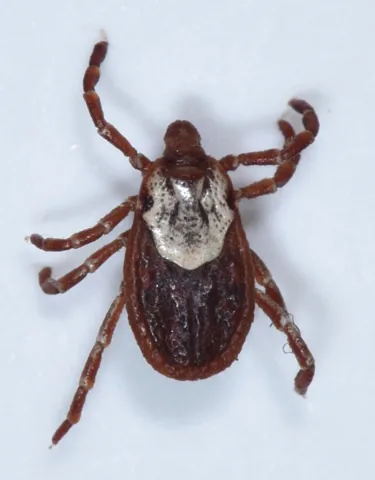 American Dog Tick
Dermacentor variabilis
The American dog tick, also called the wood tick, is widely distributed east of the Rocky Mountains. Adult females are the stage most likely to bite people, especially in spring and summer, and adults commonly climb to the crown of the head.
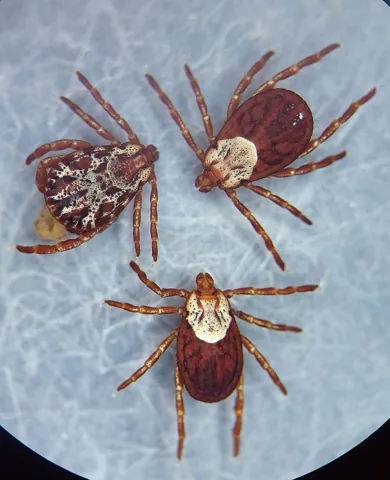 Rocky Mountain Wood Tick
Dermacentor andersoni
The Rocky Mountain wood tick is the tick most often found on people and pets in Colorado and Utah. It is most active in spring, then goes dormant as the weather turns hot and dry, and it is the vector of Colorado tick fever.
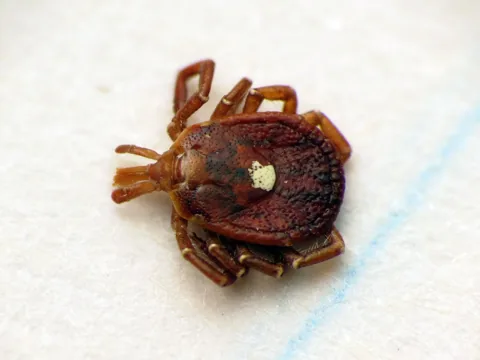 Lone Star Tick
Amblyomma americanum
The lone star tick is a very aggressive tick that readily bites people and pets across the Northeast, South and Midwest; its bite is linked to alpha-gal syndrome, a red meat allergy.
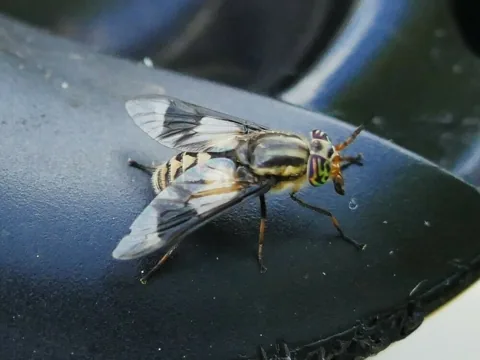 Deer Fly
Chrysops spp. (shown: Chrysops callidus)
Deer flies (genus Chrysops) are biting flies in the horse fly family. Only females bite, slicing the skin and lapping up the blood, mostly on warm days near the swamps, streams and woodland edges where their larvae develop.
 Rabbits (cottontails; eastern cottontail shown)
Sylvilagus species (shown: eastern cottontail, S. floridanus)
Cottontail rabbits are common in yards with brush and dense landscaping. They clip vegetables and flowers in spring and summer and gnaw the bark of young trees and shrubs in fall and winter.
 Muskrat
Ondatra zibethicus
The muskrat is a common native rodent of marshes, ponds and streams. Its burrows dug into banks, dams and levees can cause leaks, muddy water and cave-ins, and Missouri's conservation department warns that tunneling into a dam can even lead to complete dam failure. It also eats crops and plants near water.
 Black-tailed prairie dog
Cynomys ludovicianus
The black-tailed prairie dog is a stocky, burrowing member of the squirrel family that lives in colonies called dog towns on the Great Plains. Towns support many other kinds of wildlife, but they conflict with ranching when prairie dogs compete with livestock for grass.
What tularemia is
Tularemia is a disease of animals that people can also get. CDC says rabbits, hares and rodents are especially susceptible and often die in large numbers during outbreaks. Minnesota's health department describes it as a naturally occurring disease of wildlife, particularly rabbits, squirrels and other rodents.[1][11]
MedlinePlus lists several other names for it, including rabbit fever and deerfly fever.[9]
CDC calls the bacterium highly infectious: it can enter the body through the skin, eyes, mouth or lungs, and the illness a person gets depends on which way it came in.[2][3]
It does not spread between people. CDC, the Virginia Department of Health and the Minnesota Department of Health all say person-to-person spread has not been reported or does not occur.[2][10][11]
How people catch tularemia
These are the routes CDC and state health departments describe:[1][2][10]
- Tick bites. CDC names three US ticks that pass tularemia to people: the American dog tick (Dermacentor variabilis), the Rocky Mountain wood tick (Dermacentor andersoni) and the lone star tick (Amblyomma americanum). CDC notes it is not spread by the same ticks that carry Lyme disease.[2][6]
- Deer fly bites. CDC says deer flies (Chrysops species) have been shown to transmit tularemia in the western United States. MedlinePlus also lists bites from horseflies and mosquitoes.[2][9]
- Handling infected animals. CDC says the bacteria can pass through the skin when people handle infected animal tissue, in particular when hunting or skinning infected rabbits, muskrats, prairie dogs and other rodents. Virginia's health department adds handling pelts and paws, and handling or eating uncooked meat from infected animals.[2][10][9]
- Pets. CDC says domestic cats are very susceptible to tularemia and have passed it to people, that outbreaks have occurred among hamsters bought from pet stores, and that at least one US child got tularemia after a pet hamster bite. Minnesota's health department also says it can spread to people from infected pets.[2][11]
- Mowing and landscaping dust. CDC says people can breathe in the bacteria in dust or aerosols, especially when a tractor or mower runs over an infected animal or carcass. This is rare, but it can cause pneumonic tularemia, one of the most severe forms.[2][1]
- Untreated water. CDC says water can be contaminated through contact with infected animals and that drinking untreated contaminated water can cause the throat form of the disease; it adds that this route appears much more common in Europe than in the US.[2][10]
Where and when it happens
CDC says tularemia has been reported from all states except Hawaii but is most common in the south-central United States, the Pacific Northwest, and parts of Massachusetts, including Martha's Vineyard. MedlinePlus names Missouri, South Dakota, Oklahoma and Arkansas as states where it is found more often.[5][9]
The most recent national review, a CDC report covering 2011 to 2022, counted 2,462 reported cases from 47 states. Arkansas, Kansas, Missouri and Oklahoma accounted for half of them. The authors say the rise in reported cases compared with 2001 to 2010 came largely from more probable cases being reported and may reflect a real increase or better detection as lab tests changed.[8]
Season: CDC says most cases happen May through September. Tick and deer fly bites usually happen in summer, but illness from handling animals and hunting can happen at any time of year.[5]
Who gets it: CDC says it occurs at all ages but is most common in children, and is more common in males, possibly because hunting and landscaping expose them more. Minnesota's health department lists veterinarians, hunters, trappers, landscapers, farmers and people who spend time outdoors where ticks and biting flies are common as higher-risk groups. Virginia's health department says it is thought of mostly as a disease of rabbit hunters and people bitten by ticks or deer flies.[5][11][10]
Martha's Vineyard is a known spot for the breathing-in form. MedlinePlus says pneumonia after inhaling infected dirt or plant material has occurred there, where the bacteria are found in rabbits, raccoons and skunks.[9][5]
Symptoms and the different forms
CDC says every form comes with fever, which can be as high as 104 °F, and that illness ranges from mild to life-threatening. General symptoms CDC lists include chills, headache, tiredness, loss of appetite, muscle aches, chest discomfort and cough, sore throat, vomiting, diarrhea and belly pain. MedlinePlus says the illness usually starts suddenly.[3][6][9]
Timing: CDC gives an incubation period of 3 to 5 days, with a range of 1 to 14 days. The Virginia and Minnesota health departments give the same window.[6][10][11]
The forms CDC describes:[3]
- Ulceroglandular: the most common form, usually after a tick or deer fly bite or handling an infected animal. A skin ulcer forms where the bacteria entered, with swollen lymph glands, usually in the armpit or groin.[3][6]
- Glandular: like ulceroglandular but with no ulcer, picked up the same ways.[3]
- Oculoglandular: the bacteria get into the eye, for example when someone butchering an infected animal touches their eyes. The eye becomes irritated and inflamed, and glands in front of the ear swell. CDC lists light sensitivity and heavy tearing.[3][6]
- Oropharyngeal: from eating or drinking contaminated food or water, including undercooked meat of infected animals. Sore throat, mouth ulcers, tonsillitis and swollen glands in the neck.[3][2]
- Pneumonic: the most serious form, with cough, chest pain and trouble breathing. It comes from breathing in contaminated dust or aerosols, or when another form goes untreated and the bacteria spread through the blood to the lungs.[3][10]
- Typhoidal: any mix of the general symptoms without the local signs of the other forms.[3][6]
When to see a doctor
MedlinePlus says to contact your health care provider if symptoms develop after a rodent bite, a tick bite, or exposure to the flesh of a wild animal. Virginia's health department says to contact your doctor immediately if you suspect you have been exposed.[9][10]
Tell them what you were doing. CDC says tularemia is rare and its symptoms can be mistaken for more common illnesses, so share any likely exposures, such as tick and deer fly bites or contact with sick or dead animals. Minnesota's health department gives the same advice.[3][11][10]
Don't wait it out. Minnesota's health department says early recognition and treatment can help prevent serious illness, and MedlinePlus lists pneumonia, meningitis, infection around the heart and bone infection among the possible complications.[11][9]
Treatment is with antibiotics a doctor prescribes. CDC and the Virginia Department of Health both say tularemia is treated with antibiotics, and CDC says most infections can be treated successfully.[1][10]
How it is diagnosed
Doctors confirm tularemia with lab tests. MedlinePlus lists a blood culture, a blood test for antibodies, a chest x-ray and a PCR test of a sample from an ulcer. Virginia's health department says tests of blood or other samples from the affected part of the body can help confirm it.[9][10]
CDC tells doctors to warn the lab when they suspect tularemia, because the bacteria grow slowly and the lab may need special safety steps. Antibodies often can't be detected until 2 to 3 weeks after symptoms start, so a negative blood test early in the illness does not rule it out.[7]
Preventing tularemia outdoors and in the yard
Most of the risk comes from bites and from handling animals, so prevention is about those two things. CDC, Virginia and Minnesota give the same core steps.[4][10][11]
- Use repellent when hiking, camping or working outdoors. CDC lists EPA-registered repellents containing DEET, picaridin, IR3535, oil of lemon eucalyptus, para-menthane-diol or 2-undecanone; follow the product instructions. Virginia's health department names DEET, picaridin and IR3535.[4][10]
- Cover up: long pants, long sleeves and long socks keep ticks and deer flies off your skin.[4][10]
- Remove attached ticks promptly.[4]
- Check before you mow. CDC and Virginia's health department both say don't mow over sick or dead animals, and to check the area for carcasses first when possible. CDC says wearing a mask while mowing or landscaping may reduce the risk of breathing in the bacteria, but this has not been studied.[4][10]
- Hunters and trappers: wear gloves when handling animals, especially rabbits, muskrats, prairie dogs and other rodents, and cook game meat thoroughly. Virginia's health department says to use impervious gloves when skinning or handling animals.[4][10]
- Leave wild animals alone. Minnesota and Virginia advise avoiding contact with wild animals and not touching wild rabbits or other animals that may be infected.[11][10]
- Water: don't drink untreated surface water. Virginia's health department also says to avoid drinking, bathing, swimming or working in untreated water where wild animals are known to be infected.[4][10]
- No vaccine: CDC says the vaccine once used for lab workers is under FDA review and not generally available in the US, and Virginia's health department says none is currently available.[4][10]
Cats, dogs and tularemia
The Merck Veterinary Manual says tularemia has been reported in cats, dogs, sheep, pigs and horses, and that cats may be at higher risk because they hunt. Cats can develop the skin-and-gland or throat forms, presumably from infected prey.[12]
Signs Merck lists in animals include fever, swollen lymph nodes, mouth ulcers, cough, fast heart rate and breathing, and vomiting and diarrhea. Sheep, cats and dogs may also carry the infection without obvious signs. Merck notes that fatal infections have been reported in cats.[12]
Merck says case reports have implicated cats as a source of human infection, and CDC says domestic cats have passed the bacteria to people. If your pet is diagnosed and you get sick, Merck says to tell your own healthcare provider about the pet's diagnosis.[12][2]
Merck says prevention means cutting down tick and other arthropod infestations and limiting hunting and other contact with wildlife, and that early treatment matters both for the animal and to lower the chance of people being exposed.[12]
Common questions
- Why is tularemia called rabbit fever?
- Because rabbits and hares are a major source. CDC says they are especially susceptible and often die in large numbers during outbreaks, and skinning or handling infected rabbits is a classic way people catch it. MedlinePlus lists rabbit fever and deerfly fever as other names.[1][2][9]
- Which ticks spread tularemia?
- In the US, CDC names the American dog tick, the Rocky Mountain wood tick and the lone star tick. CDC notes it is not spread by the same ticks that carry Lyme disease.[2][6]
- Can you get tularemia from mowing the lawn?
- Yes, though it is rare. CDC says running a mower or tractor over an infected animal or carcass can put the bacteria into the air, and breathing it in can cause the pneumonic form. CDC and Virginia's health department say to check for carcasses before mowing.[2][4][10]
- Is tularemia contagious between people?
- No. CDC and the Virginia and Minnesota health departments say person-to-person spread has not been reported.[2][10][11]
- Is it safe to eat wild rabbit?
- CDC says to wear gloves when handling rabbits and other game and to cook game meat thoroughly. Undercooked meat from an infected animal can cause the throat form of tularemia.[4][2][10]
- How soon do tularemia symptoms start?
- Usually 3 to 5 days after exposure, though it can be anywhere from 1 to 14 days, according to CDC and state health departments.[6][10][11]
- Can my cat give me tularemia?
- It can happen. CDC says domestic cats are very susceptible to tularemia and have been known to transmit it to people, and Merck Veterinary Manual says case reports have implicated cats.[2][12]
- Is there a tularemia vaccine?
- Not for the public. CDC says the vaccine once used for lab workers is under FDA review and not generally available in the US.[4][10]
Photo credits
- American Dog Tick: (c) Don Loarie, some rights reserved (CC BY) — via iNaturalist, CC BY 4.0
- Rocky Mountain Wood Tick: (c) Toby, some rights reserved (CC BY) — via iNaturalist, CC BY 4.0
- Lone Star Tick: (c) Katja Schulz, some rights reserved (CC BY) — via iNaturalist, CC BY 4.0
- Deer Fly: (c) John A. Gerwin, some rights reserved (CC BY) — via iNaturalist, CC BY 4.0
- Rabbits (cottontails; eastern cottontail shown): (c) Michael J. Papay, some rights reserved (CC BY) — via iNaturalist, CC BY 4.0
- Muskrat: Robert McLeod, public domain (CC0), via iNaturalist
- Black-tailed prairie dog: (c) Judy Ulrich, some rights reserved (CC BY) — via iNaturalist, CC BY 4.0
Sources
- Centers for Disease Control and Prevention, “About Tularemia.” www.cdc.gov/tularemia/about/index.html (accessed 2026-11-15)
- Centers for Disease Control and Prevention, “How Tularemia Spreads.” www.cdc.gov/tularemia/causes/index.html (accessed 2026-11-15)
- Centers for Disease Control and Prevention, “Signs and Symptoms of Tularemia.” www.cdc.gov/tularemia/signs-symptoms/index.html (accessed 2026-11-15)
- Centers for Disease Control and Prevention, “Preventing Tularemia.” www.cdc.gov/tularemia/prevention/index.html (accessed 2026-11-15)
- Centers for Disease Control and Prevention, “Tularemia Data and Statistics.” www.cdc.gov/tularemia/data-research/index.html (accessed 2026-11-15)
- Centers for Disease Control and Prevention, “Clinical Signs and Symptoms of Tularemia.” www.cdc.gov/tularemia/hcp/clinical-signs/index.html (accessed 2026-11-15)
- Centers for Disease Control and Prevention, “Clinical Testing and Diagnosis for Tularemia.” www.cdc.gov/tularemia/hcp/diagnosis-testing/index.html (accessed 2026-11-15)
- MMWR (PubMed 39736154), “Rich SN et al. Tularemia - United States, 2011-2022. MMWR Morb Mortal Wkly Rep 2025;73(5152):1152-1156.” pubmed.ncbi.nlm.nih.gov/39736154/ (accessed 2026-11-15)
- MedlinePlus, U.S. National Library of Medicine, “Tularemia (Medical Encyclopedia).” medlineplus.gov/ency/article/000856.htm (accessed 2026-11-15)
- Virginia Department of Health, “Tularemia fact sheet.” www.vdh.virginia.gov/epidemiology/epidemiology-fact-sheets/tularemia/ (accessed 2026-11-15)
- Minnesota Department of Health, “Tularemia Fact Sheet.” www.health.state.mn.us/diseases/tularemia/tularemiafs.html (accessed 2026-11-15)
- Merck Veterinary Manual, “Tularemia in Animals.” www.merckvetmanual.com/generalized-conditions/tularemia/tularemia-in-animals (accessed 2026-11-15)