The short answer
- Look at the outline. Squash bugs are narrow and flat-backed, about one third as wide as they are long. Stink bugs are wider and rounder, shaped like a shield.[1][5][6]
- Look at the middle of the back. A stink bug has a large triangular plate (the scutellum) there, covering the rear of the thorax and the front of the abdomen. Missouri's field guide uses that big triangle to separate stink bugs from leaf-footed bugs, the squash bug's family.[5][6][7]
- Look at the edges. Adult squash bugs have orange and brown stripes along the sides of the abdomen, and they're dark gray to brown. Brown marmorated stink bugs have light and dark bands on the abdomen edge and white bands on the antennae.[2][1][3][8][5]
- Look at the plant. Squash bugs feed only on squash, pumpkins, melons and other cucurbits. UC IPM says stink bugs aren't considered cucurbit pests in the garden; they go for tomatoes, beans and fruit.[1][2][5]
Profiles on this site
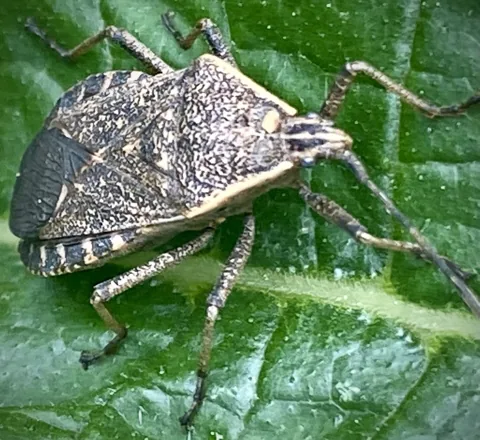 Squash Bug
Anasa tristis
The squash bug is a common vegetable garden pest that sucks sap from squash, pumpkins, melons and other cucurbits. Heavy feeding makes plants wilt and can kill young plants outright.
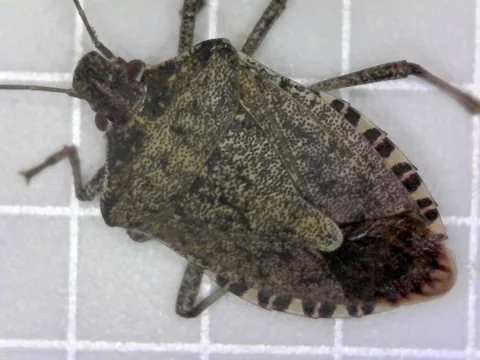 Brown Marmorated Stink Bug
Halyomorpha halys
The brown marmorated stink bug is an invasive insect from east Asia that damages fruit and vegetable crops and invades homes in fall looking for overwintering sites. Minnesota Extension says it feeds on about 200 plant species and, unlike the native stink bugs there, prefers to spend the winter in homes. Clemson notes that the bugs gather on outside walls before they move in.
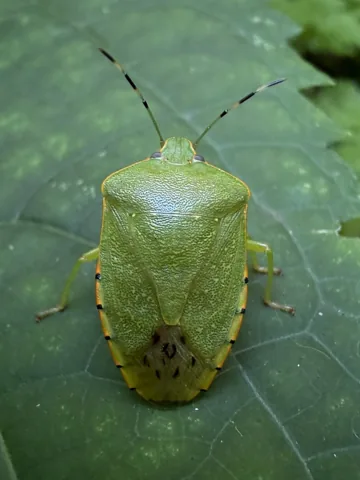 Green Stink Bugs
Chinavia hilaris (green stink bug) and Nezara viridula (southern green stink bug)
Two bright green stink bugs damage gardens and orchards in the U.S.: the green stink bug, a native of North America that feeds on a wide range of crops, and the southern green stink bug, one of the three most abundant stink bug pests in a North Florida tomato study. Both suck juices from developing fruit, seeds and shoots. UF/IFAS calls the green stink bug the most commonly encountered stink bug in North America.
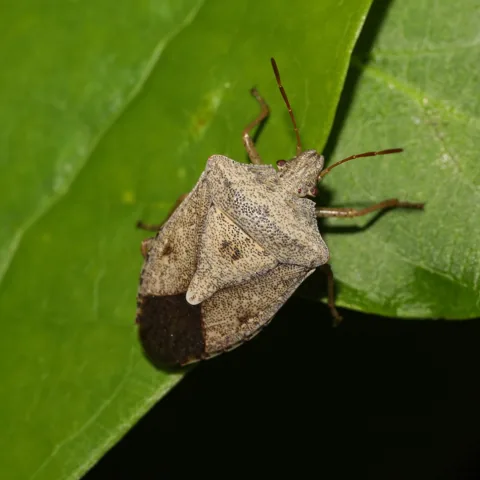 Brown Stink Bug
Euschistus servus
The brown stink bug is a native stink bug and often the first one to show up in Southern vegetable gardens, where it feeds on tomatoes, green beans and other crops. On farms it is a damaging pest of corn, cotton and soybeans, especially in the southeastern United States. The University of Florida calls it a serious pest of most seed, grain, nut and fruit crops in the southern U.S.
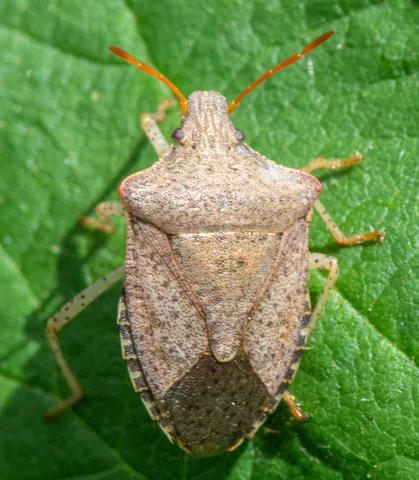 Consperse stink bug
Euschistus conspersus
The consperse stink bug is a native, shield-shaped stink bug about half an inch long that is the most common stink bug on California tomatoes and a pest of apples in the Pacific Northwest. Its feeding leaves pinprick spots on tomatoes and dimpled, corky patches on apples.
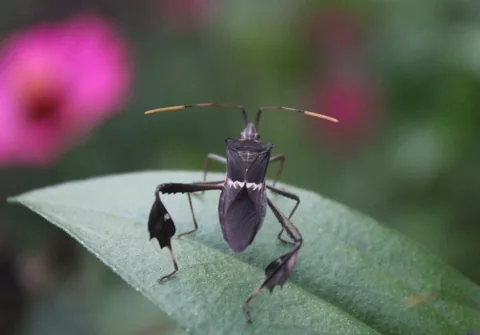 Leaffooted Bug
Leptoglossus zonatus
Leaffooted bugs are medium to large sap-feeding bugs named for the small leaf-like flaps on their hind legs. They pierce fruits, vegetables and nuts to feed, especially on the seeds, and gardeners most often find them on tomatoes and pomegranates.
Side by side
These are the field marks extension and state field guides give. Each line describes the squash bug first, then the stink bug.[1][6]
- Family: the squash bug, Anasa tristis, is a leaf-footed bug (family Coreidae). Stink bugs are family Pentatomidae.[7][6][3]
- Size: adult squash bugs are 5/8 inch long according to UC IPM, Minnesota Extension and Utah State; Nevada Extension says about a half inch. Missouri's field guide gives stink bugs up to about ¾ inch depending on species, and the brown marmorated stink bug is about 5/8 inch.[1][2][3][4][6][5]
- Shape: squash bugs are flattened and longer than wide, about one third as wide as long. Stink bugs are oval or shield-shaped, and UC IPM says they are generally wider and rounder than squash bugs.[1][2][4][6][5]
- Scutellum: stink bugs have a large triangle with a rounded rear end on top of the back, covering the rear of the thorax and the front of the abdomen. Missouri's field guide lists this big triangle as a stink bug trait that separates them from leaf-footed bugs such as the squash bug.[5][6][7]
- Antennae: stink bug antennae have 5 segments; leaf-footed bugs, the squash bug's family, have 4. Brown marmorated stink bugs have alternating light and dark bands on the antennae.[6][7][8][9]
- Color: squash bugs are dark gray to dark brown or grayish brown, with orange and brown stripes along the edges and underside of the abdomen. Stink bugs vary by species: some are drab brown, gray or tan, others leaf green, and others red or orange with black patterns.[2][1][3][6]
- Eggs: squash bug eggs are oval, about 1/16 inch long, yellowish to bronze or brick red, laid in small clusters on the undersides of leaves, often in the V between veins. Stink bug eggs are barrel-shaped with round caps, laid side by side in groups on leaves.[2][1][3][4][5][6][8]
- Egg cluster size: Minnesota Extension says about 20 squash bug eggs per cluster, Utah State 12 to 20, and UC IPM 15 to 40. Penn State says brown marmorated stink bug masses hold 20 to 30 eggs.[2][3][1][9]
- Nymphs: young squash bugs have a light green abdomen with a black or red head and legs, then turn light gray and brownish gray with black legs; UC IPM says they are spiderlike and often dusted with whitish powder. Brown marmorated stink bug nymphs hatch small, black and red, and are colored like adults without wings.[2][3][1][9][8]
- Food plants: squash bugs attack squash and pumpkins mainly, and also melons, cucumbers and other cucurbits. Stink bugs feed on a wide range of fruits, nuts and vegetables, from beans and tomatoes to apples and stone fruits; the brown marmorated stink bug feeds on roughly 200 plant species.[2][1][5][8]
- Damage: squash bug feeding makes yellow spots that turn brown, and heavy feeding wilts runners and kills young plants. Stink bug feeding on fruit leaves misshapen, discolored spots; Penn State says it causes "cat facing" on apples and spongy areas in tomatoes and peppers.[2][1][9][8]
- Behavior when disturbed: squash bugs hide under leaves and move quickly. Most stink bugs fly well, so they can turn up almost anywhere, including inside homes.[2][1][6]
- Winter: squash bugs overwinter as unmated adults under plant debris, rocks, compost piles and around building foundations near the garden. Stink bugs overwinter as adults in sheltered places; brown marmorated stink bugs cluster on the sides of houses on warm fall days and get into homes, sometimes in large numbers.[3][1][4][6][8][9]
- Smell: both give off an unpleasant odor when crushed or disturbed, so smell won't tell them apart.[1][6][8]
Squash bug or brown marmorated stink bug?
The brown marmorated stink bug is the one most often confused with squash bugs. Both StopBMSB.org and Utah State Extension list the squash bug among the insects mistaken for it.[10][11][1]
A brown marmorated stink bug is mottled brown or gray, about 5/8 inch long, with white bands on its dark antennae and one white band on each hind leg. Minnesota Extension calls the alternating light and dark bands on the antennae and the edge of the abdomen the key feature. A squash bug has no white antenna bands; its abdomen edge is striped orange and brown.[5][8][9][2][1]
Where you find it helps too. A gray-brown bug clustered on squash leaves, or grouped on squash fruits in fall is a squash bug. One clustered on the side of the house in fall, looking for a way indoors, is far more likely the stink bug.[2][1][8][9]
How to confirm what you have
Catch one and look from above in good light. Check the outline (narrow or shield-shaped), the size of the triangle in the middle of the back, and whether the antennae have white bands.[5][6][8]
Turn it over. UC IPM suggests flipping squash bugs to see the orange to orange-brown stripes on the edges and underside of the abdomen.[1]
Look at eggs. Bronze or brick-red oval eggs under squash leaves are squash bug eggs. Rows of barrel-shaped eggs with round lids belong to stink bugs.[2][1][5][6]
Lay a board in the squash patch. Squash bugs gather under boards at night, and you can check them in the morning.[2][1]
If you're still unsure, take a sharp photo or the bug itself to your county extension office. University extension IPM programs, such as Nevada's, work on pest identification and public education.[4]
Why it matters
Squash bugs are a pest of the cucurbit family only, and their damage lands on one crop group. Young seedlings and flowering plants are the most vulnerable, and heavy feeding can kill small plants. Squash bugs also carry the bacterium that causes cucurbit yellow vine disease.[1][2]
Squash bug wilt can look like bacterial wilt spread by cucumber beetles. UC IPM says squash bug wilting comes from feeding, not from an infection, so finding the bugs settles it.[1]
Stink bugs spread across many crops and, for brown marmorated stink bugs, into homes. UC IPM notes that some stink bugs are beneficial predators, such as the spined soldier bug, so not every shield-shaped bug in the garden is a pest.[5][8][9]
What to do about each
Squash bugs: check young plants from spring on, crush the bronze egg clusters under leaves, and drop nymphs and adults into a pail of soapy water. Boards laid on the soil gather adults overnight. Clean up cucurbit vines and debris after harvest, and use row covers where squash bugs were a problem, removing them at bloom for pollination. Minnesota Extension says insecticides are normally not required in home gardens. See our squash bug and vine borer guide for more.[2][1][3][4]
Stink bugs in the garden: handpick bugs and eggs from small plants, and clear weeds and groundcovers in early spring before stink bugs build up there.[5]
Stink bugs in the house: seal gaps around doors, windows, screens and where pipes, cords and cables enter. Vacuum bugs that get in and empty them outdoors or into a bucket of soapy water. Minnesota Extension says physical removal works better than insecticides for these.[8]
Common questions
- Is a squash bug a kind of stink bug?
- No. Both are true bugs and both smell when crushed, but the squash bug is a leaf-footed bug (family Coreidae) and stink bugs are family Pentatomidae. Utah State notes that squash bugs are sometimes called stink bugs even though they belong to a different family.[3][7][6]
- Do stink bugs eat squash plants?
- Not as a rule. UC IPM says stink bugs aren't considered pests of cucurbits in the garden and prefer the flowers and fruit of other plants, such as tomatoes and legumes. A gray-brown bug feeding on squash or pumpkins is most likely a squash bug.[1][5]
- Do squash bugs come into the house like stink bugs?
- The squash bug fact sheets describe adults wintering under garden debris, in compost piles and around building foundations near infested plants. Moving into homes in large numbers is the habit of the brown marmorated stink bug.[3][4][2][8][9]
- What do the eggs look like?
- Squash bug eggs are oval and bronze to brick red, in clusters under squash leaves, often between the veins. Stink bug eggs are barrel-shaped with circular caps, laid in tight groups on leaves.[2][1][5][6]
- How many generations do squash bugs have?
- It depends on climate. Minnesota Extension says one generation a year, with a partial second in some summers. UC IPM says two to three generations a year in California.[2][1]
Photo credits
- Squash Bug: Anne P, public domain (CC0), via iNaturalist
- Brown Marmorated Stink Bug: (c) Stan Rullman, some rights reserved (CC BY) — via iNaturalist, CC BY 4.0
- Green Stink Bugs: (c) Marc-Olivier Beausoleil, some rights reserved (CC BY) — via iNaturalist, CC BY 4.0
- Brown Stink Bug: (c) Adrienne van den Beemt, some rights reserved (CC BY) — via iNaturalist, CC BY 4.0
- Consperse stink bug: (c) Don Loarie, some rights reserved (CC BY) — via iNaturalist, CC BY 4.0
- Leaffooted Bug: (c) Ricard Busquets Reverte, some rights reserved (CC BY) — via iNaturalist, CC BY 4.0
Sources
- UC Statewide IPM Program, “Pest Notes: Squash Bugs.” ipm.ucanr.edu/home-and-landscape/squash-bugs/ (accessed 2026-11-14)
- University of Minnesota Extension, “Squash bugs.” extension.umn.edu/yard-and-garden-insects/squash-bugs (accessed 2026-11-14)
- Utah State University Extension, “Squash Bug, ENT-120-08.” extension.usu.edu/pests/uppdl/files/factsheet/ENT-120-08.pdf (accessed 2026-11-14)
- University of Nevada, Reno Extension, “A Northern Nevada Homeowner's Guide to Identifying and Managing Squash Bugs, FS-21-111.” extension.unr.edu/publication.aspx?PubID=4650 (accessed 2026-11-14)
- UC Statewide IPM Program, “Pest Notes: Stink Bugs.” ipm.ucanr.edu/home-and-landscape/stink-bugs/ (accessed 2026-11-14)
- Missouri Department of Conservation, “Stink Bugs (Field Guide).” mdc.mo.gov/discover-nature/field-guide/stink-bugs (accessed 2026-11-14)
- Missouri Department of Conservation, “Leaf-Footed Bugs (Coreids) (Field Guide).” mdc.mo.gov/discover-nature/field-guide/leaf-footed-bugs (accessed 2026-11-14)
- University of Minnesota Extension, “Brown marmorated stink bug.” extension.umn.edu/yard-and-garden-insects/brown-marmorated-stink-bug (accessed 2026-11-14)
- Penn State Extension, “Brown Marmorated Stink Bug.” extension.psu.edu/brown-marmorated-stink-bug (accessed 2026-11-14)
- StopBMSB.org (Northeastern IPM Center, USDA NIFA Specialty Crop Research Initiative project), “Look-Alike Insects.” www.stopbmsb.org/stink-bug-basics/look-alike-insects/ (accessed 2026-11-14)
- Utah State University Extension, “Invasive Insect Look-Alikes.” extension.usu.edu/pests/research/invasive-insect-lookalikes (accessed 2026-11-14)