The short answer
Profiles of pests that wilt squash
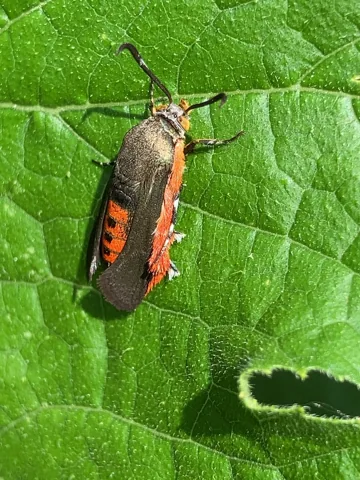 Squash Vine Borer
Eichlinia cucurbitae
The squash vine borer is a day-flying clearwing moth whose caterpillars feed inside the stems and crowns of summer squash, winter squash and pumpkins. A vine that wilts suddenly in midsummer is often the first sign, and in a bad year home gardens and small farms can lose the whole crop.
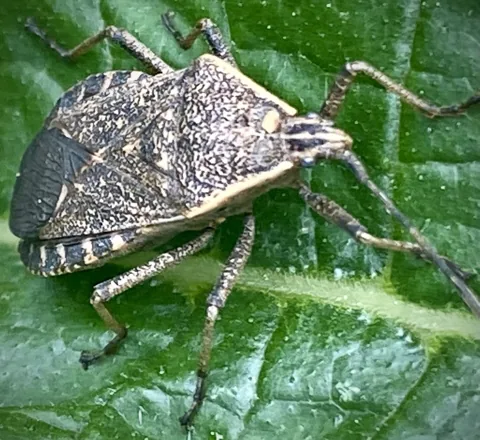 Squash Bug
Anasa tristis
The squash bug is a common vegetable garden pest that sucks sap from squash, pumpkins, melons and other cucurbits. Heavy feeding makes plants wilt and can kill young plants outright.
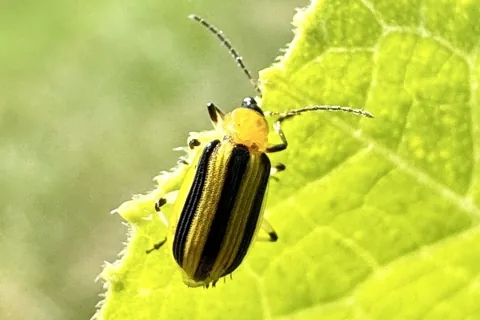 Striped Cucumber Beetle
Acalymma vittatum
Cucumber beetles are small yellow-and-black beetles that feed on squash, cucumbers, melons and other cucurbits. The striped cucumber beetle is the main concern because it can carry bacterial wilt into cucumbers and muskmelons.
Wilting clues and the likely culprit
Wilting can come from any of these, and Wisconsin notes it can also be confused with Fusarium wilt. The stem is where the evidence is.[3]
- Plants wilting at midday or in the morning in mid-summer, often a whole runner at once, with sawdust-like frass near the base and holes in the side of the stem: squash vine borer. Vines usually die beyond the point of attack.[3][1][2]
- Permanent wilting of leaves and stems followed by collapse, often on cucumbers and melons, with striped or spotted cucumber beetles around: bacterial wilt. Cucumber beetles spread the bacteria through feeding wounds.[6][7][8]
- Wilting leaves that collapse, with flat gray-brown bugs on the plant: squash bugs, which suck sap with straw-like mouthparts. Young plants can wilt and die.[5][4][2]
- In melons, watermelon and pumpkin, squash bugs can also transmit Yellow Vine Decline, which causes yellowing, wilting and death.[2]
How to confirm the cause
- Look for entrance holes near the base of wilting vines. If sawdust-like frass is there, it's squash vine borer; split the stem and one to several cream-colored, brown-headed caterpillars are usually inside.[3][2]
- String test for bacterial wilt: cut the stem near the ground and slowly pull the cut ends apart. Shiny, clear to white elastic strands mean bacterial wilt. No strands doesn't rule it out, so contact your local extension office if unsure.[9][8]
- Check leaves and stems for squash bugs and their oval yellowish-to-bronze eggs.[4][5]
What to do next
- Bacterial wilt has no treatment. The only way to manage it is to manage cucumber beetles, especially on cucumbers, cantaloupe and honeydew.[6][7]
- Squash vine borer: larvae feed inside the stem for weeks, then leave to pupate in the soil, so act as soon as you find frass. See the guide below for options.[1][3]
- Squash bugs: protect young plants early, since early feeding does the most harm.[2][4]
Common questions
- My squash wilts at midday but recovers by evening. Is it dying?
- Midday wilting is the first symptom of squash vine borer feeding, so check the base of the vine for holes and sawdust-like frass.[3][1]
- Can a plant with bacterial wilt be saved?
- No. There is no treatment for plants infected with bacterial wilt; prevention means controlling cucumber beetles.[6]
- Does watermelon get bacterial wilt?
- UNL notes watermelon is resistant to bacterial wilt; cucumber, squash, muskmelon, pumpkin and gourd are affected.[8]
Photo credits
- Squash Vine Borer: (c) Zeke Blankenship, some rights reserved (CC BY) — via iNaturalist, CC BY 4.0
- Squash Bug: Anne P, public domain (CC0), via iNaturalist
- Striped Cucumber Beetle: (c) L.J. Lamera, some rights reserved (CC BY) — via iNaturalist, CC BY 4.0
Sources
- University of Minnesota Extension, “Squash Vine Borers.” extension.umn.edu/garden-and-home/yard-and-garden/yard-and-garden-insects/squash-vine-borers (accessed 2026-11-12)
- University of Kentucky Entomology, “ENTFACT-314: Squash Vine Borer and Squash Bug (revised January 2026).” entomology.ca.uky.edu/ef314 (accessed 2026-11-12)
- University of Wisconsin-Madison Extension (Wisconsin Horticulture), “Squash Vine Borer.” hort.extension.wisc.edu/articles/squash-vine-borer/ (accessed 2026-11-12)
- University of Minnesota Extension, “Squash Bugs (reviewed 2026).” extension.umn.edu/yard-and-garden-insects/squash-bugs (accessed 2026-11-12)
- University of California Statewide IPM Program, “Squash Bugs (Pest Notes, Home and Landscape).” ipm.ucanr.edu/home-and-landscape/squash-bugs/ (accessed 2026-11-12)
- Cornell Integrated Pest Management, “Striped Cucumber Beetle (Acalymma vittatum), Vegetable IPM Fact Sheet (N. Murray, B. Nault, M. Zuefle, 2025).” cals.cornell.edu/integrated-pest-management/outreach-education/fact-sheets/striped-cucumber-beetle-acalymma-vittatum-vegetable-ipm-fact-sheet (accessed 2026-11-12)
- University of Minnesota Extension, “Cucumber Beetles.” extension.umn.edu/garden-and-home/yard-and-garden/yard-and-garden-insects/cucumber-beetles (accessed 2026-11-12)
- University of Nebraska-Lincoln Extension, “G2023 Bacterial Wilt of Cucurbits (NebGuide).” extensionpubs.unl.edu/publication/g2023/2010/html/view (accessed 2026-11-12)
- The Ohio State University, “Bacterial Wilt of Cucurbits: For the Professional Diagnostician (Vegetable Disease Facts).” u.osu.edu/vegetablediseasefacts/?p=1954 (accessed 2026-11-12)