The short answer
- Count the prolegs, the fleshy stubs on the belly behind the three pairs of true legs. Sawfly larvae have six or more pairs; caterpillars have two to five pairs. Illinois Extension's trick: a sawfly has enough to spell 'sawfly'.[1][2][3][6]
- Check the feet of the prolegs: caterpillars have crochets, tiny hooks, on them, and sawfly larvae do not.[2][4][5]
- Look at the head: a sawfly larva has a single eye spot on each side, while a caterpillar has several tiny eyes on each side.[2][6][7]
- Watch the group: many sawfly larvae feed side by side and rear up together when disturbed.[1][2][5]
- Why it matters: Bt (Bacillus thuringiensis kurstaki) controls caterpillars but does not kill sawfly larvae.[1][6][3][15]
Profiles on this site
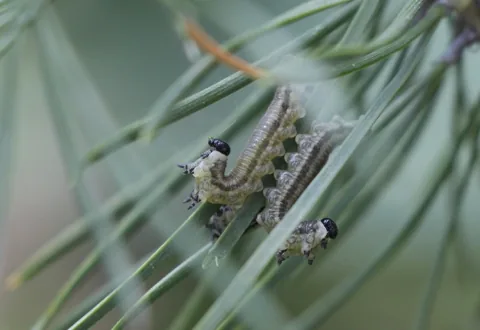 Pine Sawflies
Diprionidae (e.g., Neodiprion sertifer, the European pine sawfly)
Pine sawflies are wasp relatives whose caterpillar-like larvae feed in groups on pine needles. The European pine sawfly is the most common on pines in Pennsylvania, and several other species, such as the redheaded pine sawfly, attack pines too.
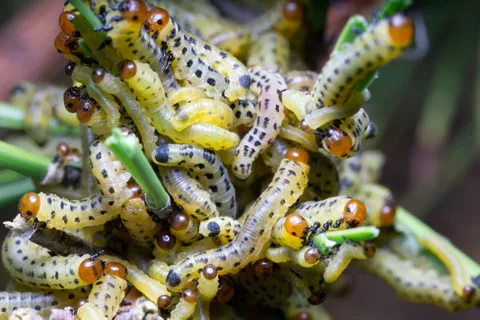 Redheaded Pine Sawfly
Neodiprion lecontei
The redheaded pine sawfly is a native insect whose yellow, black-spotted larvae with red heads feed in groups on pine needles. It does not harm people or pets, but it can strip and kill small pines. Pick or shake colonies off small trees and crush them, or spray young larvae with spinosad; Bt products for caterpillars do not work on sawflies.
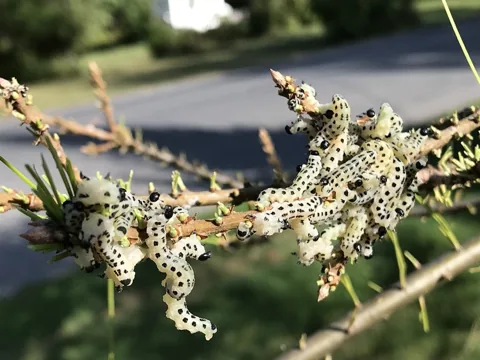 White Pine Sawfly
Neodiprion pinetum
The white pine sawfly is a sawfly whose pale yellow, black-spotted larvae feed in groups on eastern white pine and other pines in summer, eating both old and new needles.
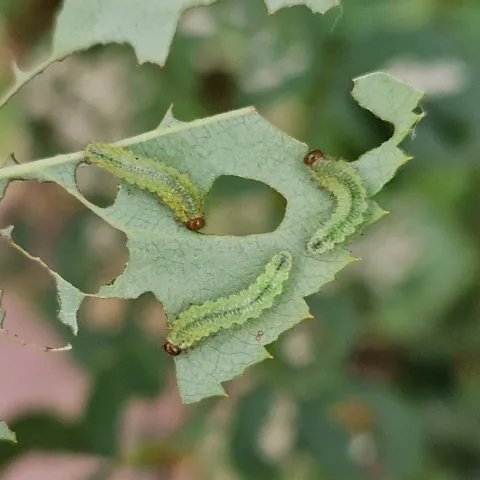 Rose Slugs (Rose Sawflies)
Cladius difformis (bristly roseslug; GBIF treats it as a synonym of Cladius pectinicornis), Endelomyia aethiops and Allantus cinctus
Rose slugs, or roseslugs, are the larvae of sawflies, wasp relatives that feed on rose leaves. The bristly roseslug causes the most trouble because it has several generations a year and keeps feeding until frost, while the roseslug and curled rose sawfly feed mainly early in the season. Ohio State says the bristly roseslug has largely replaced the other two in Ohio.
 Pear Slug
Caliroa cerasi (pear sawfly, cherry slug)
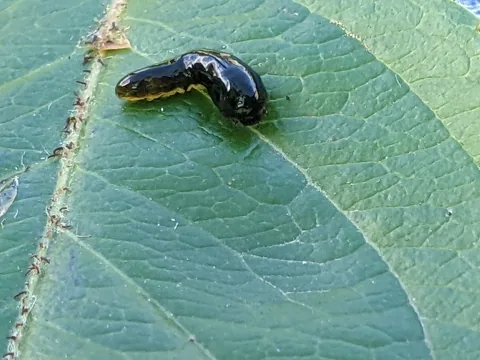
Pear slugs aren't slugs at all. They're sawfly larvae coated in olive-green slime that skeletonize cherry and pear leaves.
 Elm Sawfly
Cimbex americana
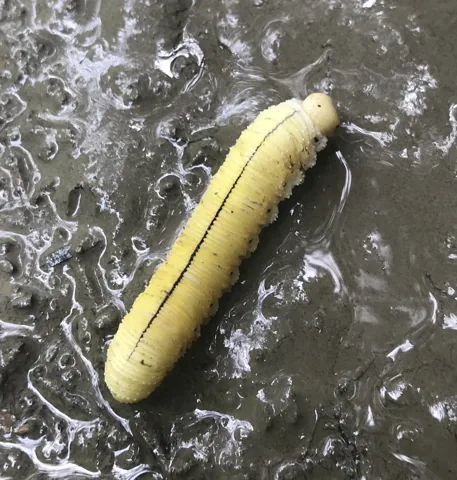
The elm sawfly is the largest sawfly in North America: a big, blue-black, wasp-like insect whose larvae look like fat yellow caterpillars with a black stripe down the back and eat the leaves of elm and willow. Iowa State and South Dakota State describe sawflies as non-stinging wasp relatives. Trees usually suffer little, though large numbers can defoliate a tree and small trees may be stunted. Larvae can be picked off small trees by hand; South Dakota State says larger trees could warrant an insecticide specifically labeled for sawflies.
 Eastern Tent Caterpillar
Malacosoma americana
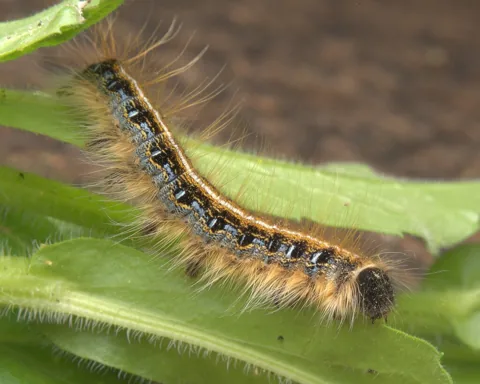
Eastern tent caterpillars build silk tents in the crotches of wild cherry, apple and crabapple in spring. They can nearly defoliate a tree, but the tree usually recovers and puts out new leaves. It is a native insect with many natural enemies, and often no spraying is needed.
 Fall Webworm
Hyphantria cunea
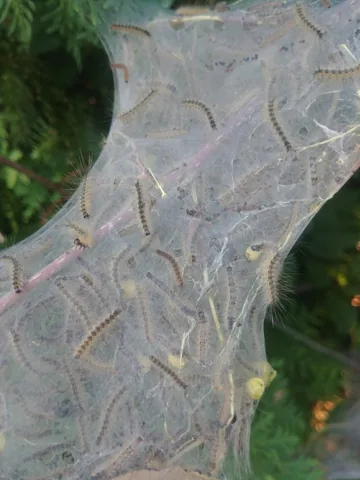
The fall webworm is a native caterpillar that spins large, loose webs over the ends of branches on a long list of deciduous trees and shrubs. The webs look alarming from midsummer into fall, but on healthy, established trees the damage is mostly cosmetic.
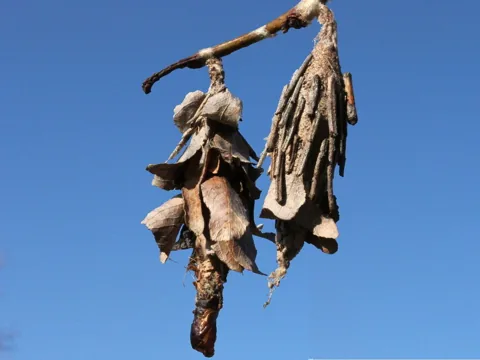 Bagworm
Thyridopteryx ephemeraeformis
Bagworms are caterpillars that build spindle-shaped bags of silk and bits of plant material and feed from inside them. Ohio State says they are hard to control because they often go unnoticed until the larvae are mature, by which time arborvitae, cedar or juniper can be badly defoliated; Missouri Extension notes complete defoliation is not uncommon.
Side by side
What they are: sawflies are in the order Hymenoptera with bees, ants and wasps. Caterpillars are the larvae of moths and butterflies (Lepidoptera).[2][3][6]
Legs: both have three pairs of true legs behind the head. Caterpillars have 2-5 pairs of prolegs on the abdomen; sawfly larvae have 6 or more. Penn State counts seven pairs of prolegs on the European pine sawfly. UC IPM puts it as prolegs on at least six abdominal segments on sawflies, versus five or fewer on most other caterpillarlike larvae out in the open on leaves.[2][1][8][6]
Crochets: caterpillars have crochets, tiny hooks that work like hook-and-loop fastener, on the tips of their prolegs. Sawfly larvae have none.[2][4][5]
Eyes: Wisconsin Extension says caterpillars have 4-6 eyes on each side of the head, while sawfly larvae have just a single pair of tiny eyes. Illinois Extension describes them differently: caterpillar eyes are very small and difficult to see, while sawflies have relatively large eyes that can easily be seen. UC IPM describes the curled rose sawfly's head with a black eye spot on each side, and Kentucky the redheaded pine sawfly's red head with 2 black eye spots.[2][3][6][7]
Body and size: Minnesota Extension says sawfly larvae are smooth with little or no hair and no more than one inch long when grown, while caterpillars can be smooth, hairy or spiny and may be longer. Some sawflies run bigger: Kentucky gives redheaded pine sawfly larvae 1 to 1-1/4 inches, and Wisconsin gives the elm sawfly 1½-2 inches. Some sawflies do carry bristles, such as the bristly roseslug.[1][7][2][3]
Slug sawflies: roseslugs and pearslugs have small prolegs that are easy to miss, and pearslugs look wet and slimy, like tiny slugs slightly wider at the head end.[1][10][2]
Behavior: most sawflies feed in groups, some species lined up along a leaf edge, and a threatened group can raise and arch their bodies all at once. Curled rose sawfly larvae coil up while feeding or at rest. Caterpillars may also feed in groups: tent caterpillars feed in groups at least when young and spin silk tents.[1][2][5][6][3][11]
Adults: adult sawflies are stout, wasp-like and do not sting, with a broad waist instead of a wasp's narrow one, and they are seldom noticed. Caterpillars turn into moths and butterflies; tent caterpillar adults are hairy, dull-colored moths.[1][2][6][11]
Host plants: each sawfly species feeds on specific plants or a related group, and the host is usually in its name. Common ones are pines (European, redheaded, white and introduced pine sawflies), roses (roseslugs), pear and cherry (pearslug), birch, mountain ash and columbine.[2][1][7][10]
Where caterpillars turn up on the same plants: eastern tent caterpillars on apple, chokecherry, crabapple, plum and cherry in May and June; bagworms on juniper, arborvitae, spruce and pine as well as deciduous trees.[12][13]
Season: sawfly timing depends on the species. European pine sawfly larvae are active from late April to mid-June, white pine sawfly larvae from late June to August, and redheaded pine sawflies throughout the growing season. Most Minnesota sawflies have one generation a year, some two.[7][9][1]
How to confirm
Look at the larva from the side: the prolegs sit on the lower side of the abdomen, behind the three pairs of true legs. Count the pairs.[8][1]
On slug-like larvae, look closely, because the prolegs on slug sawflies are small and may be overlooked.[1]
If the count is unclear, look for crochets on the proleg tips (caterpillar) and for one eye spot on each side of the head (sawfly).[2][4][6]
Check the host: a group of larvae on pine needles in spring that rear up together is a typical sawfly picture; a silk tent in a branch fork of a fruit tree is eastern tent caterpillar; a silk bag decorated with plant bits is a bagworm.[2][1][12][14]
- On roses, also rule out hover fly larvae, which eat aphids. UC IPM says they sit among aphids, do not chew leaves and have no true legs.[6]
Why the ID matters: Bt
Bacillus thuringiensis kurstaki (Btk) is a common low-impact insecticide for moth and butterfly caterpillars. Each type of Bt toxin is specific to its target insects, and the kurstaki strain controls caterpillars of moths and butterflies.[1][15]
Btk does not kill sawfly larvae, because they are not caterpillars. Minnesota, Wisconsin, Illinois and UC IPM all say so.[1][2][3][6]
Bt has to be eaten: spores damage the gut of larvae that eat them, death follows within 1-5 days, and young larvae are most affected.[15]
- Other products do overlap: Wisconsin Extension says insecticidal soaps, neem oil and many synthetic insecticides can be used on sawflies, and NC State says insecticides labeled for caterpillar control in the landscape should control redheaded pine sawfly. Read the label before you use any of them.[2][9]
What to do for each
Sawflies: because they feed in groups, small numbers can be removed by hand into a pail of soapy water, colonies on small pines can be picked or shaken off, or spot treat the infested branches rather than the whole plant. Early detection limits damage.[1][9]
Pine sawflies: watch for tufts of dry, straw-like needles on last year's growth in late April and early May, the sign of young larvae, and act while they are small. See how to get rid of sawflies.[8]
Caterpillars: Bt, neem or spinosad work best early, while caterpillars are small; for bagworms Kentucky says to catch them in May or June. See the tent caterpillar and webworm guide and the bagworm guide.[13][15]
Common questions
- Are sawflies wasps?
- They are in the same order as wasps, bees and ants, and the adults look somewhat wasp-like, but adult sawflies do not sting.[2][1]
- Will Bt kill roseslugs or pine sawflies?
- No. Bt kurstaki works only on true caterpillars; roseslugs, pearslugs and pine sawflies are sawfly larvae.[6][3][2]
- What is the quickest single test?
- Count the prolegs on the abdomen: six or more pairs means a sawfly, two to five pairs means a caterpillar.[1][2]
- Why are dozens of larvae rearing up together on my pine?
- That group display is typical of sawflies, which feed in groups and raise and arch their bodies together when threatened.[1][2][5]
Photo credits
- Pine Sawflies: Liubov Ilminska, public domain (CC0), via iNaturalist
- Redheaded Pine Sawfly: (c) Jack Forrester, some rights reserved (CC BY) — via iNaturalist, CC BY 4.0
- White Pine Sawfly: (c) Kenneth Burdick, some rights reserved (CC BY) — via iNaturalist, CC BY 4.0
- Rose Slugs (Rose Sawflies): (c) Gabriele Pradelli, some rights reserved (CC BY) — via iNaturalist, CC BY 4.0
- Pear Slug: (c) Alexandria 'Alex' Wenninger, some rights reserved (CC BY) — via iNaturalist, CC BY 4.0
- Elm Sawfly: (c) Allison Zon, some rights reserved (CC BY) — via iNaturalist, CC BY 4.0
- Eastern Tent Caterpillar: (c) Norman Kuring, some rights reserved (CC BY) — via iNaturalist, CC BY 4.0
- Fall Webworm: Andalyne Tofflemire, public domain (CC0), via iNaturalist
- Bagworm: (c) Peter Chen 2.0, some rights reserved (CC BY) — via iNaturalist, CC BY 4.0
Sources
- University of Minnesota Extension, “Sawflies.” extension.umn.edu/yard-and-garden-insects/sawflies (accessed 2026-11-14)
- University of Wisconsin-Madison Extension (Wisconsin Horticulture), “Sawflies.” hort.extension.wisc.edu/articles/sawflies/ (accessed 2026-11-14)
- University of Illinois Extension, “Why are there holes in my roses? Roseslugs.” extension.illinois.edu/blogs/good-growing/2024-06-07-why-are-there-holes-my-roses-roseslugs (accessed 2026-11-14)
- Kansas State University Extension Entomology, “Caterpillars and Sawflies.” www.k-state.edu/news/kansasbugs/articles/2015/05/caterpillars-and-sawflies.html (accessed 2026-11-14)
- University of Wisconsin-Green Bay, Cofrin Center for Biodiversity, “Econotes: Sawflies.” www.uwgb.edu/biodiversity-old/econotes/2004/sawfly.htm (accessed 2026-11-14)
- University of California Statewide IPM Program, “Rose Sawflies (Roseslugs).” ipm.ucanr.edu/home-and-landscape/rose-sawflies-roseslugs/ (accessed 2026-11-14)
- University of Kentucky Entomology, “Pine Sawflies (ENTFACT-410).” entomology.mgcafe.uky.edu/ef410 (accessed 2026-11-14)
- Penn State Extension, “European Pine Sawfly.” extension.psu.edu/european-pine-sawfly (accessed 2026-11-14)
- NC State Extension, “Redheaded Pine Sawfly.” content.ces.ncsu.edu/redheaded-pine-sawfly (accessed 2026-11-14)
- NC State Extension, “Pearslug.” content.ces.ncsu.edu/pear-slug (accessed 2026-11-14)
- University of California Statewide IPM Program, “Pest Notes: Tent Caterpillars.” ipm.ucanr.edu/home-and-landscape/tent-caterpillars/ (accessed 2026-11-14)
- University of Minnesota Extension, “Eastern tent caterpillars.” extension.umn.edu/yard-and-garden-insects/eastern-tent-caterpillars (accessed 2026-11-14)
- University of Kentucky Entomology, “Dealing with Bagworms on Landscape Plants (ENTFACT-440).” entomology.mgcafe.uky.edu/ef440 (accessed 2026-11-14)
- University of Missouri Extension, “The Bagworm in Missouri (G7250).” extension.missouri.edu/publications/g7250 (accessed 2026-11-14)
- National Pesticide Information Center, “Bacillus thuringiensis (Bt) General Fact Sheet.” npic.orst.edu/factsheets/btgen.html (accessed 2026-11-14)