The short answer
- Watch for scratching and head shaking, thick brown crusts inside the ears, dandruff-like flakes that move, fur loss or red, swollen skin, and fleas or flea dirt in the coat, Merck says.[1][2][3]
- Never use a fipronil flea product on a rabbit. Merck says fipronil can cause severe nervous system problems and death in rabbits, and that flea collars are not recommended for them either.[3][2][1]
- Treat every cat and dog in the house too. Merck says the rabbit is not usually the original host of its fleas.[1]
- Don't pick at ear crusts. Merck says pulling them off is very painful for the rabbit and can cause bleeding.[1][2]
- Call a vet who treats rabbits. Merck says only a small number of drugs are approved for rabbits, and rabbits often hide illness, so quick veterinary care matters.[3]
The fleas and mites on rabbits
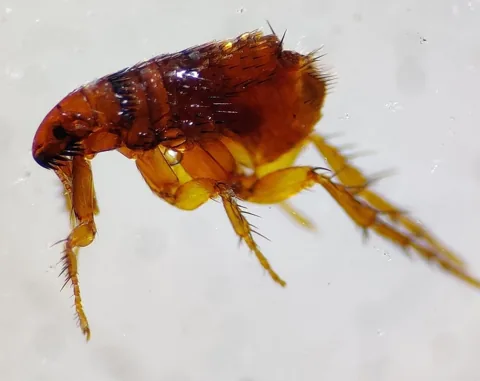 Cat Flea
Ctenocephalides felis
The cat flea is the most common external parasite of domestic cats and dogs, and the flea most often found on both. Adults spend most of their time on the pet, while eggs, larvae and pupae build up wherever the pet rests.
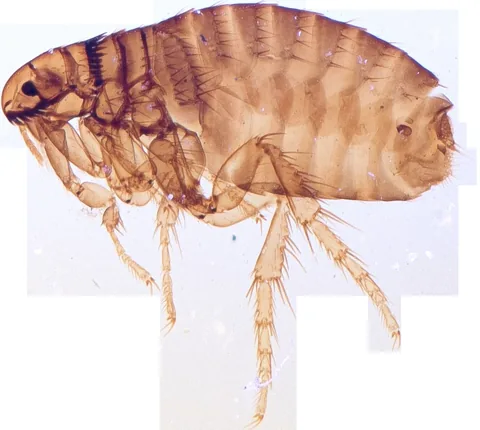 Dog Flea
Ctenocephalides canis
The dog flea looks very much like the cat flea but is the less common of the two on U.S. pets: UC IPM says the cat flea is the most common external parasite on domestic cats and dogs and calls the dog flea rare in California. In some countries, such as South Korea and Uzbekistan, surveys have found it to be the main flea on dogs.
No photo yet
Cheyletiella mites
Cheyletiella yasguri (dogs), C. blakei (cats) and C. parasitivorax (rabbits)
Cheyletiella mites live in the fur of dogs, cats and rabbits. They can often be seen moving in the hair coat, which gives the infestation its nickname, walking dandruff. People who handle infested pets can get an itchy rash, but the mites do not stay long on humans and do not complete their life cycle on people; once the pets are treated, the rash in people clears on its own.
Fleas: usually from the dog or cat
Merck says cat fleas (Ctenocephalides felis), dog fleas (C. canis) and the human flea (Pulex irritans) can all affect rabbits.[1]
The flea problem usually starts with another pet. Merck says it is important to treat every cat and dog in the house, because the original host is not usually the rabbit.[1]
Merck's owner guide says fleas can spread from rabbits to people and to other animals, and that whatever product is used, thorough cleanup of living spaces is essential to prevent reinfection.[2]
Clean the rabbit's room along with the rest of the house; Merck says cleanup of living spaces is what prevents reinfection. The house-flea guide linked below covers the cleanup steps.[2]
Fur mites (Cheyletiella): walking dandruff
Merck says fur mite infestations are common in rabbits; Cheyletiella and Listrophorus are found worldwide, and the most common Cheyletiella on North American rabbits is C. parasitovorax.[1]
These mites live on the surface of the skin. Merck says they usually cause few signs beyond mild itching unless the rabbit is stressed, ill or debilitated.[1][2]
What you see is dandruff. Merck says scraping the flakes onto dark paper shows them moving, which is why Cheyletiella is called walking dandruff. A vet confirms it with a skin scraping under the microscope.[1][2]
They spread by direct contact, Merck says. Illinois public health says Cheyletiella can cause itching in people who handle infested pets but does not stay long on humans; the Cheyletiella profile covers the human side.[1][6]
Ear mites (Psoroptes cuniculi): ear canker
Merck calls the rabbit ear mite Psoroptes cuniculi a common parasite of rabbits worldwide. It is a different mite from the Otodectes ear mite of cats and dogs.[1]
The mites irritate the ear lining and cause serum and thick brown crusts to build up, an "ear canker." Merck says infested rabbits scratch and shake their head and ears, can lose weight and get secondary infections, and severe cases can damage the inner ear and lead to a head tilt.[1][2]
Leave the crusts alone. Merck says the brown crumbly crust should never be removed from an awake rabbit because it is very painful; the crusts slowly slough off as the mites die and the ear heals.[1][2]
The mite passes readily by direct contact, Merck says, so check and ask your vet about every rabbit that shares space with an infested one.[1]
Merck says veterinary treatment with medication is effective. Your vet chooses the product and the schedule.[2][1]
Burrowing mange mites (rare)
Merck says rabbits are rarely infested with the burrowing mites Sarcoptes scabiei or Notoedres cati, but those rabbits itch intensely, the mites are hard to eliminate and the condition is extremely contagious, including to people.[1][2]
Merck's owner guide says treatment needs vet-prescribed medication plus careful cleaning of the rabbit's environment.[2]
Products that are dangerous to rabbits
Fipronil: Merck's rabbit pages say flea products containing fipronil must never be used on rabbits because they cause severe nervous system problems and death, and the professional chapter says fipronil is contraindicated in rabbits because of potential toxicity.[3][2][1]
Flea collars: Merck says they are not recommended for rabbits.[1]
Merck's owner guide says products containing imidacloprid may be used on rabbits under veterinary guidance. Let your vet choose the product and the amount; Merck notes that only a small number of drugs are specifically approved for rabbits and vets use others with caution.[2][3]
FDA says to make sure any flea product matches your pet's species, life stage and weight class, to involve your veterinarian when choosing one, and to read the whole label every time. A dog or cat product is not a rabbit product.[5]
When you treat the dog and cat, FDA says to apply spot-ons and sprays to one pet at a time and keep the treated animal apart from the others until the product dries, so no animal grooms another and swallows it.[5]
FDA says to call your veterinarian right away if a pet has a bad reaction to a flea or tick product; signs it lists include incoordination, poor appetite, depression, vomiting, diarrhea and excessive salivation.[5]
When to call the vet
Merck's rabbit illness signs include fur loss or red, swollen skin, loss of energy, loss of appetite and weight, and not hopping or moving normally, and it says to contact your vet right away if any of these occur.[3]
Call about any crusting in the ears, head shaking, a head tilt, intense itching or moving dandruff, Merck's skin and parasite pages say; many rabbit skin problems involve parasites and need veterinary treatment.[2][1]
Groom regularly. Merck says grooming helps owners notice skin problems early.[2]
Watch the rear end too. Merck says a wet, soiled area around the tail invites fly strike, especially in rabbits kept outdoors; see the flystrike page for signs and prevention.[4]
Common questions
- Can I use my cat's or dog's flea treatment on my rabbit?
- Not without your vet. Merck says fipronil products must never be used on rabbits, and FDA says a flea product must match the pet's species, life stage and weight. Ask a vet who treats rabbits which product, if any, to use.[3][2][5]
- Where did my indoor rabbit get fleas?
- Usually from another pet. Merck says the original host is not usually the rabbit, so every cat and dog in the house should be treated as well.[1]
- Should I clean the crusts out of my rabbit's ears?
- No. Merck says removing the crusts from an awake rabbit is very painful and can cause bleeding; they slough off as treatment works.[1][2]
- Can rabbit mites bite me?
- Fur mites can make people itch. Illinois public health says Cheyletiella causes itching in people who handle infested pets but does not stay long on humans, and Merck says the rare burrowing mange mites can spread to people.[6][2]
- Is dandruff on my rabbit always mites?
- No, but Merck says Cheyletiella often shows up as dandruff, and flakes that move on dark paper point to mites. A vet confirms it with a skin scraping.[1][2]
Photo credits
- Cat Flea: (c) Thomas Gyselinck, some rights reserved (CC BY) — via iNaturalist, CC BY 4.0
- Dog Flea: Ctenocephalides canis by Hallvard Elven, Naturhistorisk museum, Universitetet i Oslo — via Wikimedia Commons, CC BY 3.0
Sources
- Merck Veterinary Manual, “Parasitic Diseases of Rabbits (Professional Version).” www.merckvetmanual.com/exotic-and-laboratory-animals/rabbits/parasitic-diseases-of-rabbits (accessed 2026-11-15)
- Merck Veterinary Manual, “Skin Disorders of Rabbits (Pet Owner Version).” www.merckvetmanual.com/all-other-pets/rabbits/skin-disorders-of-rabbits (accessed 2026-11-15)
- Merck Veterinary Manual, “Illness of Rabbits (Pet Owner Version).” www.merckvetmanual.com/all-other-pets/rabbits/disorders-and-diseases-of-rabbits (accessed 2026-11-15)
- Merck Veterinary Manual, “Noninfectious Diseases of Rabbits (Professional Version).” www.merckvetmanual.com/exotic-and-laboratory-animals/rabbits/noninfectious-diseases-of-rabbits (accessed 2026-11-15)
- U.S. Food and Drug Administration, “Safe Use of Flea and Tick Products in Pets.” www.fda.gov/consumers/consumer-updates/safe-use-flea-and-tick-products-pets (accessed 2026-11-15)
- Illinois Department of Public Health, “Mites Affecting Humans.” dph.illinois.gov/topics-services/environmental-health-protection/structural-pest-control/mites-affecting-humans.html (accessed 2026-11-15)