The short answer
- Mud means subterranean. Subterranean termites nest in the soil and reach wood that touches the ground or travel up to it through earthen shelter tubes. Drywood termites live entirely inside the wood, need no soil contact and build no mud tubes.[2][1][7]
- Little piles of hard pellets mean drywood. Drywood termites push their droppings out through tiny kickout holes, and the pellets have six flattened sides, a shape UC IPM calls diagnostic. Subterranean termites leave no pellet piles; they use their waste in their mud work.[1][5][8]
- Open the damage if you can. Drywood galleries are smooth, run across the grain and hold no mud. Subterranean termites eat the softer springwood along the grain, leaving layered wood with soil in the galleries.[5][7][3][8]
- Where you live narrows it down. Subterranean termites occur across the United States. The destructive drywood species are limited to warmer southern states and humid coastal areas, such as coastal and southern California, the Gulf Coast and Florida.[8][12][7][1]
Termite profiles on this site
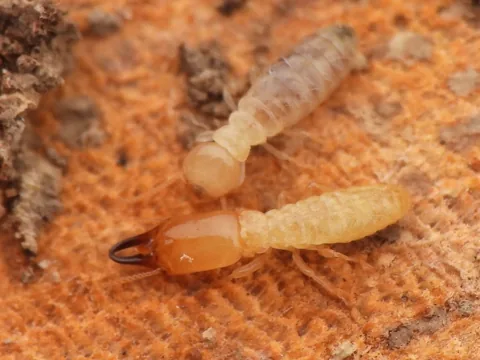 Eastern Subterranean Termite
Reticulitermes spp. (shown: R. flavipes)
Subterranean termites live in the soil and travel into buildings through earthen shelter tubes; they are the most destructive termites in most of the United States and usually warrant a professional.
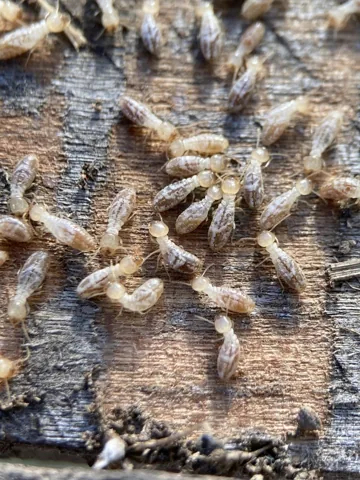 Western Subterranean Termite
Reticulitermes hesperus
The western subterranean termite lives in soil and travels through mud tubes to feed on wood, including the lumber in houses. Its genus, Reticulitermes, holds the most destructive termites found in California and ranks among the most economically important wood-destroying pests in the western United States.
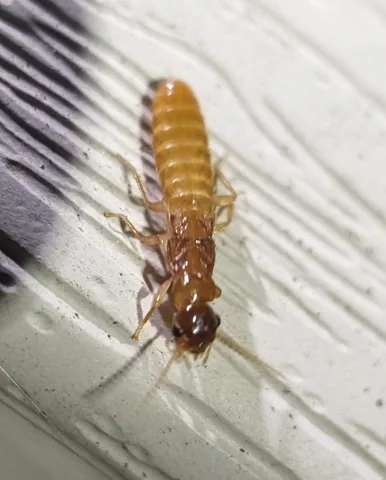 Formosan Subterranean Termite
Coptotermes formosanus
The Formosan subterranean termite is an invasive species from East Asia and one of the most aggressive and economically damaging termites in the world; its colonies are much larger than those of native subterranean termites. EPA lists it among the less common termites in the U.S., behind the native subterranean termite. UF/IFAS says it has consistently been listed among the 100 worst invasive species in the world.
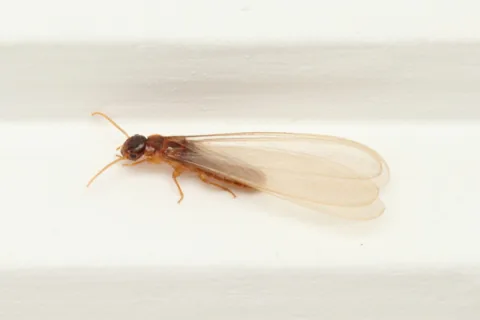 Asian Subterranean Termite
Coptotermes gestroi
The Asian subterranean termite is a very destructive tropical termite, considered second only to its relative the Formosan subterranean termite. In the U.S. both invasive Coptotermes species are established in Florida, and the Asian species has spread beyond South Florida, where it was first confined.
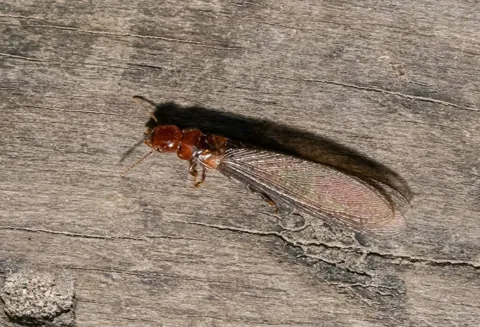 Western Drywood Termite
Incisitermes minor
Drywood termites live entirely inside wood without needing soil contact; the western drywood termite is California's second most important termite pest after subterranean termites. Clemson Extension says drywood termites get the moisture they need from humid air and are most common along humid coastal areas of South Carolina.
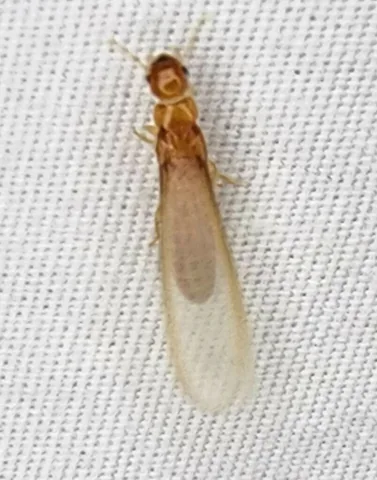 Southeastern Drywood Termite
Incisitermes snyderi
The southeastern drywood termite is the most common drywood termite in Florida and in Texas. It lives inside dry, sound wood in both natural and human-made settings, and its pale swarmers fly toward lights at night.
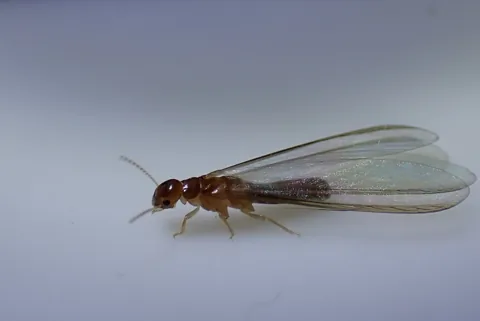 West Indian Drywood Termite
Cryptotermes brevis
The West Indian drywood termite lives its whole life inside dry wood and never needs soil. Extension entomologists describe it as almost never found in natural settings, only in the wood of buildings, furniture and picture frames, and it travels mostly when people move infested wood. UF/IFAS calls it the most common structure-infesting drywood termite in Florida and reports that nearly all structural fumigation in Florida and Hawaii is done to control this one species.
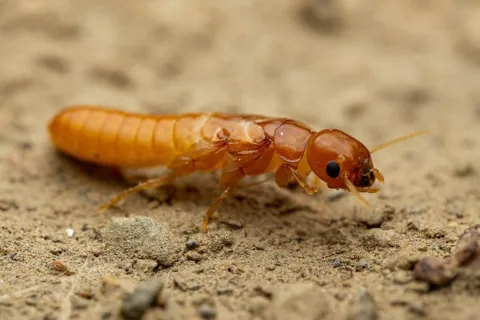 Light western drywood termite
Marginitermes hubbardi
The light western drywood termite is a pale desert termite that lives entirely inside dry wood, with no need for soil. It does not bite or harm people, but the University of Arizona says that in central and southern Arizona it is now found more often in wooden buildings than in its natural homes in cottonwoods and saguaro skeletons, and its damage there can threaten a building's structural integrity. It lives below about 4,000 feet from Phoenix to Tucson and along the Colorado River. Getting rid of it is a job for a licensed professional, by fumigation, heat or a targeted spot treatment.
Side by side
Most people never see the termites themselves, only the swarmers or the damage. Each line below gives the sign to check first.[1][9]
- Where the colony lives: subterranean termites nest in soil and reach wood in contact with soil or through shelter tubes. Drywood colonies live in the wood they eat and are not connected to the ground; Texas A&M notes they get the moisture they need from that wood.[2][5][3]
- Mud tubes: subterranean termites build earthen tubes over foundation walls, piers, sill plates and floor joists, usually about the width of a pencil. Drywood termites do not build mud tubes.[9][10][7]
- Droppings: drywood termites expel fecal pellets through small kickout holes (UC IPM: under 2 mm across; UF: about the size of a pen tip), and the pellets pile up on sills, counters and floors below. Texas A&M says the pellets are about 1/32 inch long and usually the color of the wood the termites ate; Pests in the Home says they range from light brown to almost black.[1][5][3][7]
- Galleries: drywood termites cut across the grain, leaving smooth chambers and tunnels that can run several feet, some holding pellets. Subterranean termites follow the grain and eat only the softer springwood, which leaves alternating layers, and their galleries contain soil.[5][2][3][8]
- Colony size: UC IPM says drywood colonies are small, usually fewer than 1,000 termites, and UF says a colony is often contained in a single piece of wood. Subterranean colonies range up to hundreds of thousands or perhaps millions of termites.[1][5][2]
- Where in the house: subterranean termites come up from the soil, so they reach wood that touches the ground or that their tubes connect to. UF says drywood termites more commonly infest soffits and attics, and Texas A&M says drywood swarmers found inside a building are almost a sure sign the termites are in its structural timbers.[2][9][5][3]
- Swarmers: Texas A&M describes swarmers of the most common Texas drywood termite (Incisitermes snyderi) as light yellow and 7/16 inch long, and those of the western drywood termite (I. minor) as dark-bodied and 9/16 inch. Pests in the Home describes eastern subterranean swarmers as dark brown. Use the swarmers and soldiers together for ID; UF says they are the best castes for it.[3][8][5]
Swarm timing
Native subterranean termites usually swarm by day. North Carolina's native species start in late winter and continue into September or October, especially on warm days after rain; UC IPM describes California swarms on warm, sunny days after fall or spring rains. Kentucky's extension says spring is typically when large numbers of swarmers emerge inside homes.[10][2][9]
Drywood timing depends on the species. The western drywood termite swarms by day in late summer and fall (UC IPM says summer and fall; Pests in the Home says from the end of August to November). The southern drywood termite usually swarms at night between May and November and flies to lights.[1][7]
A swarm indoors usually means an infestation somewhere in the house, and swarmers near the foundation or an attached porch point the same way. Swarms from stumps or woodpiles outdoors do not by themselves mean the house is infested.[10][9][2]
Where each one lives in the U.S.
Subterranean termites are found throughout the United States but are most concentrated in the warm southern states. EPA calls the native subterranean termite the most common termite in most of the country.[8][12]
Drywood termites are a mostly southern and coastal problem. Pests in the Home lists the warm parts of southern California, Arizona, New Mexico, Texas, Louisiana, Mississippi, Alabama, Georgia and Florida. In California, UC IPM places the western drywood termite along the Pacific coast and into the Central Valley and the southern deserts. Texas has three common drywood species, and NC State calls drywood termites relatively uncommon in North Carolina.[7][1][3][10]
Clemson's records show how patchy the edge of the range is: the eastern drywood termite turned up in six coastal South Carolina counties, plus one inland record in Pickens County.[11]
Where Formosan termites fit
The Formosan termite is a subterranean termite, not a drywood one. It is an invasive species spreading through the United States, and UF says the closely related Asian subterranean termite is spreading too. Pests in the Home lists Formosan termites in Hawaii and in Florida, Texas, Louisiana, Alabama, Georgia, Mississippi, Tennessee and North and South Carolina.[5][8]
Two things make it different from native subterranean termites. Its colonies are much larger (Texas A&M says a new colony may top 1 million termites within 5 years, and UF says a colony's foraging territory can cover over an acre), and it regularly builds aerial (above-ground) nests inside the buildings it infests. Texas A&M warns that a soil nest near the house plus an aerial nest inside it can greatly increase the damage.[4][5]
Its swarmers are yellowish brown and fly at night from early May through June, drawn to lights, per Texas A&M. UF says treatment is similar to other subterranean termites, though pest control contracts may be written differently for this species.[4][5]
How to confirm which one you have
Signs in the wood tell you a lot, but a confident ID comes from the insects themselves, and UF says termite identification often takes trained eyes.[6][5]
- Collect specimens: save a few swarmers or soldiers before you vacuum or sweep, since the winged swarmers and soldiers are best for identification. Texas A&M adds that the wings matter, and swarmers drop them quickly.[8][5][3]
- Check the pellets: UF shows the six sides of drywood pellets through a 20x smartphone magnifier, so a clip-on lens and a photo can help an identifier.[5]
- Look for tubes: scan foundation walls, piers, crawlspace joists and the base of walls for pencil-width mud tubes.[9][10]
- Get an expert ID: many states run insect identification labs and county extension agents can identify samples. In Florida, the UF/IFAS termite research team identifies samples; UF notes that termite ID often needs a microscope or a high-resolution camera, even for experienced identifiers.[8][6]
Why the difference matters: the treatments are different
Subterranean termites are controlled where they live, in the soil. The two main options are liquid termiticides applied to the soil along the foundation and under slabs, and baits: cellulose food with a slow-acting toxicant placed in stations in the ground. UC IPM notes bait systems may take several months or even years to work and need ongoing monitoring.[9][2]
Drywood colonies are not connected to the ground, so their treatments go after the wood instead. They are either whole-structure, mainly fumigation with sulfuryl fluoride (tenting), which should reach every infestation including hidden ones, or localized treatments of a single board or a small group of boards.[1][2]
UC IPM's caution about localized work is that you can never be sure every infestation was treated. UF says spot treatments need products labeled for drywood termites and a thorough inspection to succeed, and Pests in the Home says pellets turning up in several places may mean the building needs fumigation.[1][5][7]
NC State notes that spraying swarmers or the surface of infested wood kills the termites you see but does not stop the infestation.[10]
What to do for each
Whichever group it is, the treatment decision follows the ID, so confirm it first. Then use the steps for your termite.[6][5]
- Subterranean: break up any mud tubes and note whether they are rebuilt, keep wood from touching soil, and get a professional inspection. Kentucky's extension says subterranean termites usually warrant a professional, and UC IPM says most proven methods in California are for professional use only.[2][9]
- Drywood: sweep up pellet piles and check whether new ones appear, note where the kickout holes are, and have the building inspected for how widespread the infestation is before choosing between fumigation and localized treatment.[1][7]
- Formosan or Asian subterranean (if your area has them): get the species confirmed, since UF says contracts and warranties may treat these termites differently.[5][6]
Common questions
- Do drywood termites make mud tubes?
- No. Drywood termites live inside the wood, do not maintain contact with soil and do not build mud tubes. Mud tubes point to subterranean termites.[7][1]
- What do drywood termite droppings look like?
- Small, hard pellets with six flattened sides, often in little piles below a kickout hole. Their color varies with the wood eaten, from light brown to nearly black.[1][5][7][3]
- Is a Formosan termite a drywood termite?
- No. The Formosan termite is an invasive subterranean termite, though it also builds above-ground nests inside infested buildings.[5][4]
- How are drywood termites treated if not through the soil?
- Drywood colonies are not connected to the ground, so treatment targets the wood: whole-structure fumigation, or localized treatment of the infested boards.[5][1]
Photo credits
- Eastern Subterranean Termite: (c) Sam Kieschnick, some rights reserved (CC BY) — via iNaturalist, CC BY 4.0
- Western Subterranean Termite: (c) Z, some rights reserved (CC BY) — via iNaturalist, CC BY 4.0
- Formosan Subterranean Termite: (c) ncb1221, some rights reserved (CC BY) — via iNaturalist, CC BY 4.0
- Asian Subterranean Termite: (c) Carlos Alexandre Mattos Raposo, some rights reserved (CC BY) — via iNaturalist, CC BY 4.0
- Western Drywood Termite: (c) Jeremiah Degenhardt, some rights reserved (CC BY) — via iNaturalist, CC BY 4.0
- Southeastern Drywood Termite: (c) Alexis Smith, some rights reserved (CC BY) — via iNaturalist, CC BY 4.0
- West Indian Drywood Termite: (c) Robin White, some rights reserved (CC BY) — via iNaturalist, CC BY 4.0
- Light western drywood termite: (c) Jake Nitta, some rights reserved (CC BY) — via iNaturalist, CC BY 4.0
Sources
- University of California Statewide IPM Program, “Pest Notes: Drywood Termites.” ipm.ucanr.edu/home-and-landscape/drywood-termites/ (accessed 2026-11-14)
- University of California Statewide IPM Program, “Pest Notes: Subterranean and Other Termites.” ipm.ucanr.edu/home-and-landscape/subterranean-and-other-termites/ (accessed 2026-11-14)
- Texas A&M University, Urban and Structural Entomology Program, “Drywood Termites.” urbanentomology.tamu.edu/urban-pests/termites/drywood/ (accessed 2026-11-14)
- Texas A&M AgriLife Extension Service, “E-367: Formosan Subterranean Termites.” extensionentomology.tamu.edu/wp-content/uploads/sites/3/2017/01/Formosan-subterranean-termites-E367.pdf (accessed 2026-11-14)
- University of Florida IFAS Extension, “ENY-2044/IN1277: Termite Prevention and Control.” ask.ifas.ufl.edu/publication/IN1277 (accessed 2026-11-14)
- University of Florida IFAS Extension, “ENY-2079/IN1360: Termite Species Distribution in Florida and UF Termite Identification Services.” ask.ifas.ufl.edu/publication/IN1360 (accessed 2026-11-14)
- eXtension Foundation, Pests in the Home, “How to Get Rid of Drywood Termites.” pestsinthehome.extension.org/termites/how-to-get-rid-of-drywood-termites/ (accessed 2026-11-14)
- eXtension Foundation, Pests in the Home, “How to Get Rid of Subterranean Termites.” pestsinthehome.extension.org/termites/how-to-get-rid-of-subterranean-termites/ (accessed 2026-11-14)
- University of Kentucky Entomology, “ENTFACT-604: Termite Control: Answers for Homeowners.” entomology.ca.uky.edu/ef604 (accessed 2026-11-14)
- NC State Extension, “Termites: Biology and Control.” content.ces.ncsu.edu/termites-biology-and-control (accessed 2026-11-14)
- Clemson Cooperative Extension, Home & Garden Information Center, “Termites of South Carolina.” hgic.clemson.edu/factsheet/termites-of-south-carolina/ (accessed 2026-11-14)
- U.S. Environmental Protection Agency, “Termites: How to Identify and Control Them.” www.epa.gov/safepestcontrol/termites-how-identify-and-control-them (accessed 2026-11-14)